Time of Use Battery Savings: Does the Math Add Up?

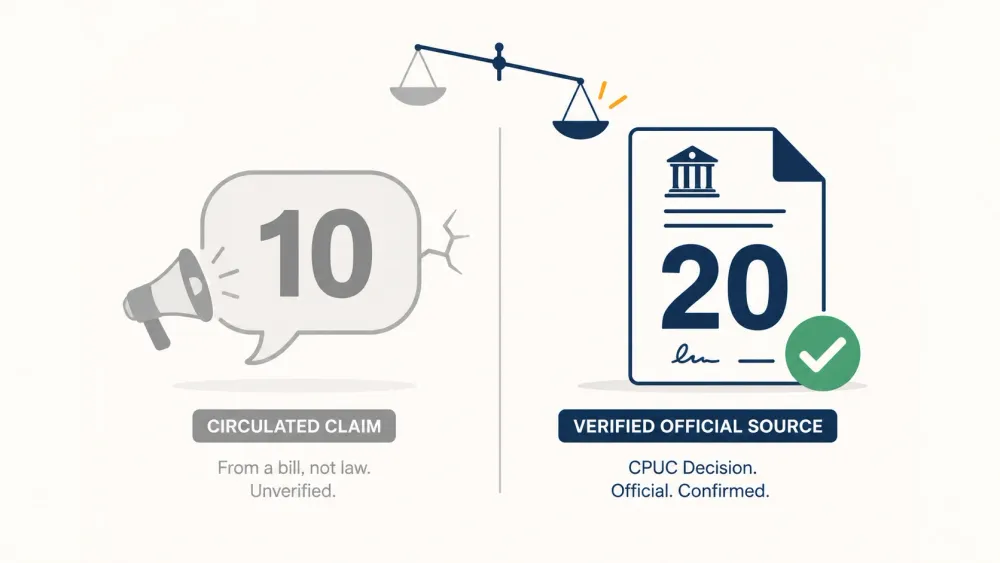
If you already own solar in California, the rule that governs your export credits is the one in the California Public Utilities Commission's Decision D.22-12-056. The CPUC states that NEM 2.0 customer generators "are allowed to remain on the NEM 2.0 tariff for 20 years from the date they interconnected, or they are permitted to switch to the current tariff." The widely circulated "10 year" transition comes from a proposed state bill, AB 942, not from a CPUC decision. At the time of writing, the Legislature's own records showed that bill had not been enacted, and that the 10 year provision had been removed from its text.
Sources for this article were verified against the CPUC and the California Legislature's own bill records at the time of writing. This is general information, not tax, legal or financial advice, and not a prediction about what the Legislature or the CPUC will do next. Legislation can move quickly. Check your own account and the current status of any bill before acting on anything here.
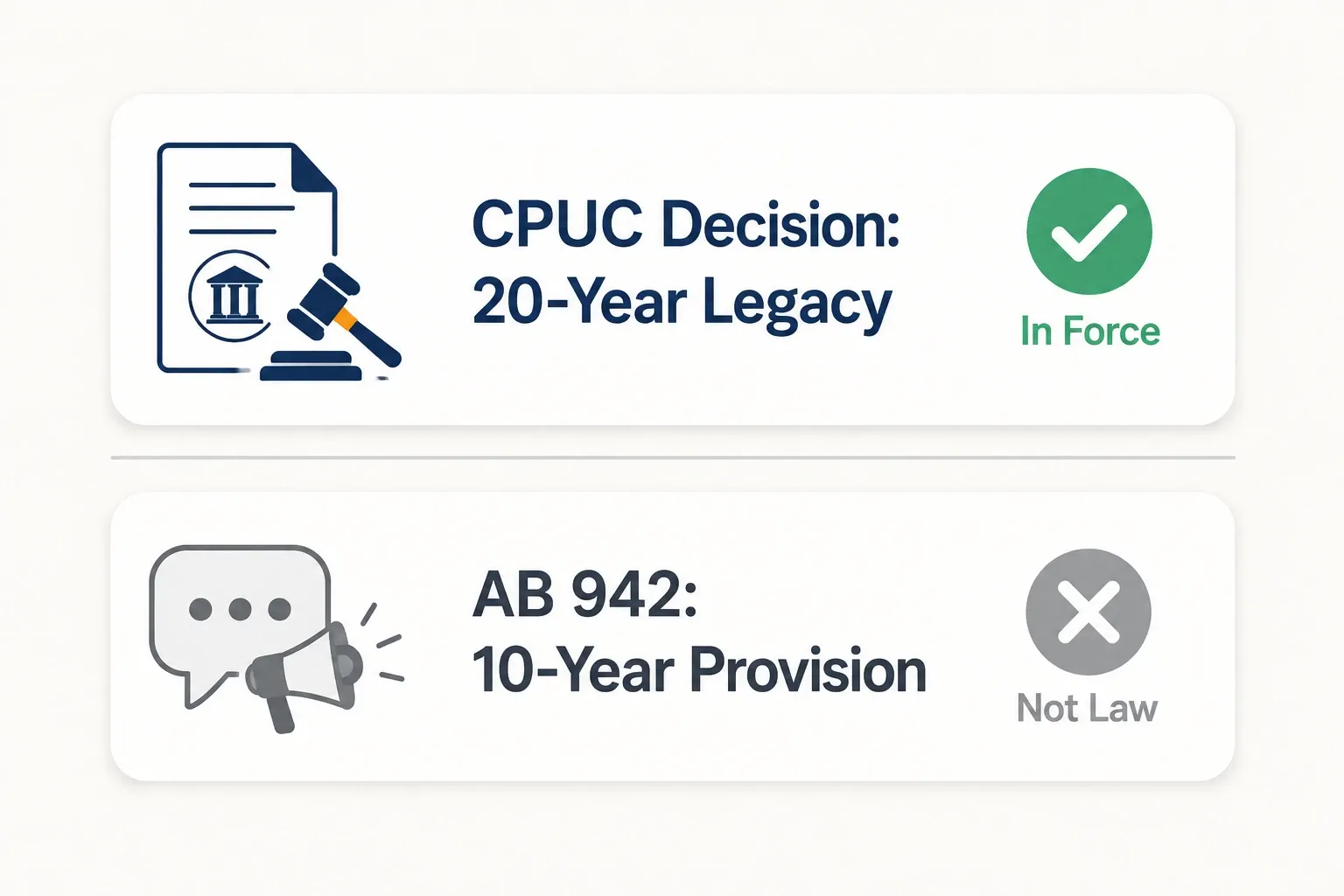
Two different things got merged in search results, and separating them is most of the value of this page.
| What it is | Status at the time of writing | |
|---|---|---|
| The 20 year legacy period | A CPUC decision (D.22-12-056) governing how long existing NEM customers keep their tariff | In force. This is the rule your utility administers today |
| The "10 year" transition | A provision in an introduced version of Assembly Bill 942 that would have moved long standing NEM customers onto the current tariff | Not law. Removed from the bill text by amendment, and the bill itself was not chaptered |
An article that presents the second row as a scheduled deadline is describing something that, on the Legislature's own record, did not happen in the form that was reported.
The CPUC's position on legacy customers is short and specific: NEM 2.0 customer generators may remain on the NEM 2.0 tariff for 20 years from the date they interconnected, or may choose to switch to the current tariff. NEM 1.0 tariffs are closed to new enrollments.
Three things follow from that, and they are the practical content of the whole topic.
Your interconnection date is the governing fact. Not your install date, not your contract date, not when your panels first produced. The 20 year clock in the CPUC's language runs from interconnection. If you do not know yours, that is the single piece of paperwork worth finding this week.
The legacy period is finite by design. A 20 year window ends. Nothing about a legacy tariff was ever permanent, and a homeowner who assumed permanence was assuming something the decision does not say.
Switching is described as permitted, not forced. The CPUC's wording allows a legacy customer to move to the current tariff voluntarily. Whether that would ever be in a given household's interest is a modeling question specific to that household, and this page does not answer it.
Assembly Bill 942 was introduced in the 2025-2026 California legislative session. As introduced and as reported at the time, it would have required customers who had taken service under a NEM tariff for 10 or more years to move to the tariff current after December 1, 2022, which is the Net Billing Tariff. That is where a July 1, 2026 date entered the public conversation.
Two things then happened, both visible in the Legislature's own records rather than in commentary.
The provision was amended out. The version of the bill text available at the time of writing was amended in the Senate on July 17, 2025, and it contains no 10 year net energy metering provision and no July 1, 2026 date. What the amended text does address is different: it would exclude certain customers, including eligible customer generators, from the California Climate Credit, and it addresses new owners who acquire property with an existing solar facility.
The bill was not enacted. The published bill history at the time of writing showed its most recent action as August 29, 2025, when it was passed by committee and re-referred to the Senate Rules Committee. There was no chaptering, no signature, and no recorded action after that date.
So the honest statement is this: a 10 year forced transition was proposed, was removed from the bill by amendment, and the bill carrying it had not become law. It is not a deadline on your calendar. It is also not a guarantee that no future bill will revisit the subject, and nobody should read this page as one.
Most coverage of this topic is written to create urgency about a date. The useful version is written to tell you which facts about your own account decide your outcome regardless of what any bill does. There are four.
1. Your interconnection date. This sets your 20 year window under the CPUC's language. Your utility has it. Ask for it in writing and keep it with your system paperwork.
2. Which tariff you are actually on. NEM 1.0, NEM 2.0 and the Net Billing Tariff are different animals with different export treatment. Your utility can tell you which one your account is enrolled under. Do not infer it from your install year alone.
3. Whether anything you plan to do would trigger a change. Expanding a system, replacing equipment or transferring the property can interact with tariff eligibility rules. Ask your utility, before the work, what would and would not move your account. This is the question that catches people, and it is answerable in advance.
4. What your bill would look like on the current tariff. If you ever want to compare, ask your utility rather than modeling it yourself. California NEM 3.0: What You Actually Get Paid for Exports explains why an export figure under the current tariff is an hourly schedule rather than a single rate, which is exactly why a self built comparison tends to go wrong.
The California legacy story is a clean example of a pattern this site was built around. A proposal gets reported as though it were enacted, the reporting gets summarized, the summaries get summarized, and a date that never took effect ends up in a hundred articles and eventually in a sales conversation.
The same failure is why so much 2026 solar content still tells homeowners to claim a 30 percent federal credit that the Section 25D residential credit no longer provides. Is There Still a Federal Solar Tax Credit in 2026? covers that one, and Solar Incentives in the US in 2026: What Actually Survived is the wider picture. The habit that protects you in all of these cases is identical: trace the claim to the body that issued it. For a California tariff, that is the CPUC. For a state law, that is the Legislature's own bill record. For your account, it is your utility.
This page describes what was on the record at the time of writing. It cannot tell you what the Legislature will do in a future session, and it does not predict. It also does not tell any legacy solar owner whether to switch tariffs, expand a system or sell a home, because those are financial decisions that depend on numbers this page does not have. If you are still deciding whether solar makes sense at all, start with Are Solar Panels Still Worth It in the US in 2026?.
Is California moving legacy solar customers to NEM 3.0 after 10 years? Not under any rule confirmed at the time of writing. The CPUC's position is that NEM 2.0 customer generators may remain on their tariff for 20 years from their interconnection date. The 10 year concept came from a proposed bill, AB 942, and the provision had been removed from that bill's text.
Was AB 942 signed into law? Not according to the Legislature's published bill history at the time of writing, which showed the most recent action as August 29, 2025, a committee passage and re-referral to the Senate Rules Committee. There was no record of chaptering. Confirm the current status directly on the Legislature's website before relying on this.
How long do NEM 2.0 customers keep their tariff? The CPUC states that NEM 2.0 customer generators are allowed to remain on the NEM 2.0 tariff for 20 years from the date they interconnected, or may switch to the current tariff instead.
Which date starts my legacy clock? The CPUC's language ties the period to the date of interconnection. That is not necessarily your installation or contract date. Ask your utility to confirm your interconnection date in writing.
Does selling my house change my solar tariff? Tariff treatment on transfer is set by the rules in force at the time and has been the subject of proposed legislation. Because this can change, ask your utility directly what happens to your specific account on sale or transfer rather than relying on a general article.
One email a week with new guides, tips, and solar news. Zero fluff, no sales pitch.