Solar Options for Renters: Four Routes Compared
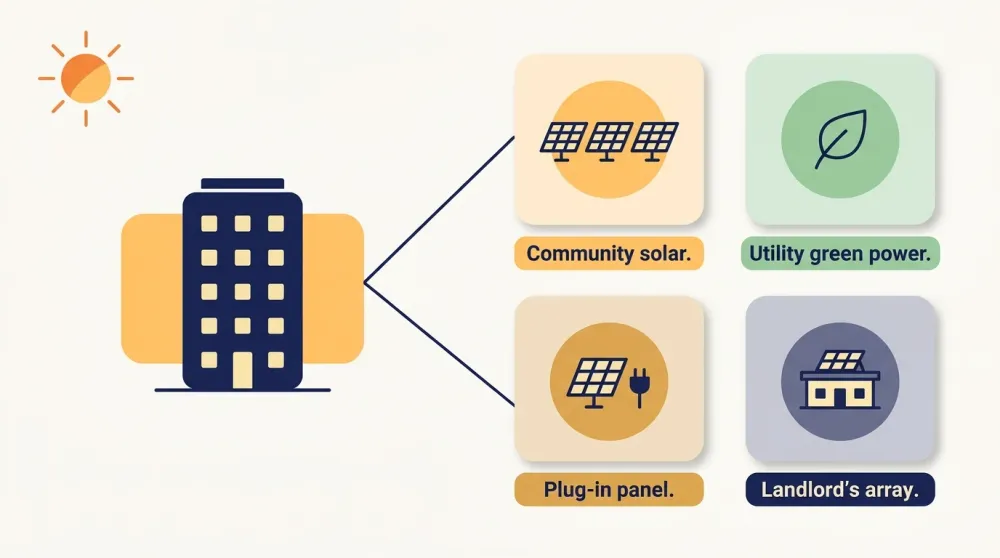
Solar options for renters in the US: community solar, utility green power, plug-in panels and a landlord's roof, compared by cost, contract and permission.
Our free solar calculator by address runs the numbers on your rooftop, your bill, and your electricity rate, and estimates your solar power in kWh, before any sales call. No email or personal information needed, and if the answer is not in your favor, the report will say that clearly too.
The numbers above are already the full picture on this page, including month by month production, 25 year savings, and CO₂ avoided. The email adds two things only: a printable PDF of the full report, and an email copy you can keep and compare against installer quotes.
We find your home on a map using OpenStreetMap. We use your monthly bill and the price you entered to work out how much electricity you use in a year.
If Google has data for your roof, we use it to check which way your roof faces, how sloped it is, and how many panels could fit. We then use the US government solar lab calculator (PVWatts, from the National Laboratory of the Rockies, formerly NREL) to estimate how much power you would make each month and each year. If that calculator is not available, we use a backup source called PVGIS, and your report will clearly say which one was used.
We work out the cost using a typical market price of $2.75 per watt, for panels of 410 watts each. Your savings use the price you entered, going up by 3% a year, while panel output slowly drops by 0.5% a year. From that we work out your payback time and your savings over 25 years. If the payback looks bad, the report will say so clearly.
Turns your street address into a spot on a map, so we can look up your roof and local sunlight. It is free to use.
Checks your roof size, which way each part faces, how sloped it is, and the most panels that could fit, using photos taken from above. It is only used when Google has data for your roof. Your estimate still works without it.
A trusted calculator from the National Laboratory of the Rockies, formerly NREL. Installers use it too. It estimates how much power your panels would make each month and each year, based on your system size, roof slope, and direction.
A backup calculator from Europe. If the main calculator does not work, we use this one instead, and your report will clearly say so. We never pretend a backup result came from the main calculator.
Your savings use the price you entered, or 17 cents per kWh if you left the default. We do not look up a live price for you, so check your bill for the most accurate number.
The old tax credit for home solar ended on 31 Dec 2025. We leave it out on purpose ($0), so your payback does not look better than it really is.
Reports are cached: if the same address and bill are entered again within 30 days, the saved report is shown instead of running every lookup again. That keeps the free services within their limits.
Home Solar Guider takes no money from installers. So a report can honestly say “solar is not worth it for your roof.” Start with the full breakdown: Are solar panels worth it in 2026?
The report is the first tool, not the only one. These are the next ones, built for people who already own panels, or who are holding an installer quote.
Enter an address + bill to get panel count, production, cost, and payback, with headline numbers free and the full report by email.
Paste in an installer quote. It is checked line by line against PVWatts production and the typical cost per watt, flagging inflated estimates and padded line items.
Enter a month’s output and compare it with what PVWatts expects for your system and area. Is the dip weather, or a real fault?
Describe the problem and get which warranty applies: panel, inverter, or workmanship. You also get a draft claim letter and a list of the photos to attach.
Does adding a battery ever pay for itself at your rate and outage history, or is it a comfort purchase? The honest arithmetic, both ways.
The same system, four ways to pay, one total cost table over 25 years, including what happens to each when you sell the house. A PPA is a power purchase agreement, where you buy the power the panels make instead of owning the panels.
Solar options for renters in the US: community solar, utility green power, plug-in panels and a landlord's roof, compared by cost, contract and permission.
Solar panel recycling and disposal in the US: what EPA rules say, which states have their own, why Washington's takeback is delayed, and who to call.
One email a week with new guides, tips, and solar news. Zero fluff, no sales pitch.