Solar Installation Timeline: Contract to Switch-On

Yes, A home battery without solar charges from the grid, stores the energy, and runs the circuits it is wired to when the power goes out. It makes sense in three situations: your outages are short and frequent, your time-of-use rate charges far more at peak than overnight, or a utility program pays for access to the battery. It makes little sense for multi-day outages, because with no panels it cannot recharge until the grid returns. And a battery you own that is placed in service in 2026 carries no federal tax credit.
This page is about a battery wired into your home's electrical system by a licensed electrician. A plug-in power station that runs devices from its own outlets is a different product and is not covered here. It covers the United States only. Utility rates, programs and permit rules differ by state and by utility, and they change, so confirm the local version with your own utility before acting on anything below.
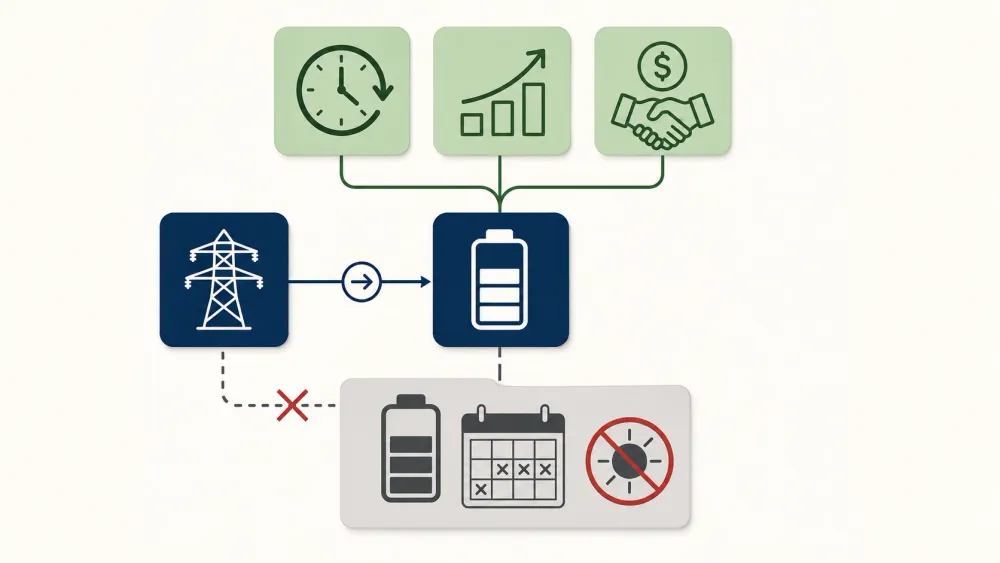
A standalone battery sits between the grid and the circuits it is wired to back up, either a chosen set or the whole panel. While utility power is on, it charges from the grid and waits, or it discharges on a schedule if you use it to change when you buy electricity. When the grid goes down, it powers only the circuits it was wired to back up, for as long as its stored energy lasts.
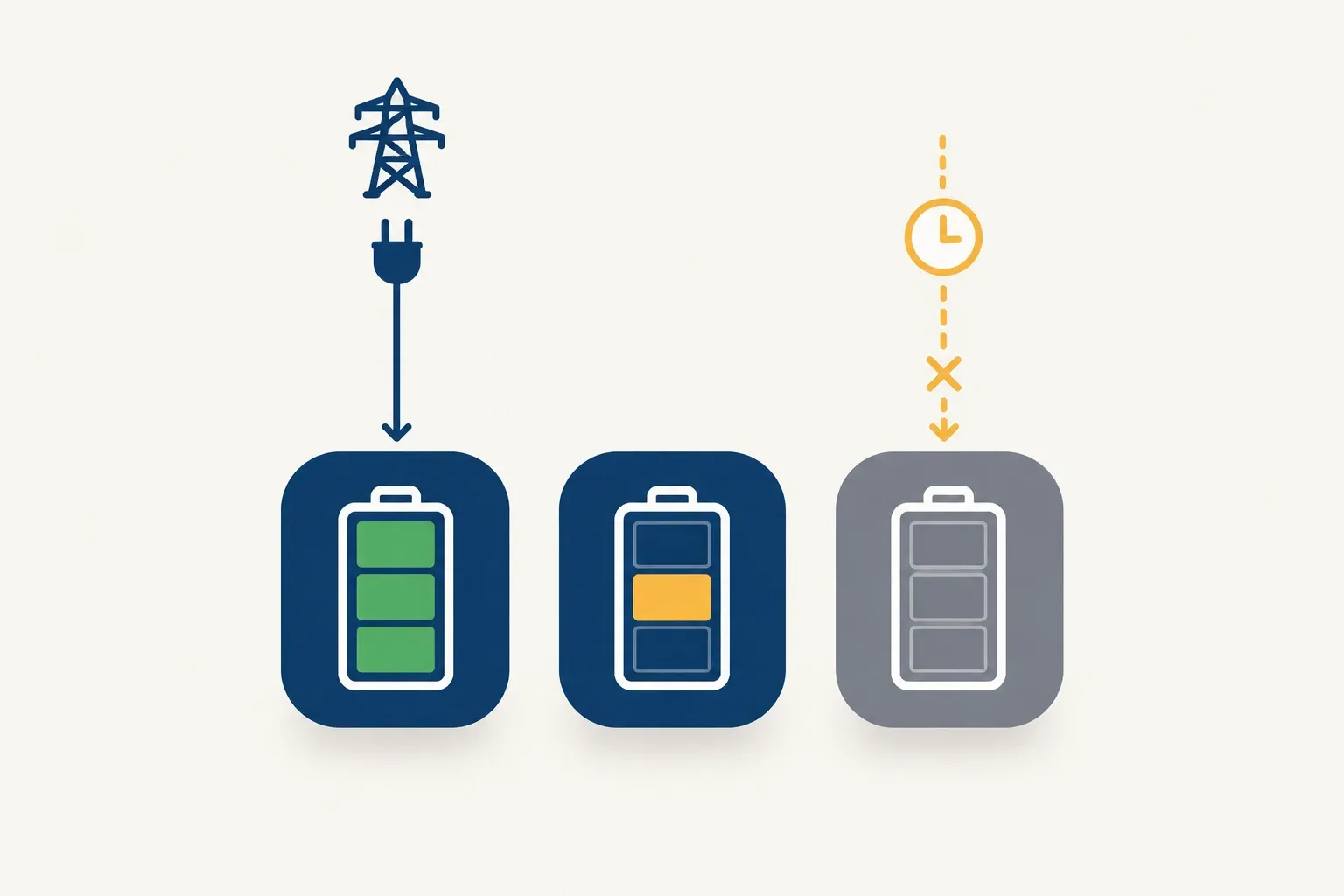
That last clause is the whole story. EnergySage's guide to battery backup without solar (updated August 18, 2026, read September 24, 2026) puts it plainly: a grid-tied battery without solar is "effectively, a one-time reserve. Once it's empty, you're waiting for the grid to come back on like everyone else." With panels, and equipment set up to allow it, a battery can recharge on sunny days during an outage. Without them, the energy in the battery when the lights go out is all the energy you get.
The reasons to buy a battery without solar fall into three jobs, and each one has a specific condition that makes it work and a specific condition that rules it out.
| What you want the battery for | What has to be true | What rules it out |
|---|---|---|
| Riding through outages | Your outages are usually shorter than the battery can run your backed-up circuits | Long, storm-driven outages, when the battery empties and cannot refill |
| Lowering a time-of-use bill | Your peak price beats your off-peak price by more than the storage loss, and by enough to recover the battery's cost | A flat rate, or a narrow gap between peak and off-peak prices |
| Earning program payments | A program in your utility area is open, and you accept its terms | Handing over control of when the battery discharges, or a program with no budget left |
A battery can do more than one job, but the jobs compete for the same stored energy. Energy discharged to save money at 6 p.m. is not in reserve for an outage at 7 p.m.
For many households, outage protection is the reason to consider a home battery without solar, so the useful question is how long outages actually last. The U.S. Energy Information Administration's review of 2024 power interruptions (published December 1, 2025, read September 24, 2026) found that U.S. electricity customers averaged 11 hours of interruptions in 2024, nearly twice the annual average of the decade before. Major events such as Hurricanes Beryl, Helene and Milton accounted for 80 percent of those hours. Interruptions not triggered by major events, the EIA notes, routinely average about two hours per year.
That split is the argument in one paragraph. A standalone battery is well matched to the ordinary outage: a line down, a failed transformer, an afternoon without power. EnergySage makes the same point, describing a standalone battery as a fit for places that see "regular one- or two-hour blips rather than multi-day storm outages." The storm-driven outage, which is where most of the hours come from, is exactly where a battery with nothing to refill it runs out.
Averages also hide geography. The EIA reported that customers in South Carolina averaged nearly 53 hours of interruptions in 2024, while customers in Arizona, South Dakota, North Dakota and Massachusetts averaged under two. Your own outage history over the last few years says more about your house than either figure.
How long a battery lasts depends on how much energy it stores and how much the backed-up circuits draw. A battery sized for essential loads has a hard ceiling: running extra appliances on backed-up circuits can overload it, tripping a breaker or shutting the system down partway through the outage. Which circuits go on backup, and how the battery and panel are sized to them, is decided by a licensed electrician, not by the homeowner.
With solar, the energy a battery stores at midday cost nothing at the moment it was stored. Without solar, every kilowatt-hour in the battery was bought from the utility, and some of it is lost on the way in and back out. The Annual Technology Baseline published by the National Laboratory of the Rockies, read September 24, 2026, uses 85 percent as a representative round-trip efficiency for residential battery storage. In plain terms, for every 10 kWh you buy to charge the battery, about 8.5 kWh comes back out.
That sets a floor. For a charge-and-discharge cycle to save anything at all, the peak price you avoid has to be higher than your off-peak price divided by 0.85, which works out to roughly 18 percent higher. Clearing that floor only pays for the lost energy. The battery's own price, about $15,650 installed for 13.5 kWh according to EnergySage, still has to be recovered from whatever is left over, one cycle at a time.
Whether it adds up depends entirely on your utility's rate design: how wide the gap is between peak and off-peak prices, how many hours the peak lasts, and whether it applies every day or only on weekdays. How your electricity rate decides if solar pays off walks through reading that structure from your own bill, and the same reading applies to a battery. Confirm your current tariff with your utility before treating any savings claim, from any seller, as yours.
EnergySage's without-solar guide notes that some states and utilities offer rebates, tax credits or programs, such as enrolling in a virtual power plant, that can add to what a standalone battery is worth. The catch is built into the structure. The payment buys the program the right to discharge your battery during grid events, and the energy that goes to the program at that moment is not in reserve for your own outage.
Home battery rebates in 2026 walks through two state programs in detail, including one where most of the money now arrives as performance payments spread over years rather than as a discount at purchase. Before enrolling, get the number of events per year, the notice you receive, the reserve the program leaves in the battery, and the penalty for opting out, all in writing.
From 2023 through 2025, battery storage had its own line in the federal Residential Clean Energy Credit. The IRS page for that credit (last updated July 4, 2026, read September 24, 2026) lists battery storage technology with a capacity of at least 3 kilowatt-hours as a qualifying expense beginning in 2023, and states that the credit "is not available for any property placed in service after December 31, 2025." EnergySage's without-solar guide says the same thing in its own words: the federal credit for batteries expired in 2025.
Some pages still advertise a federal credit on a standalone battery. For a battery you own that goes into service in 2026, the IRS page says otherwise. Your own tax position is a question for a qualified tax professional, not for a sales proposal.
Leaving out the panels removes the roof work. It does not remove the electrical work. A standalone battery still connects to your home's electrical system, which means a licensed electrician, the permits and inspection your local building department requires, and possibly a main panel upgrade if your existing panel cannot accommodate the connection. Where the battery can go, inside the house, in a garage or outdoors, is governed by local code and fire rules, and the installer should name the rules that apply before installation, not after. Some utilities also want notice or approval before a battery runs connected to the grid, so ask yours.
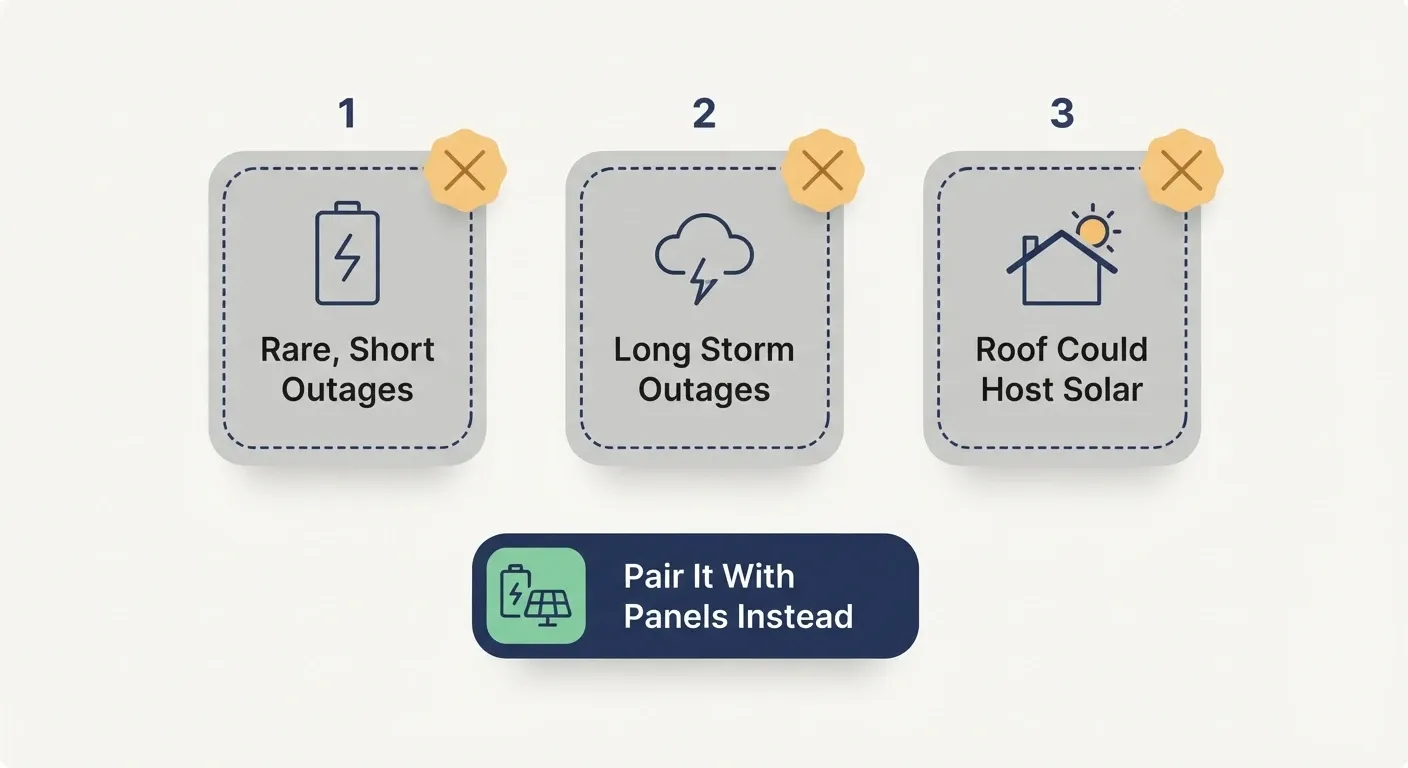
Outages are frightening, and a seller who opens with the last big storm is selling to that fear. Two facts from this page take the heat out of it. Most of the outage hours Americans experienced in 2024 came from major events, according to the EIA, and those are exactly the outages a battery without solar cannot outlast on its own. And a battery that also cycles daily for bill savings, or answers a grid program's calls, may not be full when the outage arrives.
Three questions cut through the pitch: how long this battery would run your chosen circuits, what charge level it will hold back as an outage reserve, and what happens to that reserve if you join a program. Add them to the questions to ask before you sign, which apply to a battery-only contract just as much as a solar one.
Yes. It charges from the grid and powers the circuits it is wired to during an outage. Without panels, it cannot recharge until utility power returns, so the energy stored when the outage starts is all it has.
It depends on how much energy it stores and how much the backed-up circuits draw. Once it is empty it stays empty until the grid returns, which is why EnergySage describes a standalone battery as suited to regular short outages rather than multi-day storms.
Only on a rate that charges more at peak than off-peak, and only by more than the battery loses in storage. At the 85 percent round-trip efficiency the Annual Technology Baseline uses, the peak price must be roughly 18 percent above the off-peak price before a cycle saves anything, and the battery's purchase price still has to be recovered from what is left.
Not for a battery you own that was placed in service after December 31, 2025, according to the IRS page for the Residential Clean Energy Credit. Confirm your own position with a qualified tax professional.
A licensed electrician, under the permits and inspection your local building department requires. The electrician also decides which circuits the battery can safely back up and whether your main panel needs an upgrade first.
One email a week with new guides, tips, and solar news. Zero fluff, no sales pitch.