Solar Installation Timeline: Contract to Switch-On

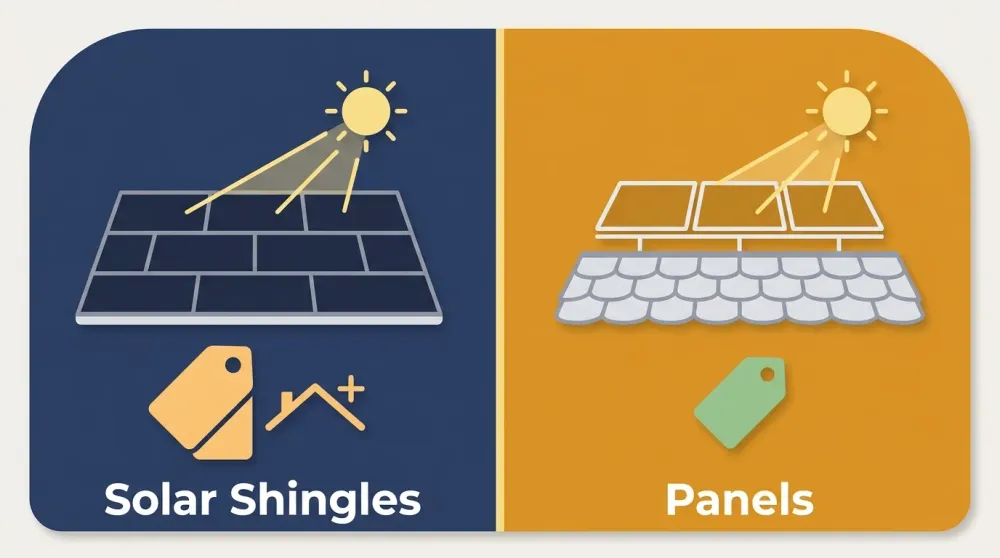
Short answer: In the solar shingles vs panels choice, shingles (also sold as solar roof tiles) replace part of your roof covering, while standard panels sit on racks above an existing roof. Shingles look cleaner, but each unit produces far less power than a panel, fewer contractors install them, and the purchase is usually tied to a new roof. They are sold as a premium, appearance-led product. They make the most sense when a new roof is already needed and the integrated look is worth paying extra for. If your roof has years of life left, standard panels avoid paying for roofing you do not need yet.
The rest of this guide is about what that trade actually involves, and one piece of older advice that no longer holds in 2026.
The two products solve different problems, which is why quotes for them are so hard to line up.
That difference means a solar shingle quote is often a roofing quote with solar built in. A panel quote usually assumes your roof is staying. Comparing the two totals side by side, without adjusting for that, tells you very little.
The first practical difference is how much power each piece makes. This Old House, in its guide "Should You Buy Solar Shingles?" (updated June 17, 2026, read September 27, 2026), puts solar shingles at 13 to 70 watts each, compared with up to 400 watts for a single traditional solar panel. The same guide says most solar shingles have efficiency ratings between 14% and 18%, while high-performance panels can reach up to 24%.
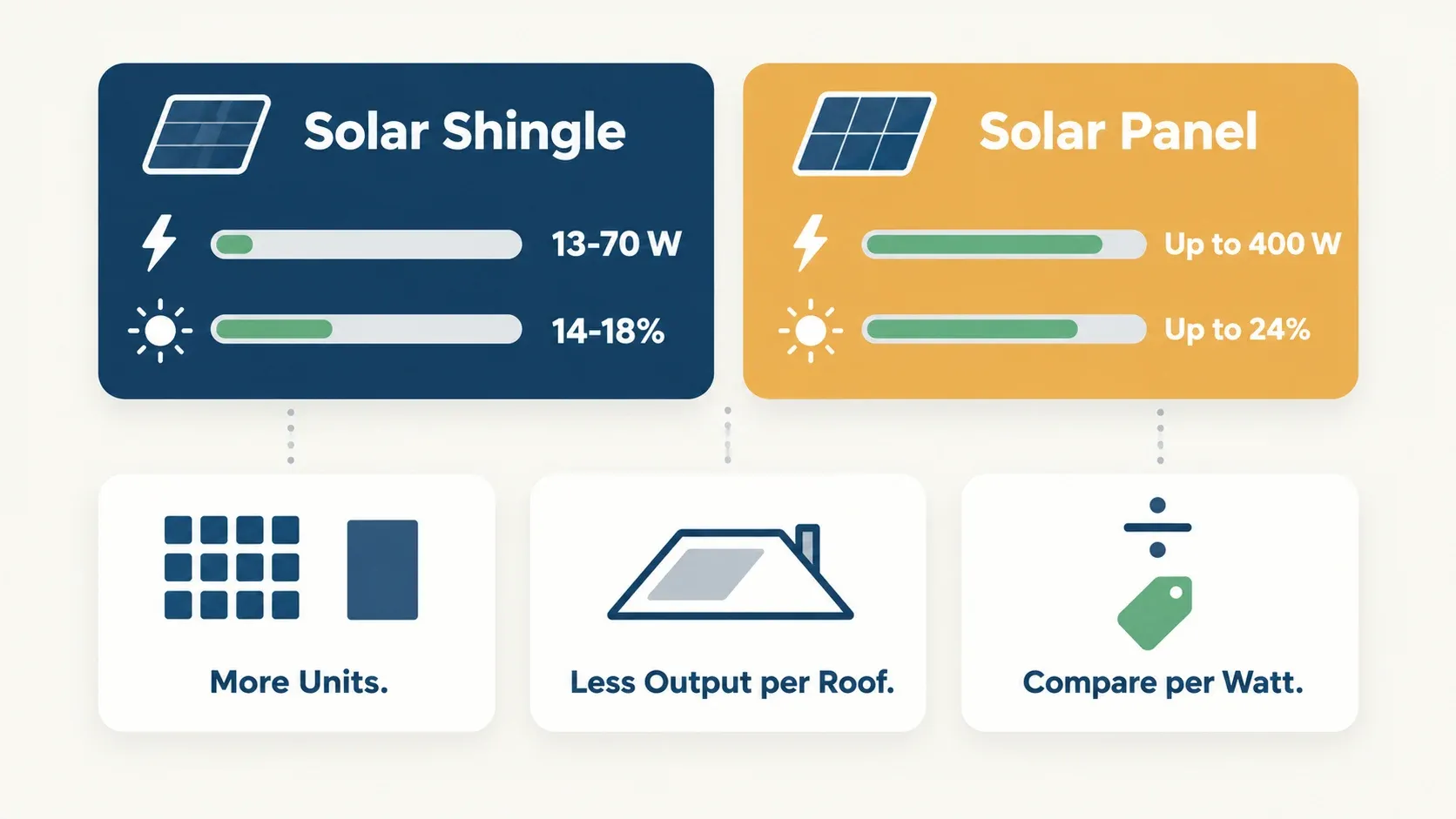
What that means for a homeowner:
We are not printing a typical price for either option. Prices vary widely by region, roof, product and whether roofing is included, and any single figure would mislead more readers than it helps. What we can say is that the quotes need to be normalized before they mean anything, as our guide on how to compare solar quotes explains.
For years, one of the strongest arguments for solar shingles was the federal tax credit. The IRS guidance on the Residential Clean Energy Credit states that solar roofing tiles and solar shingles qualified "because they generate clean energy," while "traditional shingles that support solar panels don't qualify."
That distinction no longer drives the decision for new systems. The same IRS Residential Clean Energy Credit page (last updated July 4, 2026, read September 27, 2026) states: "The credit is not available for any property placed in service after December 31, 2025."
So a sales pitch in 2026 that leans on the credit covering part of a solar roof is repeating advice from before that date. If a salesperson raises it, ask them to show you, in writing, which credit they mean and where it is stated today. Our guide to the federal solar tax credit in 2026 covers what changed and what the date rules mean. Tax situations differ, so a tax professional is the right person to confirm how any credit applies to you.
The single biggest factor is the age and condition of the roof you have now.
If your roof is due for replacement soon. Solar shingles become easier to consider, because you are paying for a new roof covering either way. This Old House notes that if a roof needs replacement within the next five to ten years, installing shingles during a complete reroofing project may end up more cost-effective. The comparison then becomes shingles plus conventional roofing versus a new conventional roof plus panels, not shingles versus panels alone.
If your roof has many years of life left. Replacing a sound roof to install solar shingles means paying for roofing you did not need yet. Panels can go on the existing roof, though it is worth asking whether the roof will outlast the panels, because removing and reinstalling panels for a later reroof is a cost of its own.
Either way, a licensed roofing contractor should assess the roof's condition before you rely on any plan. That is a job for someone qualified to work on the roof, not an estimate from the ground and not a homeowner on a ladder.
This is the part shingle marketing tends to skip. When the solar product is the roof, a leak or a failed unit sits at the meeting point of two trades.
With panels, the roof and the solar equipment are separate, so a leak and a panel fault are more clearly different problems. That separation is not a guarantee of an easy fix, but it is simpler to assign.
The question of whether the company will be around to honor any of those promises applies to both options. Our article on whether your solar installer will still exist covers the checks you can run.
| Your situation | Solar shingles | Standard panels |
|---|---|---|
| Roof has many years of life left | Usually means replacing a sound roof | Can mount on the existing roof |
| Roof needs replacing soon anyway | Roofing cost is already in the budget | Plan for a new roof first, then panels |
| Limited sunny roof area | Lower output per square foot | More output from the same space |
| Appearance or HOA rules are a priority | Integrated, low-profile look | More visible on the roof |
| Few local contractors | Fewer installers in many areas | Wider choice of installers |
| Want the simplest repair path | Roof and solar are one system | Roof and solar are separate |
HOA rules and state solar access laws vary, so if appearance restrictions are driving the decision, check your HOA's written rules and your state's current law before assuming shingles are required.
Solar shingles are sold on how they look, and that is a real benefit. This Old House describes them as suited to homeowners who are "willing to pay a premium for a sleek, integrated appearance." Some homeowners will reasonably make that choice.
The trade-off is that the look costs output, contractor choice and repair simplicity, and in 2026 it no longer comes with the federal credit that used to soften the price. The people who benefit from a buyer not weighing those costs are the ones selling the premium product on appearance alone.
A standard panel system is not automatically the right answer either. If your roof is failing, a panel quote that ignores it is incomplete, and mounting panels on a roof that needs replacing sets up a second bill later. Whichever way you lean, having the roof assessed first and making every quote state system size in kilowatts puts the two options on comparable terms. The decision itself is yours.
Not on output. This Old House puts solar shingles at 13 to 70 watts each, compared with up to 400 watts for a single standard panel, and at lower efficiency. Shingles are better on appearance and can make sense when a new roof is needed anyway. Whether the premium is worth it depends on your roof and your priorities.
The IRS lists solar roofing tiles and shingles as qualifying under the Residential Clean Energy Credit, but it also states the credit "is not available for any property placed in service after December 31, 2025." A tax professional can confirm how that applies to your situation.
Usually, yes. Solar shingles replace part of the roof covering, so they are generally installed as part of a reroofing project. Panels, by contrast, can be mounted on an existing roof in good condition.
They can be. Because the solar product is part of the roof, a leak or failed unit can involve both roofing and electrical trades, and fewer contractors work with shingles in many regions. Only licensed professionals should work on either system.
Ask each quote for total system size in kilowatts, expected annual production and whether roofing is included. Then compare on a per-watt basis and add the cost of any roof replacement the panel option would still need.
One email a week with new guides, tips, and solar news. Zero fluff, no sales pitch.