Do I Need a Battery With Solar? The Real Trade-Off

In the United States, the single biggest variable in whether solar pays for your house is not the system, it is your own electricity rate and how your utility structures and pays for it. A homeowner on a high flat rate with full retail net metering can break even years before a neighbor on a low rate with a discounted export rate, on an identical roof and an identical system. There is no national answer, because rates and rate structures are set at the state and utility level, not nationally. The only reliable way to know your own case is to read your own bill.
Reviewed on August 8, 2026. Next review: November 8, 2026. Rate structures, export compensation, and the specific utilities that offer them change on their own schedule and vary by state and by utility. Treat the mechanics below as current; treat any specific number as something to confirm against your own bill and your utility's current published tariff, not against this page.
A "neighbor saves a fortune" story tells you almost nothing about your own numbers, because it is missing the two things that actually decide the outcome: what that neighbor's utility charges for power, and what it pays for exported power. Two identical solar systems, on two identical roofs, in two different rate territories, can produce two completely different financial results. This is why this site treats "is solar worth it" as a question that runs through your own bill rather than a single verdict, a theme covered more broadly in Are Solar Panels Still Worth It in the US in 2026?.
Four things to check before anyone gives you a quote:
Your rate is one half of the equation; what the system itself costs is the other. Cost Per Watt: The Only Number That Compares Two Quotes covers that side.
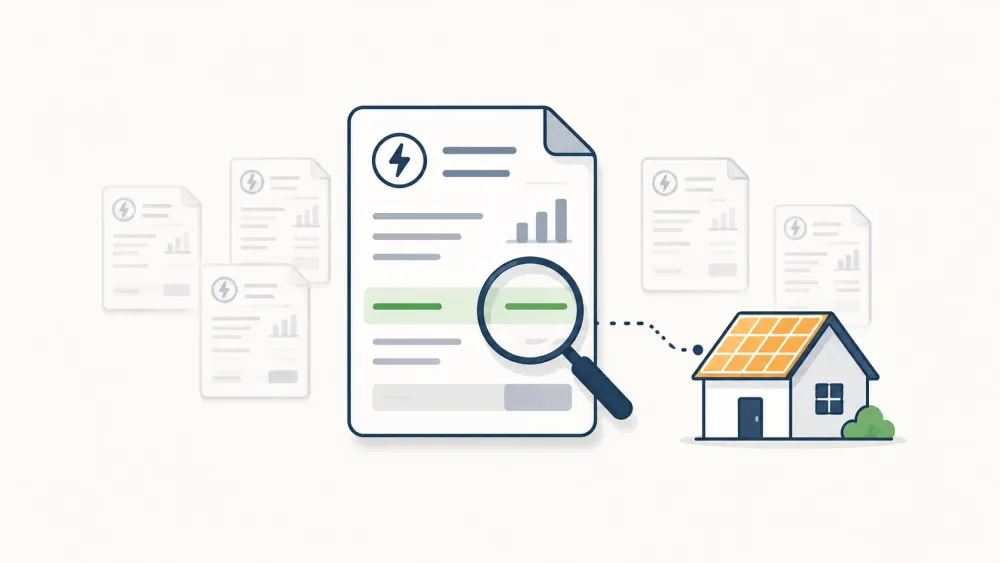
Pull a recent bill, or ideally the last twelve months, and look past the total-due line. Most utility bills print a rate schedule name or tariff code, often labeled "rate," "rate class," or "tariff," which identifies exactly which pricing plan applies to your account. That name is what lets you find the full, current, published version of your rate on your utility's website, which will spell out whether it is flat, tiered, or time-of-use, and what the fixed monthly charge is.
Your posted rate per kWh is not the same as your effective rate, which is what you actually pay once fees, riders, and taxes are included. Calculate it yourself: total dollars billed for the period, divided by total kWh used. That effective rate, not the headline number on the first page, is the figure a solar comparison should use.
If your bill does not make the rate schedule obvious, your utility's customer service line or website can tell you which tariff applies to your account, and your state's public utility commission publishes the full list of approved rate schedules and export compensation rules for utilities under its jurisdiction. Rate structures and export terms are approved and regulated at the state and utility level, which is exactly why a national figure cannot substitute for your own bill.
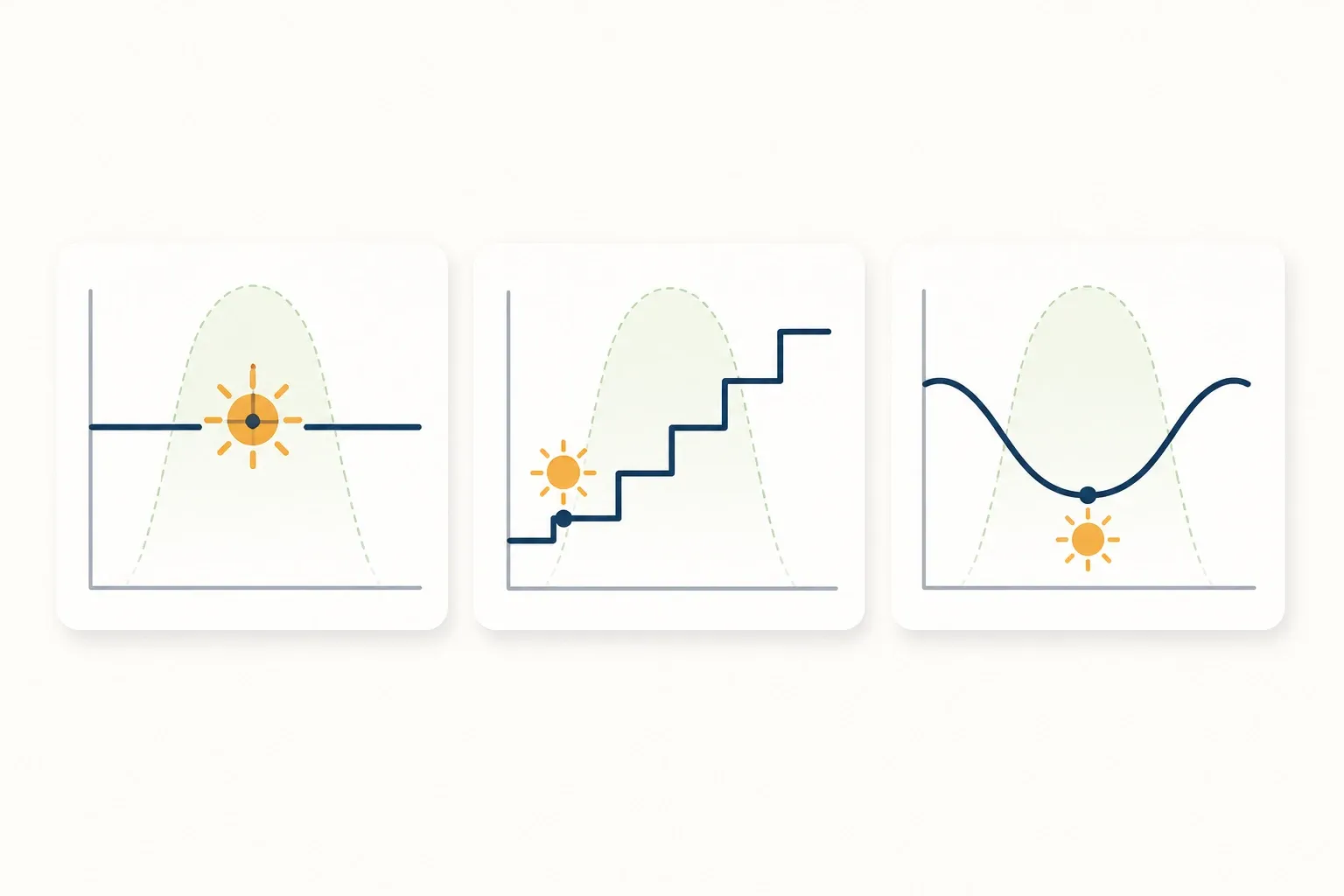
Two houses can pay the exact same average rate and still get very different value from the same solar system, because of how that rate is structured.
| Rate structure | How it works | What it means for a solar owner |
|---|---|---|
| Flat (fixed) rate | Same price per kWh at every hour and every usage level | Every kWh your system offsets is worth the same amount no matter when it is produced. The simplest case to estimate. |
| Tiered (increasing block) rate | Price per kWh rises once usage crosses set thresholds within the billing period | Solar that keeps your usage under a higher-priced tier offsets kWh priced above the lowest tier, which are worth more. Whether that happens depends on your usage pattern, not just your system's size. |
| Time-of-use (TOU) rate | Price per kWh changes by time of day, and sometimes by season, typically highest in late afternoon and evening | Solar production usually peaks midday, which on many TOU schedules is the cheapest window to buy power, not the most expensive one. The value of self-consumed solar depends on when you use it, not only how much you produce. Export compensation can follow its own separate time-of-use schedule. |
None of these structures is inherently better for a solar owner in the abstract. A flat-rate household with a high per-kWh price can do very well; so can a tiered household whose solar system keeps them out of the top pricing band; so can a time-of-use household whose usage happens to line up with the cheap hours. The structure changes how to estimate the value, not whether solar can be worth it.
Most grid-tied solar systems produce more power than the home uses at certain times of day, and that surplus flows back to the utility. What you are credited for that exported power is a separate number from what you pay to import power, and the gap between the two matters as much as your retail rate does.
Under full retail net metering, exported kWh are credited at the same rate you pay for imported kWh, one for one. Under a net billing or avoided-cost arrangement, exports are credited at a lower rate, sometimes closer to what the utility itself pays to generate or buy wholesale power, rather than the retail price a homeowner pays. Which arrangement applies to you is set by your state and, within that state, often by your specific utility. It is also common for a state to change its rules for new solar customers going forward while leaving existing solar owners on their original terms for a defined period, which is part of why one homeowner's export credit can differ from a neighbor's on the same street, on the same utility, simply because they connected in different years.
State public utility commissions are the authoritative body for these rules in most states, and they publish the current tariffs and net metering or net billing policies for utilities under their jurisdiction. That is the source to check for your specific case, not a national description of "how net metering works."
Solar does not save you a fixed dollar amount; it saves you the retail cost of the power it displaces. Each kWh a system produces and the home consumes directly is a kWh the homeowner did not have to buy from the utility at that utility's rate. A household paying a high rate avoids a more expensive purchase for every kWh the system produces than a household paying a lower rate does, even if both systems produce identical amounts of electricity.
Fixed charges add a second reason the comparison does not transfer. A utility's flat monthly connection or customer charge is billed regardless of how much power a home draws from the grid, and solar production does not reduce it. That flat charge is a larger share of a low-usage or low-rate household's total bill than of a high-rate household's bill, which mechanically lowers the percentage of the bill solar can actually address.
This is also where financing choices interact with rate, not just outright purchase. A homeowner comparing a lease or a PPA payment against their old bill is really running the same comparison, monthly payment against avoided retail rate, rather than a payback calculation on an owned system. Lease vs Buy After the Credit Expired: Why the Math Flipped walks through how that comparison works once the rate, not just the financing structure, is the deciding input.
None of this means a lower-rate household should not consider solar. It means the "my neighbor saves a fortune" story is not a forecast for a different rate, a different rate structure, and a different export arrangement. It is one household's result under that household's specific conditions.
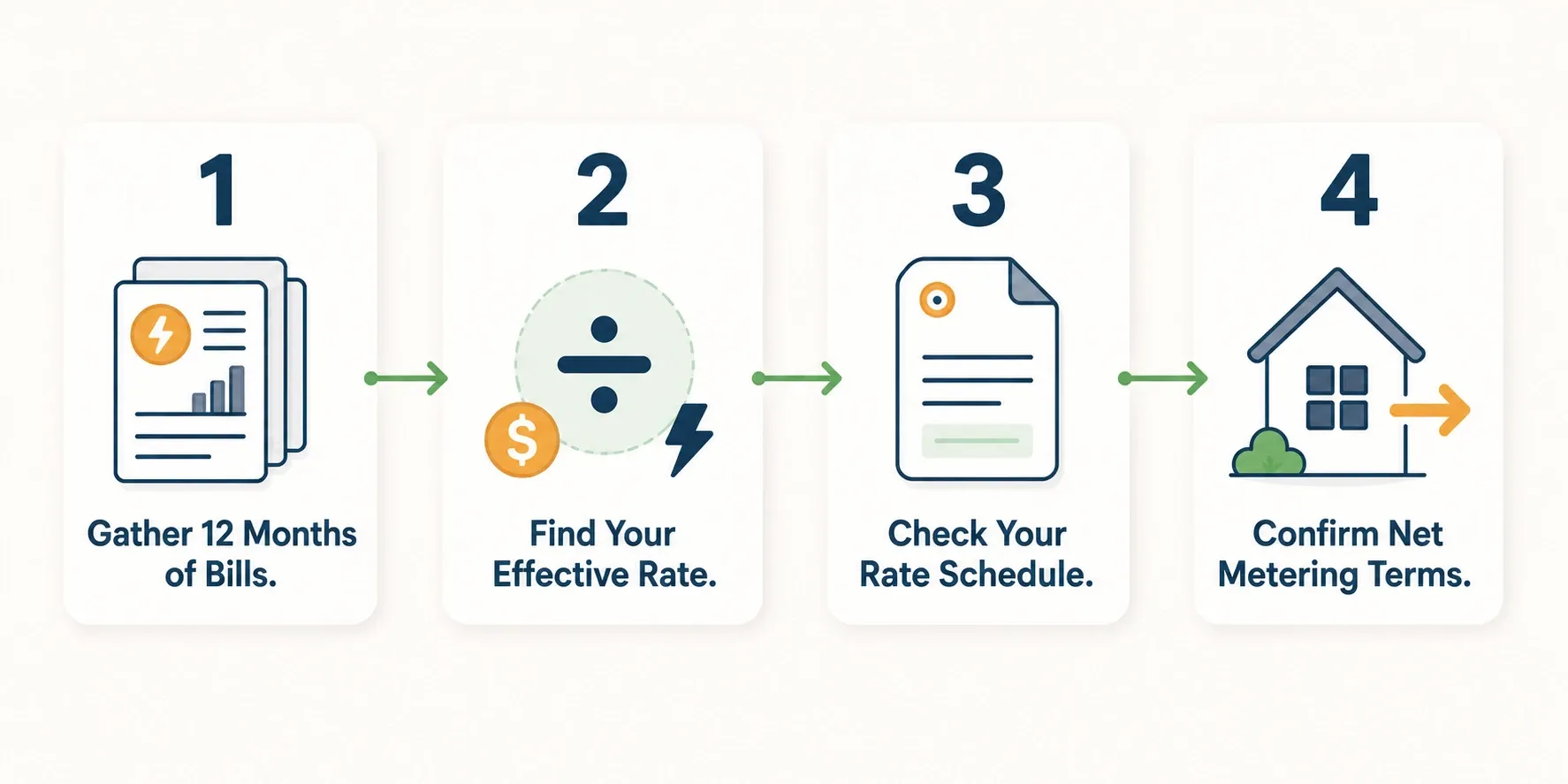
Before a salesperson, or even a neutral quote comparison, put a number in front of you, gather this yourself:
Once you have those four inputs, they feed directly into an actual payback calculation rather than a marketing estimate. Solar Payback Period: How to Calculate Yours, Not the Average walks through the formula and exactly where each of these numbers goes. Ask any installer to show, in writing, which import rate and which export rate they used to build your savings estimate, and confirm both against the current published tariff before you sign anything.
Does a national average electricity rate tell me anything useful about my own solar payback? Not much on its own. A national average blends every state's rates, from the cheapest to the most expensive, into one figure that describes no specific household's bill. The U.S. Energy Information Administration (EIA) publishes average retail electricity prices by state, updated monthly, and is the standard reference for that kind of figure, but even a state-level average does not reflect your specific utility's current rate schedule. Your own bill, not a published average, is the number to use for your own decision.
What is the difference between net metering and net billing for solar exports? Net metering credits exported power at the same rate you pay to import power, kWh for kWh. Net billing, sometimes called avoided-cost crediting, pays a different, usually lower, rate for exports. Which one applies to you is set by your state and your specific utility, and it can change for new solar customers even while existing customers stay on an older arrangement for a period. Check your utility's current published policy or your state's public utility commission rather than assuming either model applies.
Why does my rate structure matter as much as my actual rate? Because a flat rate, a tiered rate, and a time-of-use rate each change when a kWh of solar production is worth the most. A tiered household that stays under a top pricing tier because of solar offsets more expensive kWh than a flat-rate household with the same average price. A time-of-use household's solar value depends on whether production lines up with the utility's higher-priced hours. The structure, not just the number, changes the calculation.
Where do I find my utility's current rate schedule and net metering terms? Start with the rate schedule name or tariff code printed on your bill, then look it up on your utility's website, where the full pricing structure and any export compensation terms should be published. Your state's public utility commission is the regulator that approves these tariffs and is the authoritative source if your utility's own materials are unclear.
Does a higher electricity rate always make solar pay off faster, all else being equal? Generally yes, because each kWh the system produces and the home uses directly displaces a more expensive purchase. But "all else being equal" is doing real work in that sentence: system cost, rate structure, fixed charges, and export compensation all move independently of the headline rate, which is why the full set of your own numbers, not the rate alone, determines your actual payback. See Solar Payback Period: How to Calculate Yours, Not the Average for the full method.
One email a week with new guides, tips, and solar news. Zero fluff, no sales pitch.