Solar Installation Timeline: Contract to Switch-On

United States only. NABCEP's own pages read on August 26, 2026. This page names no installer, ranks nobody, and contains no price.
A proposal that says "NABCEP certified" has told you less than it sounds like. NABCEP is not one credential. Read on its own site, it is a family of board certifications with different names and different subject matter, sitting above a separate entry-level tier, and every one of them is held by an individual person rather than by the company on the letterhead. So the useful question is never "are you NABCEP certified". It is "which certification, held by which person on my job, and is it current".
This page explains what the credential is, in the certifying body's own words, and where its authority stops. It is not a criticism of the credential. It is a criticism of the way one word is doing the work of nine.
Read on NABCEP's own Board Certifications page on August 26, 2026, the board certifications listed are:
Those nine names are not interchangeable, and the differences are exactly the ones a buyer cares about. A Technical Sales certification is a sales credential. It is the person who sat across your kitchen table, not the person on your roof. A System Inspector certification belongs to someone whose job is to look at a finished array, which is a different job from building one. Solar Heating is thermal, meaning hot water, not electricity, so it has nothing to do with a photovoltaic array at all.
When a company's website says "NABCEP certified" without naming which one, all nine of those are consistent with the claim. That is the whole of the information gain on this page, and you can verify it yourself on the same page we did.
NABCEP's frequently asked questions page, read the same day, draws a line between two different things:
"The NABCEP Associate Credential is an entry level credential and is intended for people who are new to the renewable energy industry or are currently working in, or seeking employment in, the renewable energy industry."
against:
"The NABCEP Board Certification is a professional certification and is intended for people who are already in the renewable energy industry, including those who are students in renewable energy programs or workers at any stage in their renewable energy career."
Entry level and professional, in the certifying body's own words. Both are legitimate. Neither is fake. But "our people are NABCEP" covers both, and a company staffed entirely by people holding an entry-level credential can make that statement without saying anything untrue.
The site also names an Operations and Maintenance Associate Technician Credential and lists an Associate Directory alongside the Board Certified Directory, which is another way of seeing that these are two separate populations.
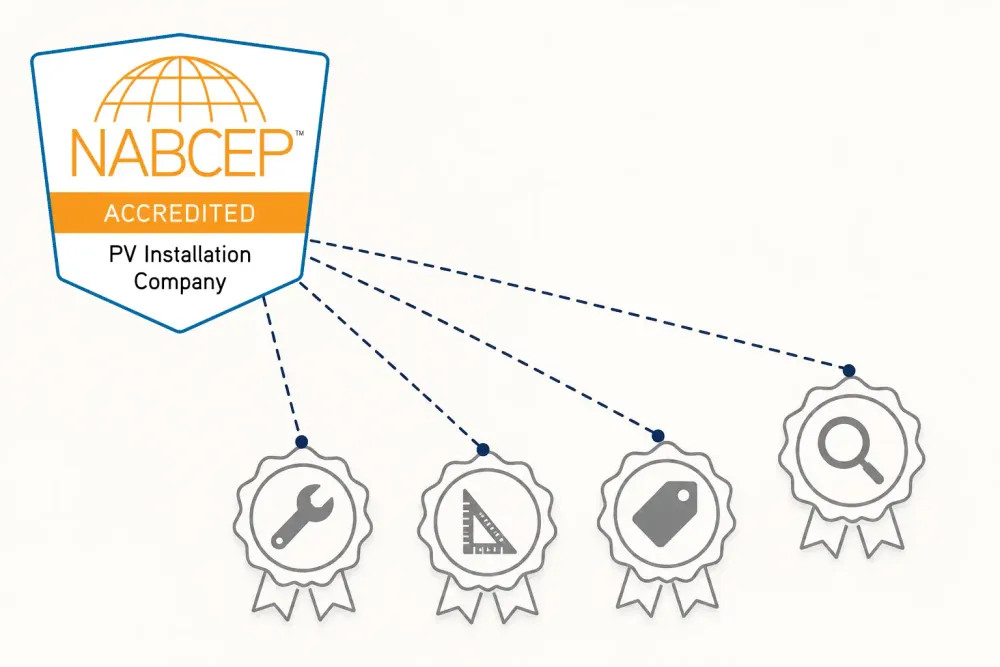
This is the part that most changes how you read a proposal. Every certification above is issued to an individual. NABCEP's own site separately lists an Accredited Companies Directory, which is a distinct listing from the Board Certified Directory and the Associate Directory.
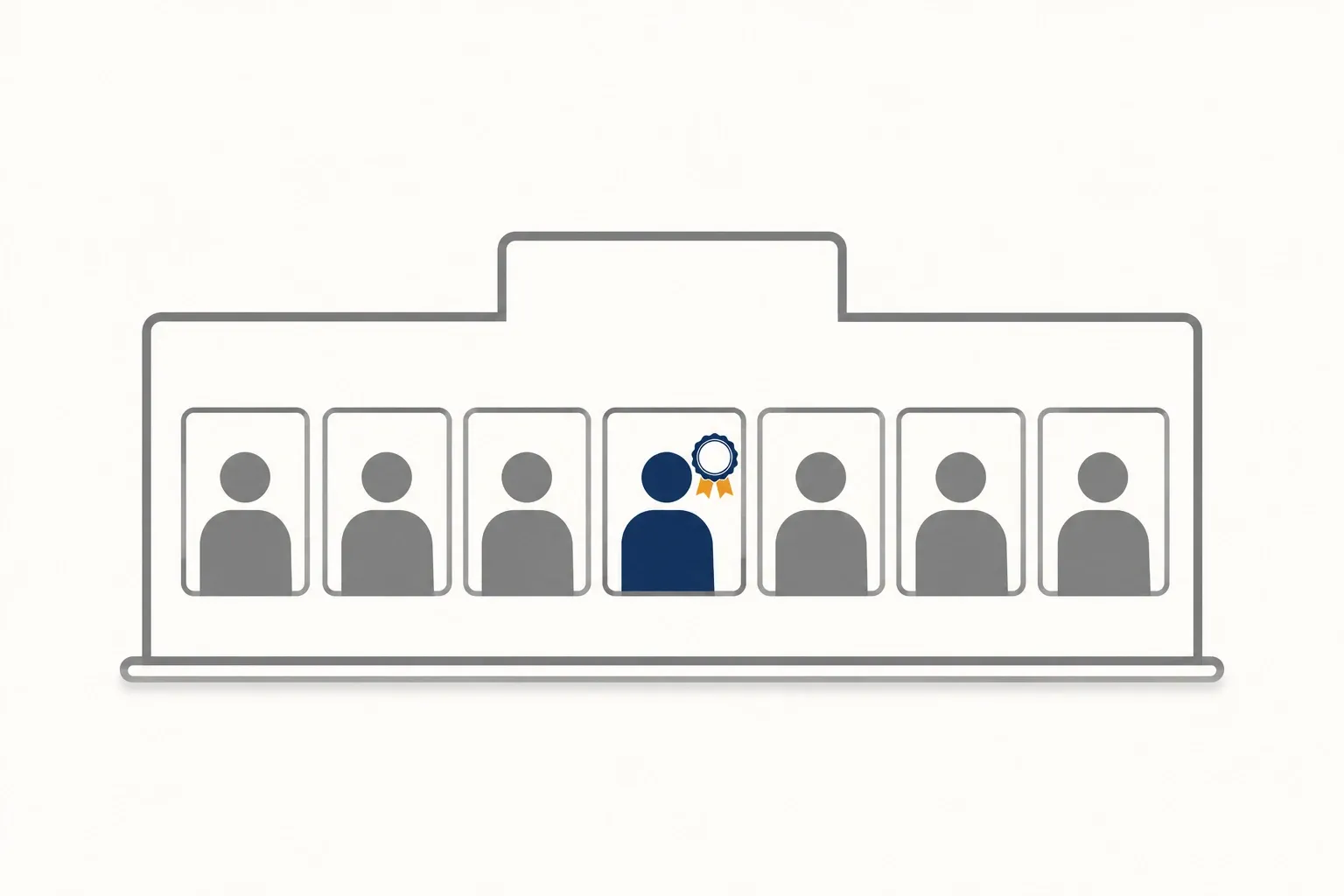
So "we are a NABCEP certified company" and "we employ someone who is NABCEP certified" are different claims, and a firm of forty people can make the second one on the strength of one employee. Nothing in the credential guarantees that the certified person will be on your roof, will design your system, or will still work there in March.
Ask it as a question about your job, not about the company. Who on my project holds a certification, which one, and will that person be present at design, at install, or at commissioning? A firm that is proud of its credentials will answer that in one sentence. A firm that treats the question as rude has told you something.
NABCEP describes what certification is for in its own terms:
"Certification assures the public, employers and practitioners that a certified professional possesses the skills and knowledge necessary to competently carry out the work processes of a specific field."
Read carefully, that is a statement about demonstrated knowledge. It is not a statement about legal authority to perform work.
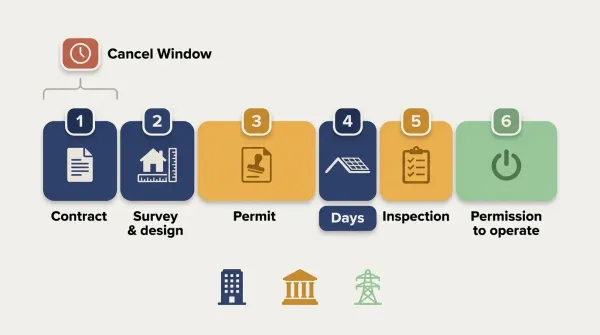
On the NABCEP pages read for this article, none of the certifications is described as a license, and the frequently asked questions page does not address licensure at all. That absence is not an oversight. Licensing is a separate system run by your state, and it is the one with legal force. Depending on where you live, installing a grid-tied photovoltaic system involves a licensed electrical contractor, a permit from your local authority having jurisdiction, an inspection, and the utility's own approval before the system may operate. A certification does not substitute for any of those, and no article can tell you which of them applies at your address.
Two practical consequences:
From the same frequently asked questions page:
"NABCEP Board Certifications and Associate Credentials are valid for three (3) years from the date of issuance."
and
"You will need to meet the requirements for recertification by the end of each three-year period in order to be eligible to recertify or renew your certification or credential."
The page adds that certificants may only submit a recertification or renewal application during the third year of their current credential period.
A logo on a website does not carry a date. The directories do. The check that costs you nothing is to look the named person up in the Board Certified Directory or the Associate Directory rather than trusting the graphic, which is also the only way to confirm the certification is current rather than historical.
This matters because of what a solar purchase actually consists of. The certifications above are about designing, installing, commissioning, inspecting and selling equipment. None of them is a credential in tax law, in utility tariff law, or in consumer finance.
That is not a gap in NABCEP's work. It is a gap between what the credential covers and what a salesperson holding it may end up telling you about. If the person quoting you explains what a federal credit is worth to you personally, what your utility's export rate will be in eight years, or what a twenty-year financing agreement will cost, none of that sits inside any certification listed on that page. The people whose credentials do cover those subjects are a tax preparer, your utility's own published tariff, and, for a contract, an attorney.
The same caution applies to the money side of a proposal generally. An installer's credential says nothing about whether the numbers in the savings model are conservative, which is why the payback arithmetic is worth running on your own assumptions rather than accepting the version printed for you.
We could not confirm from NABCEP's own pages, on the day of writing, the specific eligibility requirements for the PV Installation Professional certification: the number of installations, the nature of the decision-making role, the safety training, or the classroom hours. The page we opened for that certification is an exam-preparation reference list and does not carry them, and the requirements sit in a handbook behind a further link. Figures for those requirements circulate widely on installer and training-provider pages. This site is not going to restate them, because we did not read them at the source. If the exact threshold matters to your decision, NABCEP publishes a certification handbook and that is where the answer lives.
We also make no claim about how many certified professionals exist, what share of installers hold a certification, or whether certified firms produce better outcomes. We found no primary source for any of those and did not look for a secondary one to borrow.
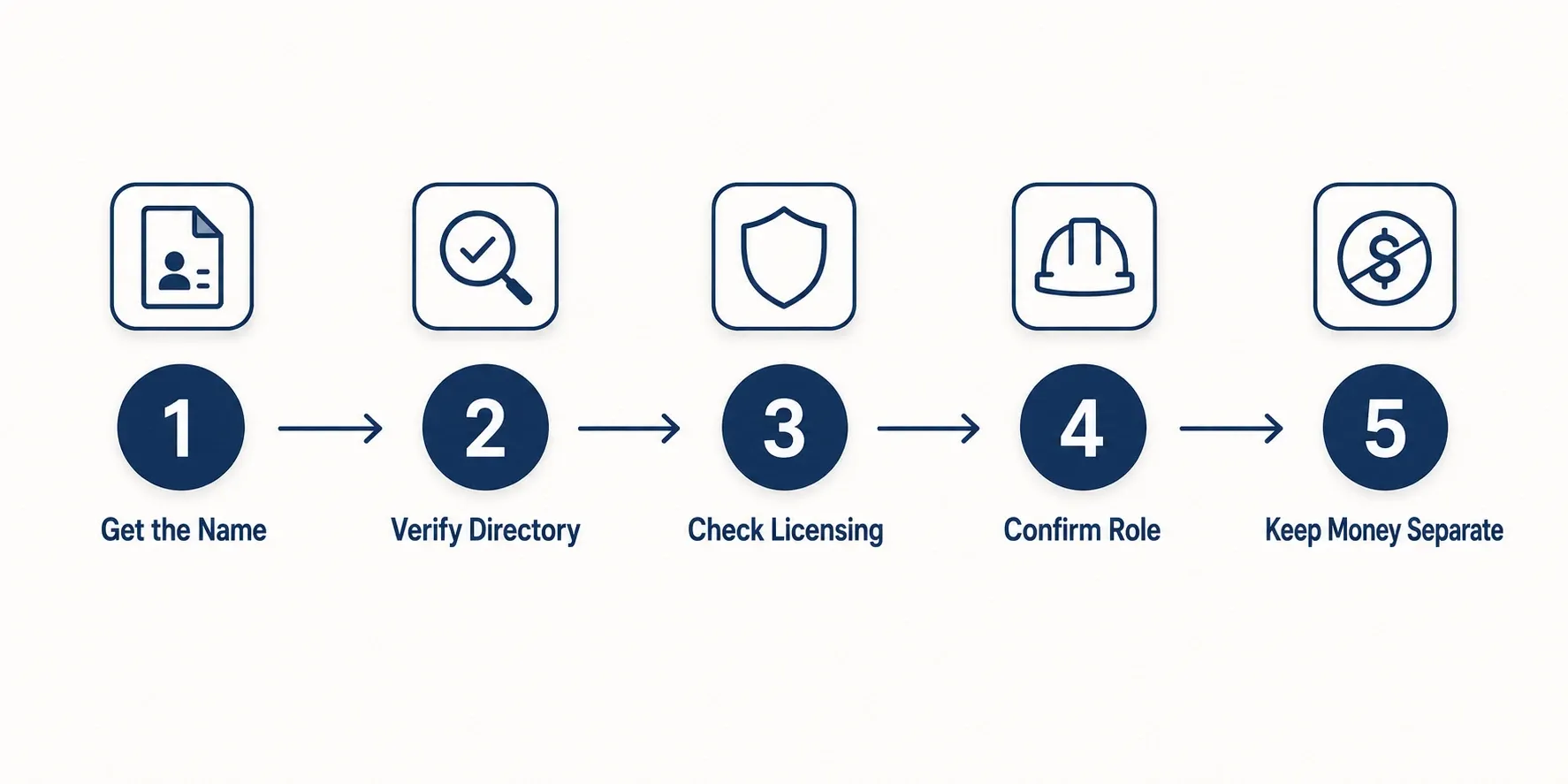
A short sequence, in the order that saves the most time:
A company that fails step one is not necessarily a bad company. It has simply not given you the thing the badge implied it was giving you, and now you know which question to ask.
The credential is real, the certifying body publishes its structure openly, and any of it can be checked in a few minutes. The problem is entirely on the marketing side: one abbreviation is being used to stand for nine certifications, two tiers, a company accreditation program and, by implication, a license it is not. Reading the badge properly costs you one question and one directory search, and it is the cheapest due diligence available in this purchase. Watch for the same pattern elsewhere in the pitch, because a proposal that leans on an unspecified certification often leans on an unspecified offer somewhere else too.
Sources. All NABCEP material on this page was read on nabcep.org on August 26, 2026: the certifications overview page, the board certifications listing page, the PV Installation Professional page, and the frequently asked questions page. Quotations are reproduced from those pages. The eligibility requirements for the PV Installation Professional certification were not on the pages read and are deliberately not stated here. Nothing on this page was tested, and no installer, product or company is named, ranked or recommended.
Editorial note for the customer. This article has no named author or reviewer attached. As with the rest of this cluster, it should carry a real named person and a visible reviewed-on date before it is published, and a next-review date, because a certification list can change.
One email a week with new guides, tips, and solar news. Zero fluff, no sales pitch.