Solar Panel Permit Requirements: Who Pulls the Permit

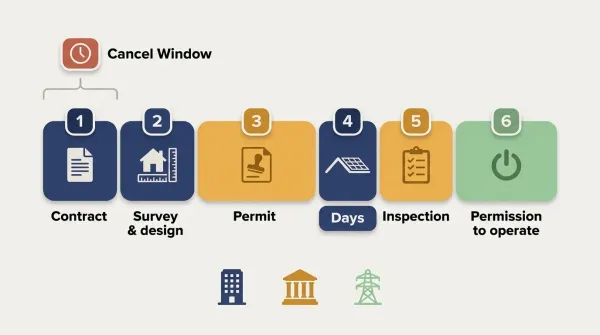
Permission to operate (PTO) is your utility's written approval to turn on a grid-tied solar system. Until it arrives, the panels can be fully installed, inspected and paid for, and still be legally required to stay off. Permission to operate solar comes from the utility, not the building department or the installer, and it usually follows two things: a passed local inspection and an approved interconnection application. If your system is sitting idle, the delay is almost always somewhere in that hand-off between installer, inspector and utility. The fix is to find out which one is holding the file.
This is general information for US homeowners. Interconnection rules are set by each utility and, for many utilities, by a state regulator, and they change. Confirm the process with your own utility before acting.
A grid-tied system connects to the utility's distribution network. The utility has a legitimate interest in knowing what is connected to its lines, because equipment on the grid affects the safety of line workers and the operation of the system around your house. So before a home system can export power, the utility reviews it.
The US Department of Energy describes the sequence in its Solar Energy Guide for Homebuilders (read October 2, 2026): "Utilities generally want to know the technical specifications of the solar energy system, and in some cases, they may want to inspect it along with the local authority having jurisdiction." It continues: "After the interconnection agreement and potential inspection, the utility will grant permission to operate." The same page notes that if you hire a solar installer, "they will do this for you."
In practice, PTO usually arrives as a letter or email from the utility. Keep it. It is the document that says your system is allowed to run.
Homeowners often hear "you passed" and assume they can switch on. There are three separate approvals, from different bodies:
Passing the inspection is necessary but not sufficient. The utility generally wants proof of that passed inspection as part of its own file, along with the interconnection application and agreement.
When a homeowner says "my panels have been up for weeks and nothing is happening," the cause tends to fall into one of these buckets.
If the local inspection failed, or passed but the paperwork never reached the utility, the utility's file is not complete. Ask your installer for the date the final inspection passed and the date proof was sent to the utility.
Utilities review applications against their own requirements: equipment details, a single-line diagram, signed agreements, and sometimes fees. A missing signature or a mismatched equipment list sends the application back. The utility's charges are separate from building permit fees; our breakdown of the five charges to check on a solar interconnection fee covers what to look for.
Some utilities move quickly and some are slower, and backlogs happen. The utility may also need to change or reprogram your meter so it can record power flowing both ways, which is needed for net metering or similar billing. That step may need a site visit.
Occasionally a utility wants additional study, for example if a system is large relative to the home's usage or the local equipment it connects to. Your installer should tell you if this applies.
Here is the trade-off that rarely gets said out loud. For the installer, the job is often substantially done, and in many contracts substantially paid, when the panels go up and the inspection passes. For the homeowner, nothing useful has happened until PTO arrives.
Look at your contract and any financing paperwork for three dates: when the installer's final payment is due, when your first loan or lease payment is due, and when the system is expected to receive PTO. If payments can begin before the system is allowed to run, you are carrying that delay, not the installer. This is not an instruction to choose one financing route over another; it is a date worth knowing before you sign. Our guide to how cash, loans, leases and PPAs differ explains where those payment terms usually sit.
If you signed a production guarantee, also check when its clock starts. A guarantee measured from installation rather than from PTO counts days when the system was not allowed to produce anything.
You do not need to wait passively. A short sequence of questions usually finds the blockage.
The California Public Utilities Commission oversees interconnection for the state's large investor-owned utilities through a tariff called Electric Rule 21. Its Rule 21 page (read October 2, 2026) describes the rule as covering "the interconnection, operating and metering requirements for generation facilities to be connected to an investor-owned utility's (IOUs) distribution system," and says it includes "procedures and timeframes for reviewing applications." The page names PG&E, Southern California Edison and San Diego Gas & Electric, plus Bear Valley Electric Service, Liberty Utilities and PacifiCorp. For missed timelines, it directs customers to the relevant utility's Rule 21 ombudsman, and for other disputes to the CPUC's Rule 21 disputes contact.
Municipal utilities and electric cooperatives in California, and utilities in other states, follow their own rules. Outside California, your state Public Utilities Commission (sometimes called a Public Service Commission) is the place to look for interconnection rules and complaint routes for regulated utilities. Export credit rules are a separate question; for how California now credits exports, see NEM 3.0 California explained.
It can be tempting to flip the system on "just to see it work" once the inspection passes. Do not. Operating a grid-tied system before the utility approves it can breach your interconnection agreement, and the utility's approval process exists partly to protect the people who work on the lines near your home.
The switching itself is also not homeowner work. The system's disconnects, inverter and connection to your electrical panel belong to a licensed electrician or your installer. Once PTO arrives, ask the installer to commission the system or to walk you through the manufacturer's start-up steps that the installer confirms are appropriate for an owner. Do not open the inverter, junction boxes or your electrical panel. If anything shows scorching, smoke or a burning smell, keep away from it and call 911.
Once the system is on, check your first bill or two to confirm the utility has moved you onto the right billing arrangement. If you expected net metering or a similar credit, our explainer on what net metering is and how it works covers what the bill should start to show. If the bill does not change at all, call the utility; a meter or rate change may not have been completed.
It is the utility's written approval to switch on and connect your grid-tied solar system. It usually follows a passed local inspection and an approved interconnection application.
In most cases the installer files the interconnection paperwork on your behalf, but the approval is tied to your utility account. You can usually ask the utility for the status directly.
It varies by utility and by how complete the application is. Ask your installer and your utility what to expect in your service area, and check your state regulator's interconnection rules if your utility is regulated.
Generally no. Operating a grid-tied system before the utility approves it can breach your interconnection agreement. Wait for the written approval, and have the installer or a licensed electrician handle the switch-on.
Start with your installer, then your utility. In California, the CPUC's Rule 21 page directs customers with missed interconnection timelines at the large investor-owned utilities to the utility's Rule 21 ombudsman.
One email a week with new guides, tips, and solar news. Zero fluff, no sales pitch.