Do I Need a Battery With Solar? The Real Trade-Off


United States only. Sources checked on August 23 and 24, 2026. Every figure below belongs to one named state or utility and is not a national rate.
There is no national solar interconnection fee. What a utility charges you to connect a rooftop system is set by your state's regulator in a tariff document, and it is usually not one fee but a stack of up to five separate charges, some one-time and some recurring on every bill for as long as you own the system. In California the governing document is Electric Rule 21. In Massachusetts it is each utility's distributed generation interconnection tariff approved by the Department of Public Utilities. In North Carolina it is the net metering rider approved by the Utilities Commission. The amounts in those three documents are not the same, and none of them is a stand-in for the others.
This is general information about how these charges are structured. It is not financial advice and it is not a quote. Only your own utility, reading your own address, can tell you what you will be charged.
A homeowner who asks an installer about the interconnection fee usually gets a single number, and the single number is usually the application fee. That is one line in a stack of five, and it is often the smallest one. The charges that matter most over twenty years are the recurring ones, and they do not appear on a quote at all because they are not something the installer bills you for.
Here is the whole stack, in the order you meet it.
This is the fee to submit the interconnection request. It is set in the utility's interconnection tariff and it varies by state, by utility, and by the size and review track of the system.
Massachusetts is the clearest current example of how much this can move. WBUR reported on August 19, 2026 that the Massachusetts Department of Public Utilities finalized a rule creating a flat $225 fee applying to solar and battery storage projects up to 25 kilowatts, replacing a prior arrangement, and that the new fee "will be in place in two to three months." That reporting describes the fee as covering the first $10,000 in interconnection costs for Eversource and National Grid customers and up to $1,450 for Unitil customers, with shared upgrade costs spread across the pool of applicants. That is a news account of a regulator's decision rather than the order itself, so if you are in Massachusetts, confirm the current amount and effective date with the Department of Public Utilities or your own utility before you rely on it.
In California, the CPUC's Rule 21 page, read on August 24, 2026, describes Rule 21 as "a tariff that describes the interconnection, operating and metering requirements for generation facilities to be connected to an investor-owned utility's (IOUs) distribution system," covering Pacific Gas and Electric, Southern California Edison and San Diego Gas and Electric plus three small and multi-jurisdictional utilities. That page states that Rule 21 contains fee schedules for processing applications, but it does not publish a residential application fee amount, so we are not printing one. The amount lives in the utility's own current tariff sheets, which is where to read it.
Interconnection requests are sorted into review tracks. A small inverter-based residential system that passes a set of technical screens goes through the fastest track. A request that fails a screen moves to a longer review, and the longer review can carry its own cost, because the utility is doing engineering work specific to your circuit.
The reason this line exists is not about your house. It is about how much generation is already connected to the same section of the distribution network. That is why two identical systems, in the same utility territory, in the same year, can produce different interconnection outcomes. Ask your installer directly what happens, and who pays, if your request does not clear the fast track.
Connecting generation can require a different meter, and in some cases an equipment change such as a disconnect switch or a service upgrade. Whether the utility absorbs the meter cost or bills it, and whether a disconnect switch is required at all, is set in the same tariff and varies by utility and by system size. North Carolina's Public Staff, the state's consumer advocate, describes solar customers as needing to contact their local electric utility to request the interconnection application, which is the correct route for exactly this question.
If the network needs work to accept your system, somebody pays for it. Some states leave that with the individual applicant. Others pool it. The Massachusetts rule reported in August 2026 is a deliberate move toward pooling: a predictable flat fee, with shared upgrade costs spread across the applicants who benefit. Which model your state uses is one of the largest single variables in what interconnection costs a homeowner, and it is a policy choice, not a fact about your roof.
This is the category most articles omit, and it is the one that compounds.
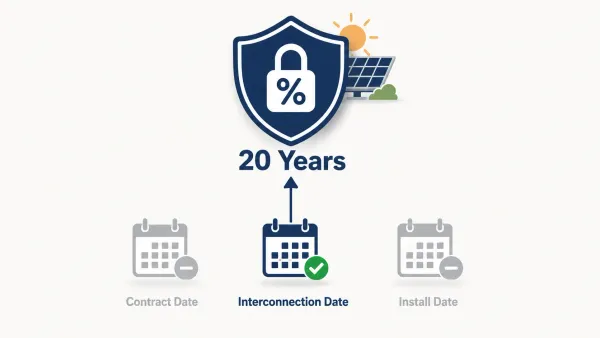
North Carolina is the cleanest published example. The North Carolina Utilities Commission Public Staff page on net metering, read on August 24, 2026, states that Rider RSC "introduces new charges, including a minimum monthly bill, non-bypassable charges for storm recovery and cyber security costs, and a grid access fee for systems larger than 15 kW (alternating current)." The same page states that a customer on Rider NMB "can stay on this rider for up to 15 years from the date of their interconnection request application," after which they move to Rider RSC or whatever tariff is then in effect.
Read that carefully, because it contains three distinct ideas that are usually blurred together: a floor under your bill regardless of production, charges that your exports cannot offset, and a fee that applies only above a size threshold. What each of those does to a specific household depends on that household's usage, and the Duke Energy solar bridge rate page covers the North Carolina rider timing in detail.
The general lesson transfers even though the North Carolina numbers do not. When you evaluate a rate, ask whether it contains a minimum bill, whether it contains non-bypassable charges, and whether it contains a capacity-based fee. Those three questions apply in every state, and the answers are in your tariff, not in a national article.
The useful skill is not memorizing a fee. It is knowing which document holds your answer and asking for it by name. Utilities answer a specific request far better than a general one.
Two more things worth doing before you sign anything. Ask which of these charges your installer has included in the quoted price and which they have not, because interconnection and permitting costs are a common gap between a quote and a final bill. The costs a solar quote leaves out covers where those gaps usually sit. And confirm what your exports are actually credited at, because a fee schedule and a credit rate together decide the economics, not either one alone. What net metering is and how it works explains the credit side, and if you are in California, the legacy question of how long your existing tariff is protected is covered in how long a California legacy NEM rate lasts.
We named three states because we could read a current, dated, named source for each. We did not publish a national average interconnection fee, because there is no such figure that means anything: the charges are set utility by utility in documents that are amended on their own schedules. We also did not print a California residential application fee, because the CPUC page we read does not state one and we will not fill that gap from memory. If a figure above matters to your decision, read it in your own utility's current tariff before you act on it, and treat the dates in this article as the last time we checked rather than as the last time anything changed.
Is there a standard solar interconnection fee in the US? No. Interconnection for a residential rooftop system is governed by state-approved utility tariffs, and both the amounts and the structure differ by state and by utility. Any single national figure is an average of documents that do not resemble each other.
Is the interconnection fee a one-time cost? Partly. The application fee and any study or equipment costs are one-time. Minimum bills, non-bypassable charges and grid access fees are recurring, and in some states they are the larger number over the life of the system.
What is a grid access fee? A charge applied to solar customers based on system capacity. North Carolina's Public Staff page describes Rider RSC as including a grid access fee for systems larger than 15 kW AC. Whether your state or utility has one, and at what threshold, is set in your rate schedule.
Who decides these charges? Your state utility commission, by approving the utility's tariff. That is why the answer changes at a state line and sometimes at a utility boundary within a state, and why a municipal utility, which answers to its own board rather than to the state commission, can be different again.
Does my installer pay the interconnection fee or do I? It depends on the contract. Ask specifically which fees are inside the quoted price, which are passed through to you, and what happens to the price if the utility requires a study or an upgrade.
One email a week with new guides, tips, and solar news. Zero fluff, no sales pitch.