Permission to Operate Solar: Why Your Panels Are Off

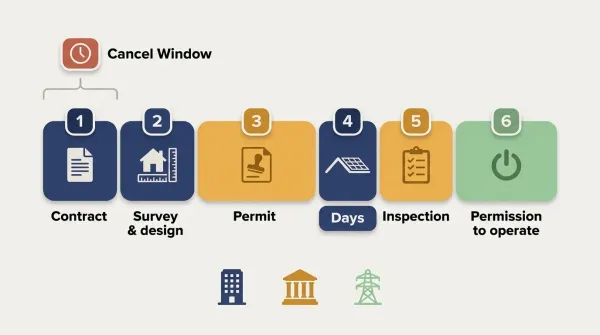
Yes. In the US, a grid-tied rooftop solar system almost always needs a permit from your local building department, usually covering both the structural work on the roof and the electrical work, and often an inspection before the utility will let you switch on. The exact solar panel permit requirements are set locally by your city or county, so they differ from one town to the next. In most installs the contractor applies for the permit, not the homeowner. Your job is to make sure the contract says so, and to confirm afterward that the permit was not just issued but closed out with a passed inspection.
This guide is general information for US homeowners. Permit rules are local and change, so confirm the details with your own building department and utility before acting.
A permit is the local government's way of checking that work on your house meets the building and electrical codes it has adopted. For rooftop solar, that usually means two areas of review, sometimes on one permit and sometimes on two.
The roof has to carry the added weight of panels and racking, and every mount that passes through the roof has to be attached and flashed properly. The plan reviewer looks at how the array is attached and, on some jobs, at a structural calculation. Roof material matters here: a tile, slate or flat roof can change both the mounting method and what the reviewer asks to see, so make sure your quote names your roof type and the mounting method.
The electrical review covers how the system connects to your home's service: wiring, disconnects, labeling and the connection at the panel. US jurisdictions build these rules on the National Electrical Code (NEC), but each one adopts a particular edition, sometimes with local amendments, so the rules on paper in one county may not match the next.
Three approvals often get confused with the building permit:
In a normal contractor-installed job, the contractor applies, because the application asks for the licensed contractor's details and the contractor is the party answering for the code compliance of the work.
The California Contractors State License Board is direct about this. Its Solar Smart consumer page (read September 28, 2026) tells consumers: "Make sure the contract specifies that the contractor will pull all required building permits." The same page lists the license classifications California allows to install solar, including C-46 Solar and C-10 Electrical contractors, and tells homeowners not to use a contractor who is not licensed for solar work. That guidance is California's; other states set their own contractor licensing rules, so check your state's licensing board.
Some jurisdictions let a property owner pull a permit for work on their own home, often called an owner-builder permit. Occasionally a salesperson suggests this to "save time." Be careful. When the permit is in your name, the building department generally treats you as the party responsible for the work meeting code. If something is wrong, the correction notice comes to you, not the company that did the work.
There is also a safety line here. A grid-tied solar system involves roof work at height and electrical connections to your home's service panel. This is licensed-contractor work. Nothing in this guide suggests a homeowner should install, wire or connect any part of the system, and permits for that work should be in a licensed contractor's name unless your building department and a licensed professional tell you otherwise for your situation.
The US Department of Energy's "Walk Me Through It" guide (read October 2, 2026) puts it plainly: "The PV system installation generally takes only a few days, but permits and inspections can take weeks to months. It depends on the local regulations in your area." The same page points homeowners to the National Renewable Energy Laboratory's SolarTRACE tool for an idea of how long permitting, inspection and interconnection take in a given jurisdiction.
Some local governments have sped this up with SolarAPP+, a free online platform that checks a standard residential solar application against code and can approve qualifying permits instantly. A Department of Energy article dated December 20, 2023 reported that 160 communities across 10 states were using it at that time. Whether your town uses it today is a question for your building department or your installer.
The wait is usually not the installer's fault, and it is not usually the homeowner's either. But a contract that promises an install date without saying "subject to permit approval" sets an expectation the installer does not control. The bigger picture of where permitting sits in the purchase is covered in our guide to how to buy solar panels from start to finish.
Permit fees are set by your local government, and they vary from place to place. DOE's consumer guidance notes that permit and inspection costs may appear in your contract and can be a meaningful part of the total, so they deserve a line of their own on the quote.
Two things to check:
A permit has a life cycle. It is applied for, issued, the work is inspected, and if the inspection passes, the permit is closed out (many departments call this "finaled"). An issued permit only means work was allowed to start. It does not mean the work passed.
That difference matters for you, not the installer. An open permit with no passed final inspection can surface years later, for example when you sell the house and a buyer's agent or inspector checks the record. By then the installer may have moved on.
Here is what to ask for, in writing:
If your local government does not publish permit status online, the permit counter can usually tell you the status if you give them the address.
A homeowner who does not know a permit exists cannot ask whether it was closed. A homeowner who does not know the permit should be in the contractor's name may agree to an owner-builder shortcut that moves the code liability onto them. And a homeowner who thinks the permit is the last step may not realize the utility still has to approve the connection.
None of this requires bad faith from the installer. It only requires the paperwork to stay vague, and vague paperwork protects the party that wrote it.
Before you sign, check that the contract or scope of work says:
These belong alongside the other questions to ask before you sign a solar contract. If you signed recently and the answers worry you, your cancellation window may still be open. The CSLB page above states that California law allows you to cancel without penalty within three business days; other states set their own rules, so check how to find your solar contract cancellation deadline and confirm with your state Attorney General's consumer protection office before acting.
In almost every US jurisdiction, yes. A grid-tied rooftop system typically needs building and electrical approval from your local building department and an inspection. Your city or county sets the exact requirements.
In a contractor-installed job, the contractor normally applies. California's Contractors State License Board advises that the contract should say the contractor will pull all required building permits.
It depends on your local government. The US Department of Energy says installation generally takes a few days but permits and inspections can take weeks to months, depending on local regulations.
The building department may require the work to be permitted and inspected after the fact, and an unpermitted system can come up when you sell. Your utility may also ask for proof of a passed inspection before it approves the connection. Ask your local building department how it handles your situation.
No. The building permit comes from your local government. Interconnection approval and permission to operate come from your utility, through a separate process.
One email a week with new guides, tips, and solar news. Zero fluff, no sales pitch.