Roof Replacement With Solar Panels: Bundle or Not?

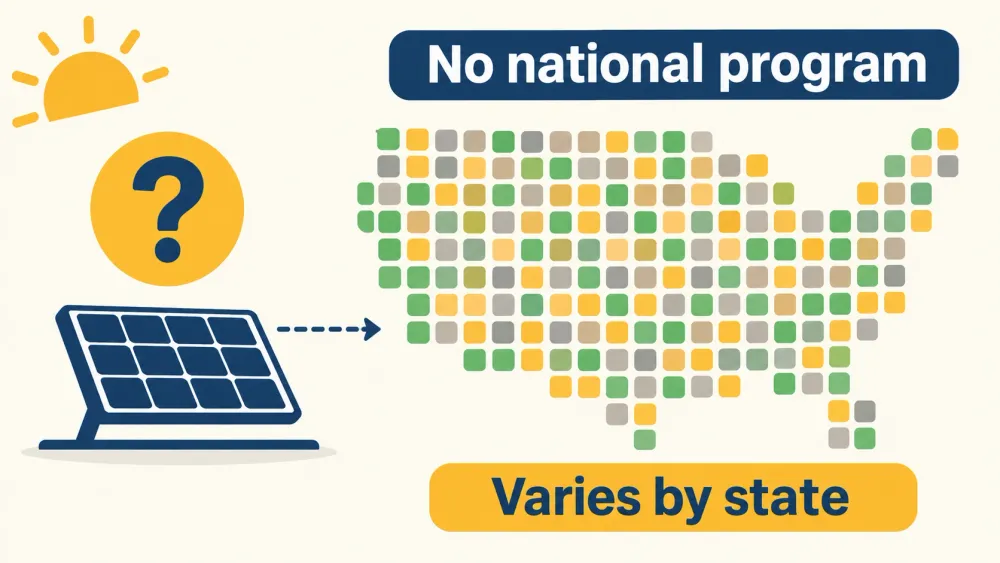
When a home solar system reaches the end of its life, the panels become waste, and in the United States there is no single national recycling program for them. The rules for solar panel recycling, disposal and handling come from federal hazardous waste law, which treats some panels as hazardous and some not, plus a short list of state rules. The Environmental Protection Agency tells homeowners to contact their installer or their state and local environmental agencies. So the practical answer to "is this my landfill problem?" is: it is a question for your installer, your contract, and your state, and the answer differs by state.
United States only. Federal and state rules were read from EPA and state agency pages on November 12, 2026. They are changing: a federal rule is still being drafted, and state laws have been delayed before. This is general information, not legal or environmental compliance advice.
The EPA's page on end-of-life solar panels (last updated September 30, 2026) sets out the federal frame. Panels are not waste while they work. "When a solar panel reaches the end of its usable life or is otherwise discarded, it becomes solid waste." Whether that waste is also hazardous depends on what is in it.
The reason is the metals. EPA says "Heavy metals like lead and cadmium may be leachable at such concentrations that waste panels would fail the toxicity characteristic leaching procedure," the test used to decide whether a waste is hazardous. The answer is not settled by brand: "Some solar panels are considered hazardous waste, and some are not, even within the same model and manufacturer."
Two more points from EPA's frequent questions on solar panel waste (last updated September 18, 2026) matter for a homeowner:
When EPA gives examples of who counts as the "generator" of solar panel waste, they are commercial and institutional: "a utility-run large solar array, schools, commercial buildings, and government buildings." For homes it says something different: "Homeowners with solar panels on their houses should contact their solar panel installer or state and local environmental agencies for more information on disposal and recycling." Neither page we read sets out a federal procedure for a single household's panels, which is why the state and the installer end up deciding.
EPA is working on one, but it is not yet a proposal. Its rulemaking page (last updated July 31, 2026) says "EPA is planning to propose new rules" and that it "is working on a proposal to add hazardous waste solar panels to the universal waste regulations." The effort responds to a 2021 industry petition.
Our reading: until a proposal is published and then finalized, nothing changes for a homeowner at the federal level. Any article that describes a federal solar recycling requirement as already in force is ahead of the record.
EPA's page lists five state policies and notes that "The list above is not comprehensive." We checked the status of one of them, Washington's.
| State | What EPA lists | What we found |
|---|---|---|
| California | State universal waste rules for PV modules | Listed by EPA; not checked further. Ask your installer or local hazardous waste program. |
| Hawaii | State universal waste regulations for solar panels | Listed by EPA; not checked further. |
| New Jersey | A Solar Panel Recycling Commission | Listed by EPA as a commission; not checked further. |
| North Carolina | A state report on the management and decommissioning of renewable energy equipment | Listed by EPA as a report; not checked further. |
| Washington | Photovoltaic Module Stewardship and Takeback Program | Delayed. See below. |
Washington is the correction worth knowing. The state's 2017 law requires panel makers to fund takeback and recycling "at no cost to the owner of the PV module," and covers modules bought after July 1, 2017. But the Washington Department of Ecology's solar panels page says implementation "was delayed, most recently during the 2025 legislative session," moving the date by which makers need an approved stewardship plan "from July 1, 2025, to January 31, 2031." Ecology expects to send the legislature recommended changes by December 1, 2028. Our reading: a Washington homeowner should not assume a free manufacturer takeback exists today.
Manufacturer documents send the question back to local rules and to a professional.
Neither manual describes a takeback program in the sections we read.
Putting the federal page, the state list and the manuals together, the decision sits with different people depending on why the panels are coming off.
| Your situation | Who decides what happens | First call |
|---|---|---|
| Panels coming off for roof work and going back on | Not disposal at all. Our reading of EPA's FAQ, which says a panel reused directly "without reclamation is not a solid waste," is that a remove-and-reinstall is not a waste event. | Your installer |
| You own the system and it is being retired | Your state's waste rules, through whoever removes it | Your installer or removal contractor, then your state environmental agency |
| Leased system or power purchase agreement | The company that owns the equipment, under your contract | The solar company, with your contract's end-of-term section in hand |
| A single broken panel replaced under warranty | The installer or maker handling the claim | Your installer |
| Selling the house with the system on the roof | Nothing is discarded; the system transfers | See our guide to selling a house with solar |
For the roof work case, our guide to removing and reinstalling panels for roof work covers who pays and who does the job. For leased and PPA systems, our guide to selling a house with solar panels explains why the solar company, not the homeowner, owns the equipment.
You do not need to solve this today, but three questions are cheap to ask while your installer is still answering the phone:
Safety line. Taking panels off a roof means work at height and disconnecting an electrical system. Qcells' manual tells owners not to disconnect modules themselves. That work belongs with your installer or a licensed electrician, and this page does not describe it.
Do not assume so. EPA says some panels can be hazardous waste depending on the metals they contain, even within the same model, and directs homeowners to their installer or state and local environmental agencies. Your local rules decide.
Some are and some are not. EPA says the most common reason a panel is classed as hazardous is failing the toxicity test for lead or cadmium. Working panels in use do not leach those metals, according to EPA.
Not nationally, in the pages we read. Washington passed a manufacturer-funded takeback law in 2017, but the deadline for makers to have an approved stewardship plan has been moved to January 31, 2031. Ask your installer what recycler they use.
EPA describes solar panels as typically having "a lifespan of more than 25 years." The point of retirement for your own system depends on its condition and your warranty terms, which our guide to solar panel degradation and the performance warranty explains.
The leasing company owns the equipment during the term. What happens at the end, whether removal, renewal or purchase, is set by your contract, so read its end-of-term section and ask the company directly.
One email a week with new guides, tips, and solar news. Zero fluff, no sales pitch.