Solar Offset: A Target Somebody Chose, Not a Law of Physics

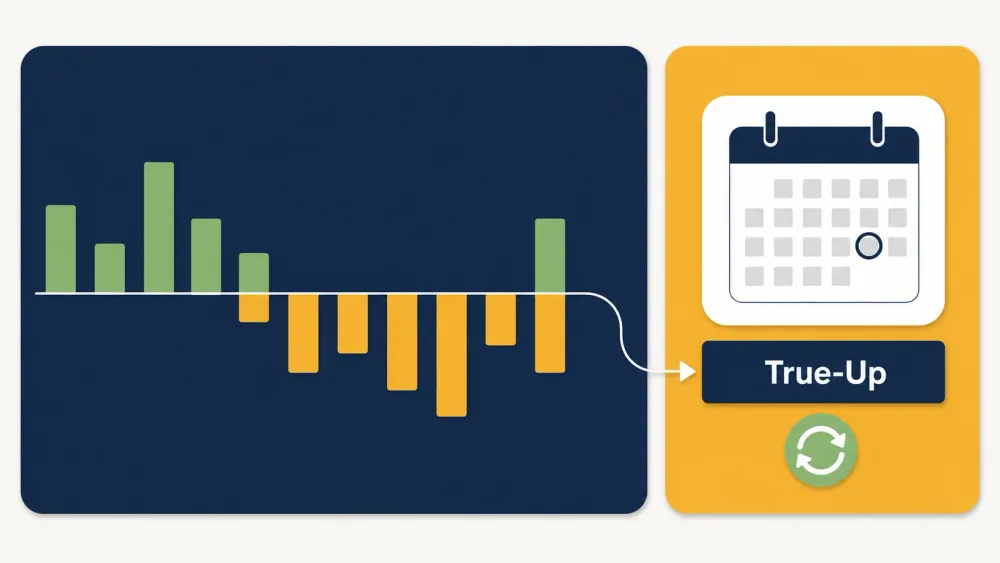
A true-up bill is the annual settlement of a net metered solar account. For twelve months the utility tracks the energy you imported and the surplus you exported, carrying the running difference as credits or charges rather than collecting it each month. On the anniversary of your interconnection, it adds everything up and bills the balance, then resets the clock. A large true-up is usually arithmetic, not an error: it is a year of small monthly gaps arriving at once. Not every state or tariff works this way, so your own utility's rate schedule is the authority.
This is general information for US homeowners, not financial or tax advice. Net metering and net billing rules are set state by state and utility by utility, and they have changed significantly in several states in recent years. Confirm every detail against your own tariff and your own statements.
Two meters' worth of information sit behind the number. One is everything your home pulled from the grid across the year. The other is everything your system pushed back when it generated more than the house was using at that moment. Energy your home consumed the instant it was produced never appears in either, because it never crossed the meter.
The Department of Energy's homeowner's guide to going solar describes net metering as an arrangement "in which the system owners are compensated for any solar power generation that is exported to the electricity grid." A true-up is simply the moment that compensation is cashed out against what you owe. During the year the utility may still bill you monthly for charges that credits cannot offset, which is why a true-up statement is usually not the only bill you got.
Three things decide the size of it: how much more you consumed than you exported, what each exported kilowatt-hour was credited at, and which charges were excluded from offset all year. The first is yours to influence. The second and third are set by the tariff. If the mechanics of the credit itself are new to you, start with what net metering is and how it works.
This is the part generic articles get wrong, because they describe one state's system as though it were national.
Annual true-up is a feature of certain net metering and net billing tariffs, most visibly in California, where it has been standard practice for solar customers for years. Other states settle differently: some credit kilowatt-hours forward indefinitely, some expire credits annually on a fixed calendar date rather than your anniversary, some cash out surplus at a wholesale rate, and some do not operate a rolling annual balance at all. A few states have no mandated net metering program for new customers.
The California Public Utilities Commission states that the older net energy metering tariffs, under which "participating customers receive bill credits for excess generation that is exported to the electric grid" at "the retail rates (including generation, distribution, and transmission components)," are closed to new enrollments. Applicants on or after April 15, 2023 are served under the Net Billing Tariff, where export compensation is "applied to a customer's bill at a rate reflecting the value of this generation to the grid." Two customers on the same street, interconnected two years apart, can therefore face very different annual reconciliations. If you are in California, how NEM 3.0 pays for exports and how long a legacy NEM rate is protected are the two things to establish before reading your statement. Outside California, net metering state by state is the place to start.
| What pushes a true-up bill up | What pulls it down |
|---|---|
| Consumption rose during the year, often from an electric vehicle, heat pump or new occupant | Exports credited at or near retail rates |
| The system was sized for partial offset from the start | Usage shifted into daylight hours |
| Exports credited below the retail import rate | A year with better than modeled sunlight |
| Evening-heavy usage on a time-of-use rate | Consumption fell |
| Charges that credits cannot offset, accumulated monthly | A tariff that rolls unused credits forward |
| Production shortfall from shading, soiling or a fault | Surplus compensated at the end of the period |
Notice how few of these are equipment problems. A true-up bill is mostly a report on sizing, usage and tariff design. A system quoted at partial offset was always going to leave a balance, which is why what an offset percentage really means is worth reading if the proposal promised a number you have not seen.
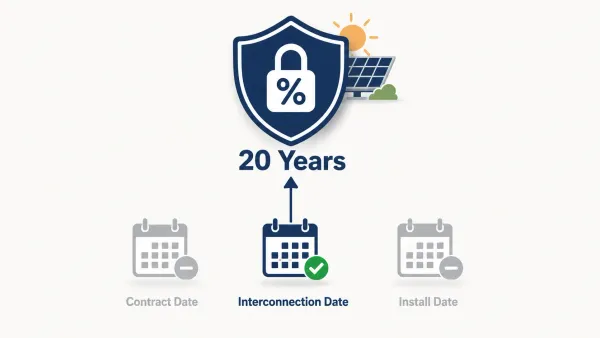
Here is the part the sales process rarely mentions, and it is the single most useful thing in this article: your true-up date is not January 1. It is tied to the date your system was authorized to interconnect, so it falls in the same month every year, and you can know it today.
Build a short routine around it.
That is the information gain over a repair-shop explanation of true-up: the bill is predictable from month three, and almost nobody is told to look.
If a full year leaves you a net exporter, the surplus is generally compensated at a rate set by the tariff, and that rate is typically well below what you pay to import. This is deliberate: it removes the incentive to oversize a system purely to sell power. In practice it means a very large surplus often converts into a modest payment or credit, so building a system around that outcome rarely works out the way a sales projection suggests. The terms, including whether surplus is paid, credited or forfeited, are in your tariff.
Work in this order, and keep everything in writing.
First, check the arithmetic against your own monthly statements for the period. The twelve import and export figures should reconcile to the annual totals on the true-up statement. Errors do happen, and most are discovered here.
Second, if the totals reconcile but the credit rate looks wrong, ask the utility which tariff your account is on and when it was assigned. Tariff misassignment after a move, a system change or a program transition is a real and correctable problem.
Third, if the utility does not resolve it, your state's public utilities commission or equivalent regulator handles billing and metering disputes between customers and regulated utilities, after you have raised it with the utility first.
Fourth, if the dispute is about what you were told you would pay, rather than what the utility charged, that is a sales issue and a different route. The Federal Trade Commission's guidance on solar power for your home directs complaints to "the Federal Trade Commission at ReportFraud.ftc.gov" or "your state attorney general." Keep the proposal that contained the projection.
It is the annual reconciliation of a net metered account. The utility totals a year of imports and exports, applies the credit rates in your tariff, and bills or credits the difference, then starts a new twelve-month period.
On the anniversary of your system's interconnection, not at the end of the calendar year. The month is fixed for the life of the account and is shown on your permission-to-operate notice and your statements.
Because the monthly bills were not settling the energy balance. They typically cover only the charges credits cannot offset, while the energy difference accumulates all year and lands in one statement.
No. Annual true-up is a feature of particular net metering and net billing tariffs. Other states credit forward, expire credits on a calendar date, or compensate exports differently. Your utility's rate schedule is the authority.
The surplus is usually compensated at a rate set by the tariff, typically well below the retail rate you pay to import. Some tariffs credit it, some pay it, and the terms are specific to your utility.
One email a week with new guides, tips, and solar news. Zero fluff, no sales pitch.