Oversize Solar System NEM 3.0? What to Weigh

United States only. This page quotes no figure, recommends no percentage, names no utility and contains no price. The right offset for you depends on a tariff this page cannot see.
Offset is the proportion of your annual electricity consumption that your system is designed to produce over a year. It is an annual accounting figure, and readers almost universally hear it as a promise about their bill.
Those are different quantities, and the gap between them is where most disappointment with solar lives.
Take your annual consumption in kilowatt-hours. Take the system's estimated annual production in kilowatt-hours. Divide the second by the first.
That ratio is the offset.
Notice three things about it.
It is annual. It says nothing about any individual month, day or hour.
It is about energy, not money. Two systems with identical offset can produce very different bill outcomes, depending entirely on what your utility pays you for exports and charges you for imports.
And it is a target somebody chose, usually the default in the proposal software, and it can be changed.
Because it is the number that sounds like the goal, and because for a long time it very often was.
Under export arrangements that credit exported electricity at or near the price you pay for imported electricity, a kilowatt-hour exported in June is worth about the same as a kilowatt-hour imported in December. In that world, annual energy balance is a good proxy for bill elimination, and sizing to full offset makes sense.
The default survived the arrangements that made it correct. What net metering is and why the version you are on matters so much is the mechanism, and what applies varies substantially by state. Where exports are now credited at less than the retail rate, annual energy balance stops meaning bill elimination, and offset becomes a much weaker guide.
So the first question is not what offset to target. It is what your utility pays for exports.
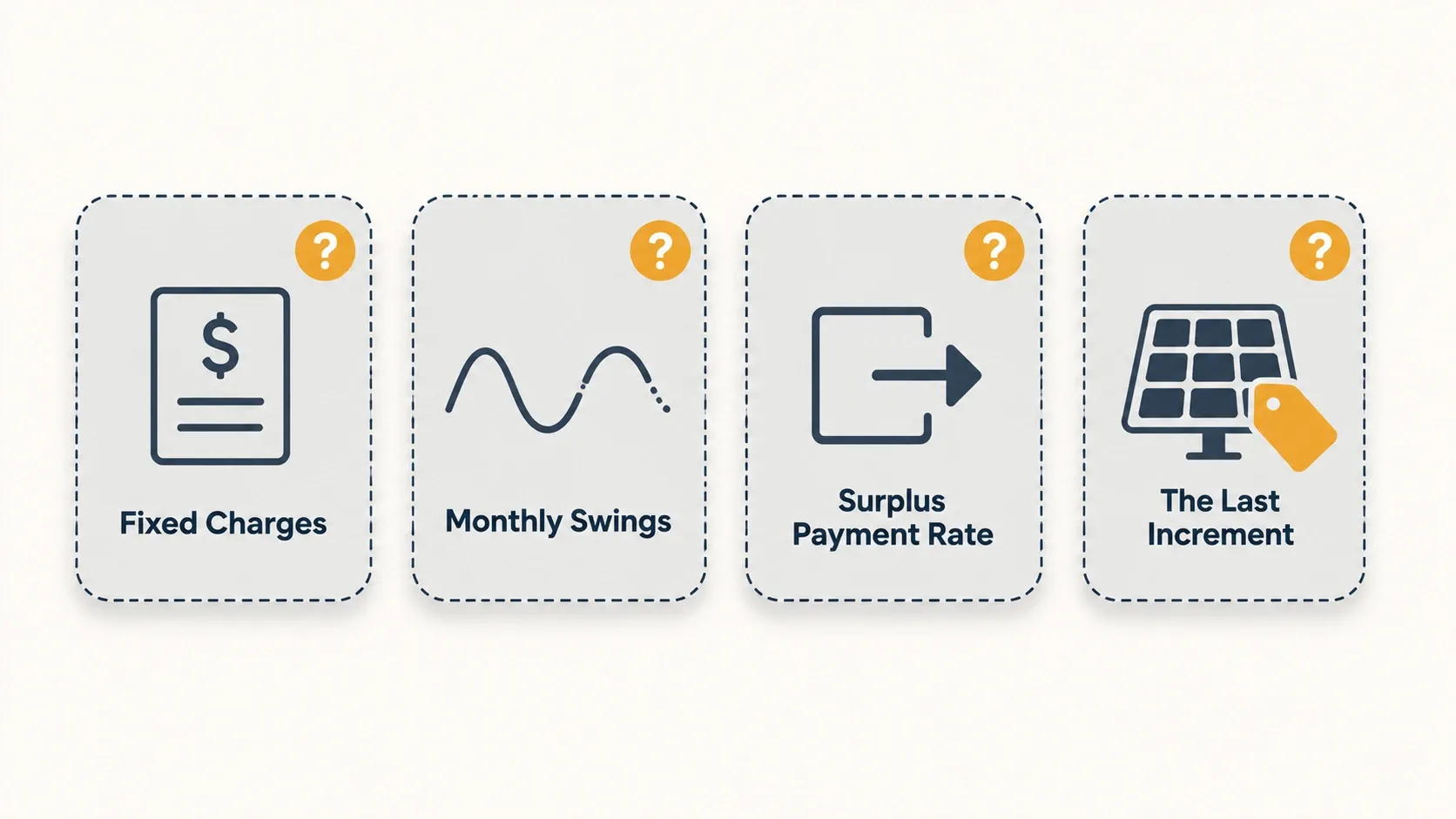
Your bill. Nearly every utility has fixed charges that exist regardless of consumption, and on many tariffs those are not offset by production at all. A system at full offset does not produce a zero bill, and expecting one is the single most common disappointment.
Your monthly experience. Production is seasonal and so is consumption, and they rarely peak together. A system at full offset annually will typically over-produce in some months and under-produce in others.
What you are paid for the surplus. Which is the whole question on modern export tariffs.
Whether the last increment was worth buying. The marginal panels on a system are the ones producing the surplus, and on a poor export tariff they earn least. That is the calculation that decides your number, and it is why asking for a second proposal at a smaller size is the single most useful request you can make.
When exports pay poorly. The clearest case. If exported energy is credited well below what you pay for imported energy, then production beyond what you use yourself is worth much less, and the capacity that generates it may not repay its own cost.
When your usage does not align with production. A home consuming mostly at night is exporting most of its production, so the export rate dominates the outcome.
When you are financing and the payment matters. What the financing costs is a separate question from what the system costs, and a smaller system is a smaller commitment.
When the roof will not take more without going onto a plane that produces poorly.
When you might move. A smaller system is easier to pay off or transfer.
When exports pay well. Then extra capacity earns, and the case for more of it is straightforward.
When you are about to electrify something. A vehicle, heating, or both. Sizing once is cheaper than adding later, because a second installation repeats the fixed costs.
When fixed costs dominate. Permitting, design, interconnection, labor mobilization and the inverter cost roughly the same for a slightly larger array, which is why cost per watt usually falls as systems grow. This is a real economy and it is the strongest argument for going bigger.
When your usage is likely to rise.
Four inputs, in order of how much they matter.
1. What your utility pays for exports, and what is scheduled to change. Your utility publishes the tariff. This is the input that changes the answer most.
2. Your consumption, over twelve real months, and its shape. Not one bill. The shape decides how much of your production you consume yourself.
3. Your roof. How much usable area there is and on which planes.
4. Your plans. Anything about to change.
Notice that none of those four is a percentage somebody on the internet can give you, which is why this page gives none.
Three requests, and they are cheap for a company to satisfy.
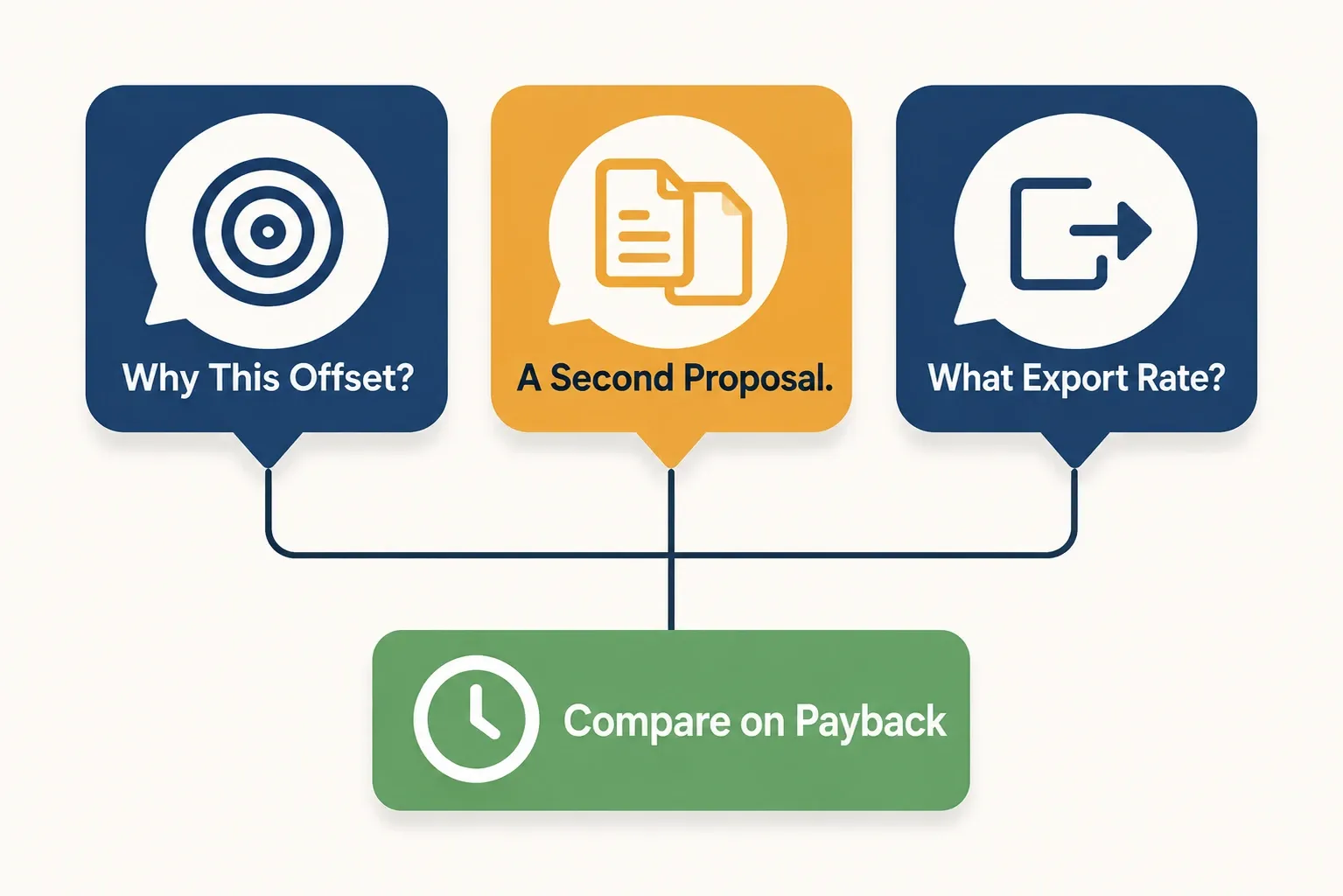
"What offset are you targeting and why that number?"
"Give me a second proposal at a lower offset." Two proposals from the same company at two sizes shows you the cost and the return of the difference between them, which is the actual question.
"What did you assume I would be paid for exported electricity?" If the answer is vague or out of date, every savings figure downstream is unreliable.
Then compare the two proposals on payback rather than on offset. The payback calculation is what turns two sizes into a decision, and it is the comparison the offset percentage was standing in for all along.
Some utilities have rules about systems sized beyond a household's historical consumption, and interconnection agreements can carry conditions about it.
We are not stating any rule, because it is utility and state specific. Ask your utility what limits apply to system sizing at your address, and ask before you commit, because it is easier to know at proposal stage than at interconnection stage.
What offset percentage should I aim for? This page recommends none, and that is deliberate rather than evasive. The right number depends on a tariff this page cannot see. Four inputs decide it: what your utility pays for exports and what is scheduled to change, your consumption over twelve real months and its shape, how much usable roof you have and on which planes, and anything about your household that is about to change. None of those four is a percentage somebody on the internet can hand you. Your utility publishes the tariff, and that is the input that moves the answer most.
Does a system at full offset mean a zero bill? No, and expecting one is the single most common disappointment with solar. Offset is an annual energy ratio, not a statement about money. Nearly every utility has fixed charges that exist regardless of consumption, and on many tariffs those are not offset by production at all. Two systems with identical offset can produce very different bill outcomes, because what your utility pays you for exports and charges you for imports is what decides the money.
Why do proposals default to covering all of my usage? Because it is the number that sounds like the goal, and because for a long time it very often was the right one. Where exported electricity is credited at or near the price you pay for imported electricity, a kilowatt-hour exported in June is worth about the same as one imported in December, so annual energy balance is a good proxy for bill elimination. Where exports are now credited at less than the retail rate, that stops being true and offset becomes a much weaker guide. The default survived the arrangements that made it correct.
When is a smaller system the better buy? When exports pay poorly, which is the clearest case, because production beyond what you use yourself is then worth much less and the capacity generating it may not repay its own cost. When your usage does not line up with production, such as a home consuming mostly at night, since the export rate then dominates the outcome. When you are financing and the monthly payment matters. When the roof will not take more without going onto a plane that produces poorly. And when you might move, because a smaller system is easier to pay off or transfer.
Can I install a system larger than my past usage? Some utilities have rules about systems sized beyond a household's historical consumption, and interconnection agreements can carry conditions about it. This page states no rule, because it is utility and state specific. Ask your utility what limits apply to system sizing at your address, and ask at proposal stage rather than at interconnection stage, because it is much easier to know before you commit.
Offset is the proportion of your annual consumption your system is designed to produce, it is an annual energy ratio rather than a statement about your bill, and full offset is a software default rather than a goal. What decides your right number is what your utility pays for exports, the shape of your consumption, your roof and your plans. Ask for a second proposal at a smaller size, compare the two on payback rather than on offset, and ask what export rate the savings figures assumed.
One email a week with new guides, tips, and solar news. Zero fluff, no sales pitch.