Solar Panel Warranty Types: Which One Covers What

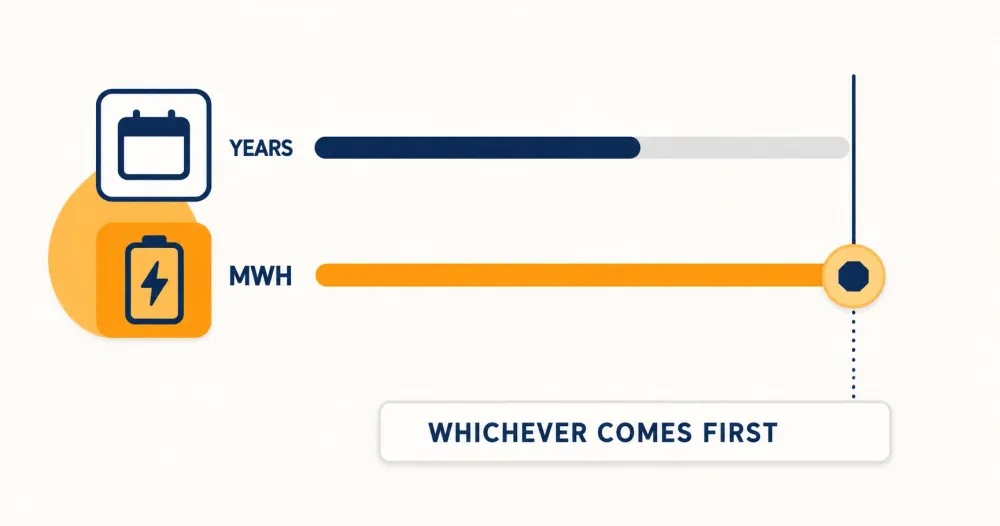
Home battery warranty throughput is the total amount of energy, usually stated in megawatt-hours (MWh), that a battery is warranted to deliver before its coverage ends. Most home battery warranties pair it with a number of years, and coverage stops at whichever limit comes first. A "10-year warranty" on a battery that is cycled hard every day can therefore run out in fewer than ten years. Whether that happens to you depends on how you will use the battery, which is something you can estimate before you sign.
This page explains the terms in a US home battery warranty that decide what "ten years" actually means. It is general information, not legal advice about any specific warranty. The warranty document itself is the only thing that binds the manufacturer, so every point below ends with "check the actual document".
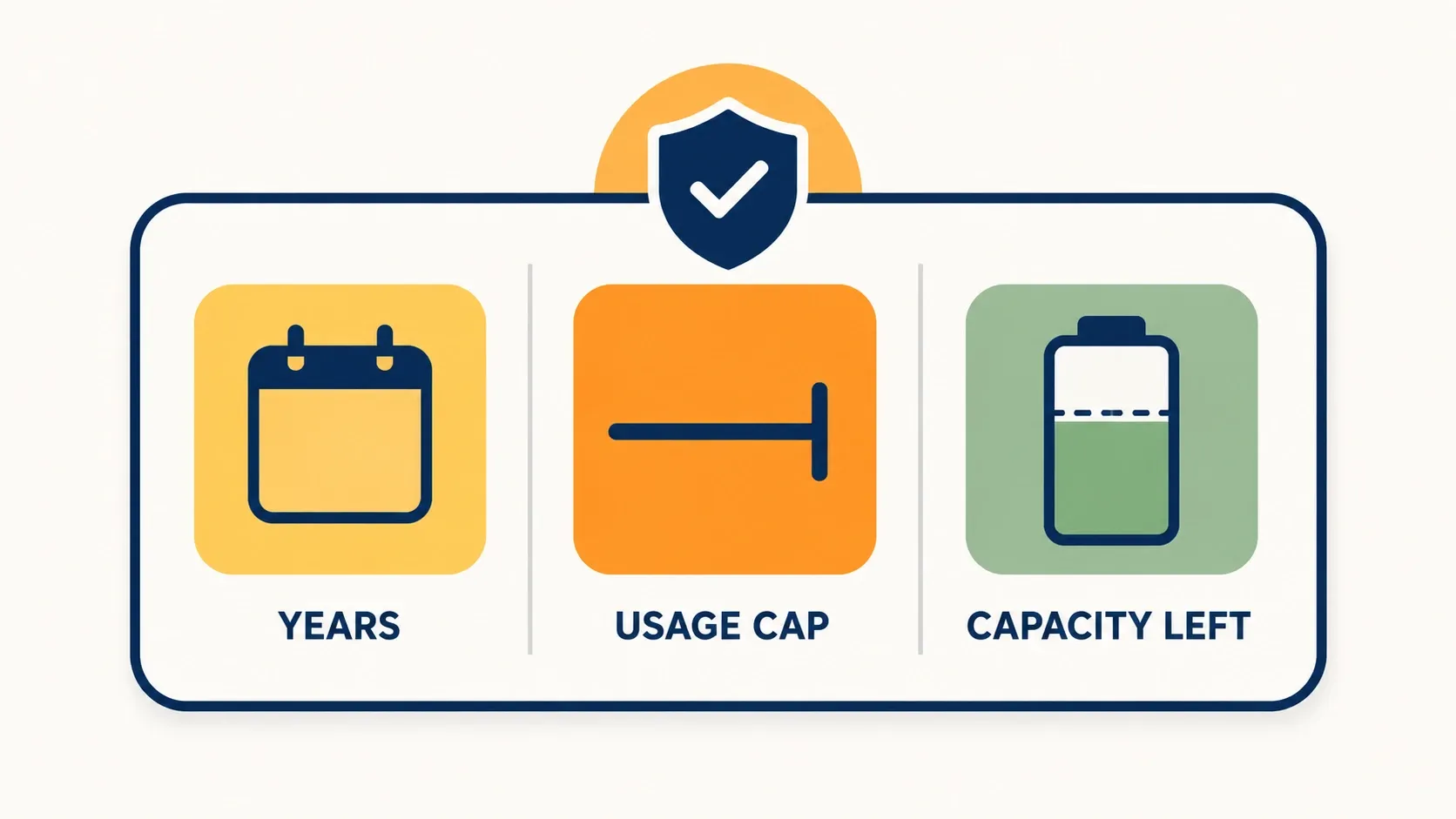
EnergySage's battery warranty guide (updated September 12, 2024, read September 25, 2026) describes home battery warranties as built from three separate limits:
Those ranges are wide, and they are two years old, which is why the only numbers that matter are the ones in the warranty for the battery you are quoted. What the ranges do show is that two batteries both sold as "10-year" can carry very different promises.
Throughput is a running meter. Every kilowatt-hour the battery delivers counts against it, whether that energy powered your house during an outage, covered your evening use to avoid peak rates, or was sent to the grid for a utility program. When the meter reaches the cap, the usage part of the warranty is spent, even if the calendar says you have years left.
You can turn a throughput cap into something easier to picture. Divide the cap in kilowatt-hours by the battery's usable capacity and you get roughly the number of full cycles it covers. EnergySage's example: a 20,000 kWh (20 MWh) throughput warranty on a 10 kWh battery means about 2,000 expected cycles.
The following is an illustration with stated assumptions, not a forecast for any real battery or household. Assume a battery with a 10-year term and a 30 MWh throughput cap, a figure inside the range EnergySage lists.
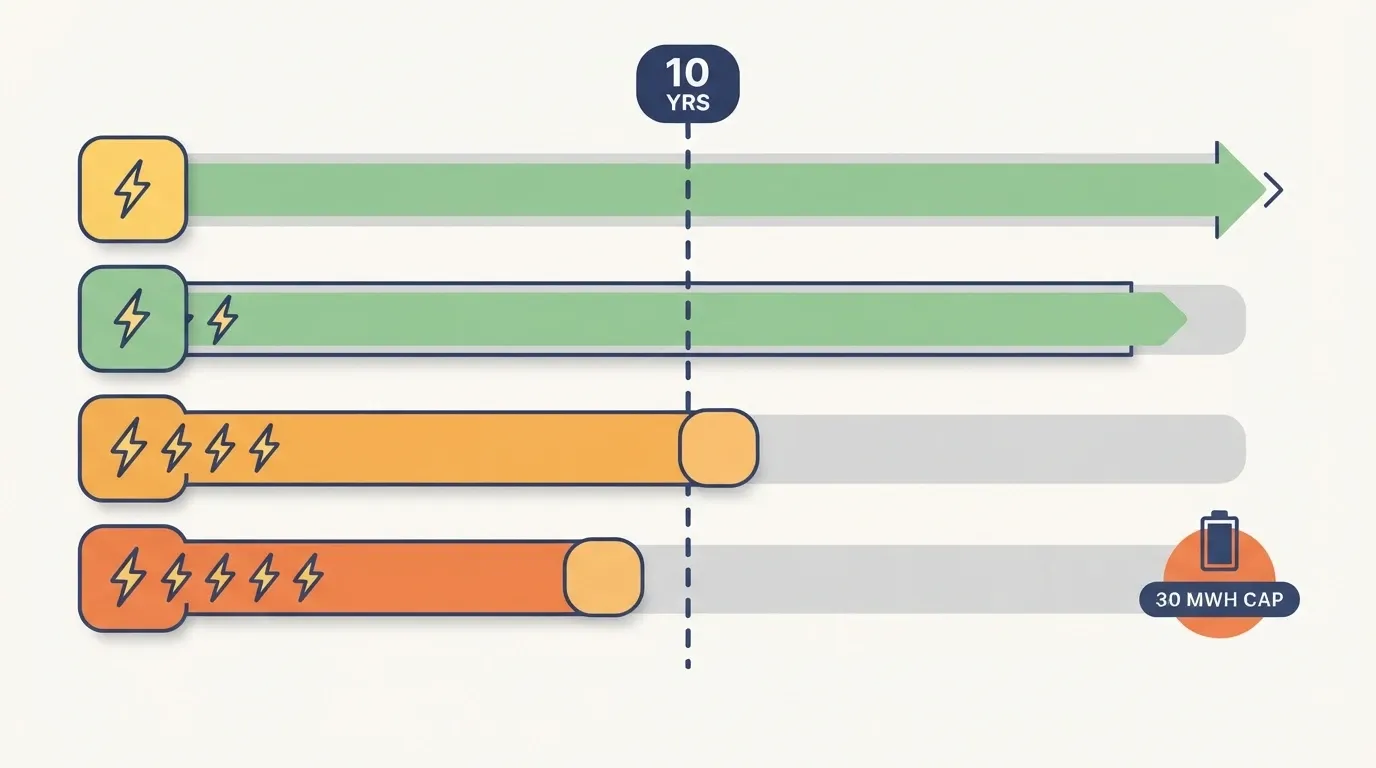
| How the battery is used (assumption) | Energy delivered per year | Years until 30 MWh is reached |
|---|---|---|
| Backup only, a few outages a year, about 200 kWh | 200 kWh | Well past 10 years; the 10-year term ends first |
| Daily evening use, about 5 kWh a day | 1,825 kWh | About 16 years; the 10-year term ends first |
| Daily evening use, about 10 kWh a day | 3,650 kWh | About 8.2 years; the throughput cap ends first |
| Daily use plus utility program events, about 12 kWh a day | 4,380 kWh | About 6.8 years; the throughput cap ends first |
The arithmetic is simple: kWh delivered per day, times 365, gives yearly throughput. Divide the cap in kWh by that and you have the years. Change the cap or the daily figure to match your own quote and your own plan.
The pattern is the point. A battery bought mainly for outages is unlikely to hit a throughput cap before its years run out. A battery bought to shift energy every day, the case built around time-of-use rates or around a utility program, is the one where the cap can decide how long you are covered.
The year figure is the one on the brochure. It is easy to remember and easy to compare. The throughput cap sits further down the warranty, and it is exactly the clause that applies most to the people a daily-savings pitch is aimed at.
A seller whose proposal relies on the battery cycling every day to justify its price is describing the usage pattern that uses up throughput fastest. That is not dishonest in itself, but the two numbers belong together. If a proposal shows daily savings from battery cycling, it is fair to ask the seller to show, in writing, how many years of that cycling the throughput cap covers.
Utility and state programs raise the same question. Some pay battery owners to discharge during peak events, and every one of those kWh counts toward the cap. Home battery rebates in 2026 covers what those programs typically ask of your battery in exchange.
The capacity promise is a floor, not a forecast. A warranty that promises 70 percent of original capacity at the end of the term is saying the battery should not fall below that level while covered. It is not saying the battery will still be at 95 percent.
For a sense of scale: on a battery with 13.5 kWh of usable capacity, a 70 percent floor is about 9.5 kWh, and a 60 percent floor is about 8.1 kWh. Those are arithmetic, not predictions of how a particular battery ages.
The limits above decide how long coverage lasts. The exclusions decide what it covers while it lasts. EnergySage's guide lists items that typically remain the customer's responsibility: installation labor, shipping fees, damage from extreme weather, damage near saltwater, and problems caused by installers the manufacturer has not certified. It also notes that temperature limits and indoor or outdoor location requirements can void coverage if they are not met.
The labor point is the one with the biggest bill attached. A warranty that replaces a failed battery module but does not pay anyone to remove the old one and install the new one can still leave a large invoice. The same guide says most manufacturers do not offer labor reimbursement.
The Federal Trade Commission's consumer page on warranties (last updated July 2023, read September 25, 2026) lists questions that apply directly here: whether specific parts or repairs are excluded, whether the remedy is repair, replacement or refund, whether you contact the manufacturer or the seller, and whether you pay for labor or shipping. It also notes that some warranties require you to register the product before you can get service.
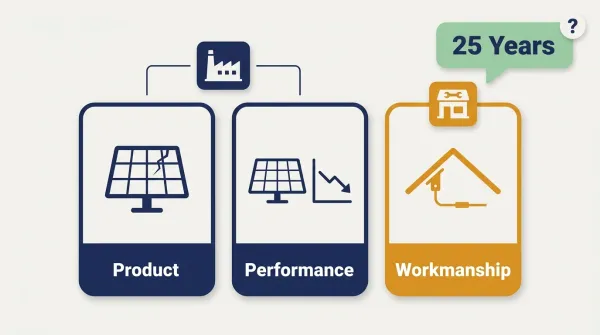
A home battery usually comes with two separate promises: the manufacturer's product warranty, and the installer's workmanship warranty on the installation itself. They are written by different companies, last for different lengths of time and cover different failures. A leak around a wall penetration or a loose connection is normally a workmanship question, not a product one.
Each is only as good as the company behind it. If the installer closes, the workmanship warranty may go with it, and the manufacturer may require a certified installer to do any warranty work. Checking whether your solar installer will still exist applies just as much to the company installing the battery.
According to EnergySage's guide, most battery warranties transfer automatically to a new owner, but some require paperwork, some charge a transfer fee and at least one it reviewed covers the original owner only. If you might sell within the warranty term, the transfer terms matter to your buyer as much as to you.
Put these on your list alongside the other questions to ask before you sign:
If anything in the warranty is unclear after you have read it, the questions go to the manufacturer and the installer in writing. If a warranty dispute is not resolved, the FTC page says consumers can report it to the FTC or to their state attorney general.
It is the total energy, usually in MWh, a battery is warranted to deliver. Most warranties combine it with a term in years and end coverage at whichever limit is reached first.
Yes, if the warranty has a throughput or cycle cap and the battery reaches it first. That is most likely when the battery is cycled heavily every day, for example to shift evening use or to take part in utility programs.
Multiply the kWh you expect the battery to deliver each day by 365. Compare that, times the warranty's years, to the throughput cap in kWh. If the total is higher, the cap will end coverage first.
Often not. EnergySage's warranty guide lists installation labor and shipping among the costs that typically stay with the customer. Check the specific warranty and ask the installer what their workmanship warranty covers.
Many do, but not all. Some require paperwork or a fee, and some cover only the original owner. Read the transfer section of the warranty for the exact model you are quoted.
One email a week with new guides, tips, and solar news. Zero fluff, no sales pitch.