Do I Need a Battery With Solar? The Real Trade-Off

United States only. This page names no company, quotes no figure and contains no price.
The distinction people think they are making is size. The distinction that will actually affect them is whether the company selling to them is the company installing.
Many national solar brands operate as dealer networks: the brand markets, finances and warrants, and an independent local company does the physical installation. So "national" and "local" are not two ends of a spectrum. They are two arrangements of the same set of jobs, and which arrangement you are buying is a question you can ask directly.
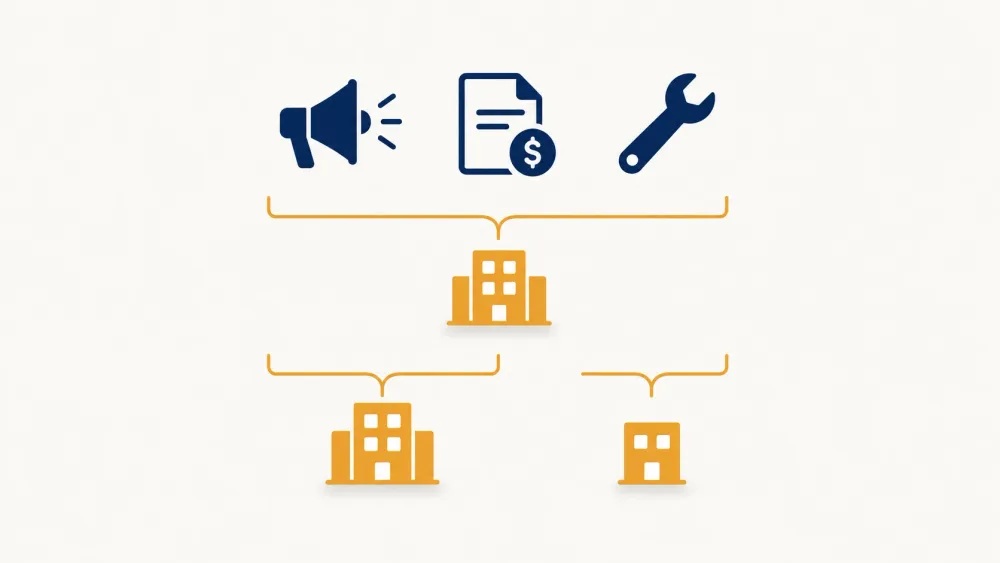
Any residential solar purchase involves at least five distinct functions:
Selling. Finding you and closing.
Designing. Choosing the system size and layout, and producing the production estimate.
Financing. Whoever holds the loan, lease or power purchase agreement.
Installing. People on your roof.
Servicing. Whoever comes back in year seven.
In a small local company these are frequently one entity. In a dealer network they are frequently three or four entities, and the paperwork will reflect that even when the sales conversation does not.
The single most useful question in this entire article: "Which legal entity performs each of those five functions, and which one holds my workmanship warranty?" Ask it of every company you talk to, national or local, and get the answer in writing.
Tendencies, not rules, and any individual company can defy them.
Financing options. More products, more relationships, sometimes better rates.
Process and paperwork. Permits and interconnection applications are administrative work that a large organization is set up for, and interconnection in particular is a process with its own timeline and sometimes its own fees.
Survivability of the brand. A larger balance sheet is not a guarantee, and it is a different risk profile from a small firm.
Equipment purchasing. Scale sometimes shows up in the price.
Knowing your utility. Tariffs, interconnection queues and inspection quirks are local, and a company that files with the same utility every week knows things a national process does not encode.
Knowing your building department. Same reasoning.
Service response. A company twenty minutes away with its own crews is a different proposition from a national service queue.
Accountability. A local firm with a reputation in one county has an incentive structure a subcontractor in a network does not.
Continuity of the actual people. The person who designed it may still be there.
This is more useful than the strengths.
Nobody owns the problem. The brand says the installer did it, the installer says they follow the brand's design, the finance company says its agreement is separate.
You do not know who to call, because you contracted with one entity and a different one was on your roof.
The workmanship warranty may be the subcontractor's, and the subcontractor may be smaller and less durable than the brand you thought you bought from.
How to protect against it before signing: get, in writing, the name of the installing entity, whose workmanship warranty applies, and a single contact route for service. If a company cannot produce those, that is the answer.
The company stops existing. Small firms fail, retire and get acquired, and the workmanship warranty goes with them, while the panel and inverter warranties stay with their manufacturers. Whether anything survives on the workmanship side turns entirely on whether a third party backs the promise. And note that the individual credentials on the job leave with the individuals: a certification is held by a person rather than by a company, which is as true of a national brand as of a local firm.
Capacity constraints. A three-crew company with a good reputation may not get to you quickly, and may be worse at paperwork.
Fewer financing options, which for some buyers is the deciding factor.
How to protect against it before signing: check the state business registry for how long the entity has existed, check the licensing board for status and complaints, and ask whether the workmanship warranty is backed by a third party.
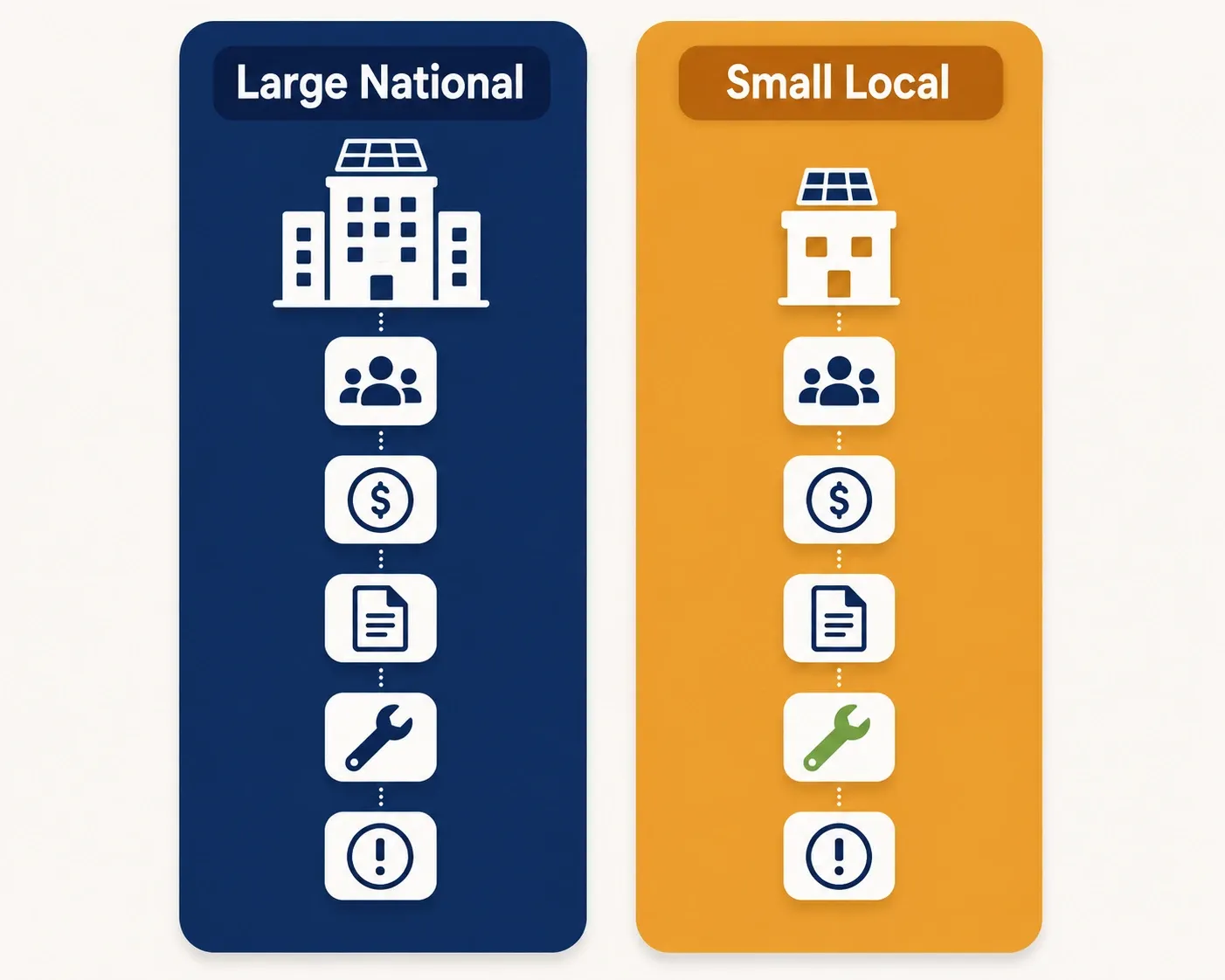
Tendencies, not rules, and any individual company can defy them.
| What you are weighing | Large national operation | Small local company |
|---|---|---|
| Who does the five jobs | Frequently three or four entities, with the brand marketing, financing and warranting while an independent local firm installs | Frequently one entity doing all five |
| Financing | More products, more relationships, sometimes better rates | Fewer options, which for some buyers is the deciding factor |
| Permits and interconnection paperwork | Administrative work a large organization is set up for | Files with the same utility and building department every week, so it knows the local queues, tariffs and inspection quirks |
| Service in year seven | A national service queue | A company twenty minutes away with its own crews, and the person who designed the system may still be there |
| The characteristic failure | Nobody owns the problem: the brand points at the installer, the installer at the brand's design, and the finance company at its separate agreement | The company stops existing, and the workmanship warranty goes with it unless a third party backs it |
| Equipment warranty | The manufacturer's | The manufacturer's |
| Free checks before you sign | Licensing board, business registry, the contract | Licensing board, business registry, the contract |
Read the bottom two rows first. They are identical on both sides, which is most of the point of this page. The table sorts tendencies and it deliberately leaves out the things that vary company by company, including how quickly a small firm can get to you and how durable any particular balance sheet is. It also cannot answer the question that actually decides your purchase, which is whether the company selling to you is the company that will be on your roof, and that is settled by the contract rather than by the brand's size.
Identical regardless of size, and all free.
State contractor licensing board. License status, scope and complaint history.
Secretary of state business registry. Entity age, status and any recent name or entity changes.
The contract. Which entity is party to it. This is the document that settles every question above, and it is available before you sign if you ask for it.
Three quotes, compared properly. Reading three proposals side by side is where the difference between two arrangements becomes visible, because the pricing structures differ.
Who will physically be on my roof, and who is contractually responsible for their work?
If the answer is the same entity for both, you have a simple relationship, whether that entity is national or local.
If they are different entities, that is workable and common, and you need to know which one owes you what.
A large brand with its own crews in your area is a different product from the same brand operating as a dealer network in the next state, and the brand will not volunteer which one you are getting.
Equipment. Panels and inverters come from manufacturers, and both national and local installers fit the same brands. The equipment warranty is the manufacturer's regardless of who installs, so equipment is not an argument for either.
Whether solar makes sense for you. That is decided by your electricity rate, your roof and your tariff, and it is worth settling before you talk to anybody.
Is a national solar company safer than a local one? Neither is safer as a category, and size is not the useful distinction. What matters is whether the company selling to you is the company installing, because many national brands operate as dealer networks in which an independent local firm does the physical work. A large brand with its own crews in your area is a different product from the same brand running a dealer network in the next state, and the brand will not volunteer which one you are getting.
What is the one question that settles it? Ask which legal entity performs each of the five functions, selling, designing, financing, installing and servicing, and which one holds your workmanship warranty. Ask it of every company, national or local, and get the answer in writing. If the same entity both installs and stands behind the work, you have a simple relationship. If they are different entities, that is common and workable, but you need to know which one owes you what.
How do national and local companies tend to fail differently? In a dealer network the characteristic failure is that nobody owns the problem: the brand points at the installer, the installer points at the brand's design, and the finance company says its agreement is separate. With a small local firm the characteristic failure is that the company stops existing, taking the workmanship warranty with it, while the panel and inverter warranties stay with their manufacturers. Local firms can also be capacity constrained and offer fewer financing options.
Does choosing a bigger company get me better equipment? No. Panels and inverters come from manufacturers, and national and local installers fit the same brands. The equipment warranty belongs to the manufacturer regardless of who installs, so equipment is not an argument for either arrangement. The installation itself, and who stands behind it, is where the choice actually bites.
Which checks should I run either way? The same three, and they are free. Your state contractor licensing board for license status, scope and complaint history. Your secretary of state business registry for entity age, status and any recent name or entity change. And the contract itself, which names the entity you are actually dealing with and settles every question above. Then get three quotes and compare them properly, since the pricing structures of the two arrangements differ.
The real division is not national against local. It is whether the company selling is the company installing, because many national brands are dealer networks that subcontract. Ask which legal entity performs each of the five functions and which one holds your workmanship warranty, in writing. National operations tend to be better at financing and paperwork; local ones tend to know your utility and your inspector and to be there in year seven. Both fail in characteristic ways, and both are checkable at your state licensing board and business registry before you sign anything.
One email a week with new guides, tips, and solar news. Zero fluff, no sales pitch.