Solar Electrical Inspection: What Inspectors Check

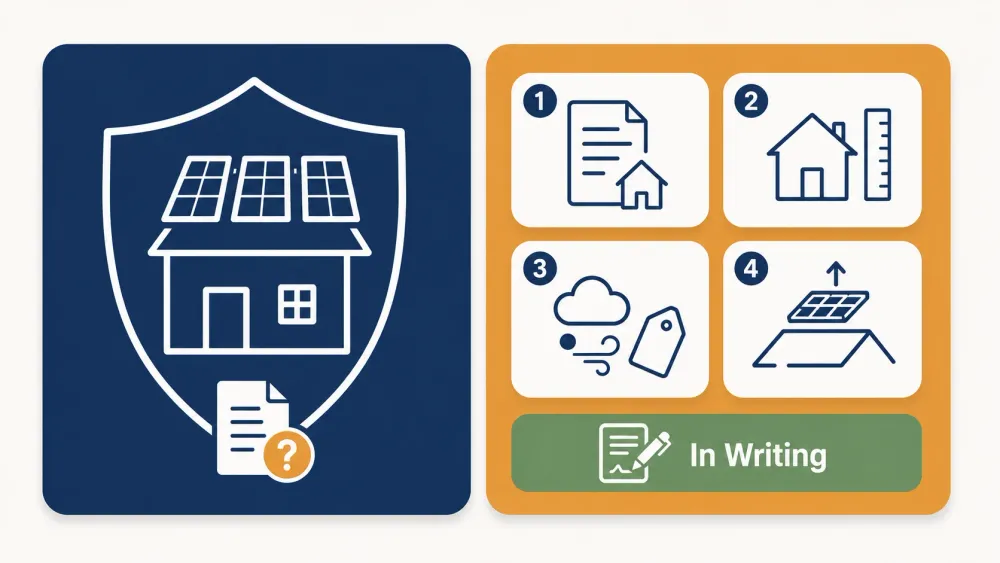
Do you need to tell your insurer about solar panels? Yes, and before installation if you can. With homeowners insurance, solar panels you own that are attached to the roof are often treated as part of the house, but "often" is not a promise. What matters is how your own policy classifies them, whether your dwelling limit still covers the cost to rebuild with the panels, which deductible applies to hail and wind, and whether removing and reinstalling the panels after a covered roof loss is included. Whether your premium changes depends on your insurer and your state. Get each answer in writing.
This is general information for US homeowners, not insurance advice. Insurance is regulated by each state, and policies differ by insurer and by form. Confirm everything with your own insurer or agent and, if you have questions about your rights, your state's insurance department.
Most homeowners policies are built around a few separate parts: coverage for the house itself, coverage for other structures on the property, coverage for your belongings, and liability. Where your solar system lands matters, because each part has its own limit.
None of these is guaranteed. Some insurers handle solar differently, and some policies carry exclusions or conditions that matter more for equipment on a roof. That is why the call to your insurer is a step, not a formality.
Telling your insurer is the only way to know where the system lands in your policy, and it protects you from finding out at claim time. Three reasons:
Tell them before the installation if you can, so you can price the change into your decision, and again when the system is finished, with the final cost and details.
It might, and it might not. A higher dwelling limit usually means a higher premium, because you are insuring more value. Some insurers treat rooftop solar as a minor change; others look at it more closely, particularly in places with frequent hail, wind or wildfire. We do not print a typical increase because no figure we could source would hold across insurers and states. Ask your insurer for a written quote of the change before you sign the solar contract, and if it is a problem, compare quotes from other insurers before the system goes on the roof.
Hail and wind are among the main risks for rooftop equipment, and many policies treat them differently from other damage. The Texas Department of Insurance, in its consumer column What to know about insurance and your roof (March 2026, read October 2, 2026), notes: "The deductible for wind and hail damage is often more than for other damage." If your policy has a separate wind or hail deductible, minor damage to a few panels may cost less than the deductible to fix, which means you pay it yourself. Know which deductible applies before you need it.
Some policies pay to replace damaged property at today's cost. Others pay less, reducing the payment for age and wear. The same Texas column says of roofs that "Some policies pay the full cost of a new roof. Others pay less based on the roof's age and condition." Ask how your policy would pay for damaged solar equipment, and whether that changes as the system ages.
If a covered storm damages your roof, the roof cannot be repaired properly with the array on it. The panels have to come off and go back on. Ask your insurer whether that detach and reset work would be part of a covered roof claim under your policy, and get the answer in writing. This is one of the less visible costs of owning solar, and it belongs with the hidden costs solar quotes skip.
A leak at a mounting point, or roofing cracked during installation, is generally a workmanship problem, and the installer's warranty and insurance are the first place to look. Your homeowners policy may not treat poor workmanship the way it treats a storm. Before installation, ask the installer for a certificate of insurance showing their liability and workers' compensation coverage, and add it to your questions to ask before you sign a solar contract.
A grid-tied system connects your home to the utility network. Read your utility's interconnection agreement for any insurance requirement, and ask your insurer whether your liability coverage is adequate for the system you are adding.
Ask these questions and ask for the answers by email or as a policy document, not just over the phone:
Keep the answers with your solar contract, permit and warranty papers.
Insurance rarely comes up in a solar sales meeting. It is not the installer's product, and a question about premiums or deductibles can slow a signature. But the gaps above show up only when something goes wrong, after the installer has been paid. A homeowner who never asked is the one who learns, after a hailstorm, that the deductible is larger than the repair, or that removing the panels for a roof claim is not covered.
Be fair to the insurer, too. Many policies handle rooftop solar without fuss. The point is to know, in writing, which kind of policy you have before the system is on the roof.
Often, when you own them and they are attached to the house, because many policies treat them as part of the dwelling. Coverage depends on your policy's classification, limits, exclusions and deductibles, so confirm with your insurer.
You should. It is the only way to confirm how the system is covered and whether your dwelling limit needs to rise. Check your policy's conditions for any requirement to report changes to the property.
They can, mainly because raising your dwelling limit to cover the system adds insured value. The effect varies by insurer and state, so ask for a written quote before you sign the solar contract.
The solar company owns leased panels and PPA equipment, and the contract should say who insures them. Read it, and ask your insurer whether you need any additional coverage.
It may, if hail is a covered cause under your policy. Check which deductible applies: the Texas Department of Insurance notes the deductible for wind and hail damage is often more than for other damage.
One email a week with new guides, tips, and solar news. Zero fluff, no sales pitch.