Homeowners Insurance and Solar Panels: What to Ask

A solar electrical inspection is the local building department's check that your installed system matches the plans it approved and meets the electrical code it has adopted. The inspector typically looks at the inverter, wiring methods, disconnects, grounding and bonding, warning labels, and the connection to your home's electrical service. Many failed inspections come down to fixable items such as missing labels, equipment that differs from the approved plans, or grounding details, rather than a dangerous system. A fail produces a correction list, the installer fixes it, and the inspector comes back. Until the inspection passes, your utility will usually not let you turn the system on.
This is general information for US homeowners. Each city or county sets its own inspection process and adopts its own code edition, so check with your local building department.
The sequence for most grid-tied rooftop systems looks like this: the contractor gets a permit, installs the system, schedules the inspection, and, once it passes, the utility reviews the system for permission to operate. Some jurisdictions split the inspection into more than one visit. The City of New Brighton, Minnesota, for example, states on its solar photovoltaic inspection checklist (read October 2, 2026) that it requires "two inspections: one final building inspection, and one final electrical inspection." Other places may add a rough-in visit for concealed wiring.
The inspection is of the contractor's work, and in a normal job the contractor schedules it. You are usually involved only to provide access and, sometimes, to be home.
Published checklists from local governments give a good picture of what inspectors look at. They differ in detail, but the same categories come up.
This is the one most homeowners never think about. The plan reviewer approved a specific design: a certain module model, a certain number of modules, an inverter, a layout. The inspector checks that what is on your roof is what was approved.
The City of Maitland, Florida's residential solar PV inspection checklist (read October 2, 2026) puts it in so many words: "Module manufacturer, make, model, and number of modules match the approved plans," and "Equipment locations, models, and specifications match the approved plans." If an installer swapped equipment because of supply problems and did not amend the plans, the inspection can fail on that alone, even if the substitute is perfectly good.
The inspector looks at how conductors are run and protected, whether conduit is supported and routed sensibly, and whether the required disconnecting means are installed and accessible. Maitland's checklist, for instance, includes an item on where rooftop DC conduit is routed.
Racking, modules and equipment have to be bonded and grounded correctly. New Brighton's checklist asks for "Verification that the racking system grounding and bonding is listed." Grounding problems are a common correction item, and they are also one of the items with the most direct safety purpose.
Solar systems carry required warning labels on conduit, enclosures, junction boxes and disconnects so that anyone working on the house later, including firefighters, can identify energized circuits. Maitland's checklist specifies labels reading "WARNING: PHOTOVOLTAIC POWER SOURCE" in "3/8 inch (9.5 mm) minimum-sized white letters on a red background." Missing or wrong labels are an easy fail and an easy fix.
Inspectors check that equipment arrived and was installed undamaged. Maitland lists "PV modules are in good condition (i.e., no broken glass or cells, no discoloration, frames not damaged, etc.)" and "Inverter is properly secured with manufacturers required clearances."
Some departments want paperwork available at the inspection. New Brighton lists the permit record number, the job address and the manufacturer's specifications for the inverter, modules and optimizers (if used).
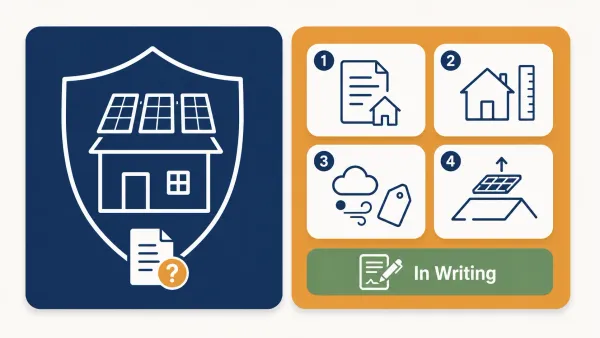
Pulling the published checklists together, failures tend to fall into four groups:
The code behind all of this is based on the National Electrical Code (NEC), but local governments adopt particular editions. Maitland's checklist, for example, references the 2017 NEC and the Florida Building Code. Your jurisdiction may be on a different edition, which is one reason an installer from another area can trip over local requirements. It is also a reason to ask any company who will actually be on your roof and how often they work in your town.
A failed inspection is not unusual and is not, by itself, a sign of a bad installer. What matters is what happens next.
Ask the installer directly how many of their recent jobs in your jurisdiction passed on the first visit. They may not track it, but how they answer is informative.
A homeowner who does not know an inspection happened cannot ask whether it passed. A homeowner who never sees the correction notice cannot tell a labeling fix from a grounding fix. And a contract that bills the final payment at "installation complete" rather than at a passed inspection means the installer may be paid in full before the building department has signed off.
Some contracts tie the last payment milestone to a passed final inspection or to permission to operate. Others do not. That is a term worth reading closely before signing, and worth raising with the installer if it is unclear. It belongs on your list of questions to ask before you sign a solar contract, along with who pays reinspection fees, which otherwise has a way of turning into one of the hidden costs that quotes skip.
An installed solar array can produce voltage whenever light hits the panels, even with your main breaker off. The inspector and the installer are trained and licensed for that environment; a homeowner is not expected to be.
During and after the inspection:
Your role is to keep a record: the permit number, the inspection results, the correction notice if there was one, and the final sign-off. Those papers matter if the installer later closes; our guide to what to check if your solar installer goes out of business explains why.
Typically the inverter installation, wiring methods, disconnects, grounding and bonding, required warning labels, and whether the installed equipment matches the approved plans. Local checklists vary, so your building department's version is the one that applies.
Published local checklists point to recurring items such as labeling, grounding and bonding, wiring details, and equipment that differs from the approved plans. Many are paperwork or detail issues that the installer can correct.
That depends on your contract. Correcting the installer's work is normally the installer's responsibility, but reinspection fees and delays should be addressed in writing before you sign.
Sometimes. Inspectors may need access to your electrical panel, garage or interior equipment. Ask the installer and your building department what access the inspector needs on the day.
Generally no. Most utilities require a passed local inspection before they grant permission to operate. Operating a grid-tied system without that approval can break your interconnection agreement, so wait for the utility's written go-ahead.
One email a week with new guides, tips, and solar news. Zero fluff, no sales pitch.