Solar UCC Filings and Liens: What Gets Recorded, and Where

United States only. Export-rate design and cancellation deadlines are set state by state and change; confirm both with your own utility and state before acting on anything below.
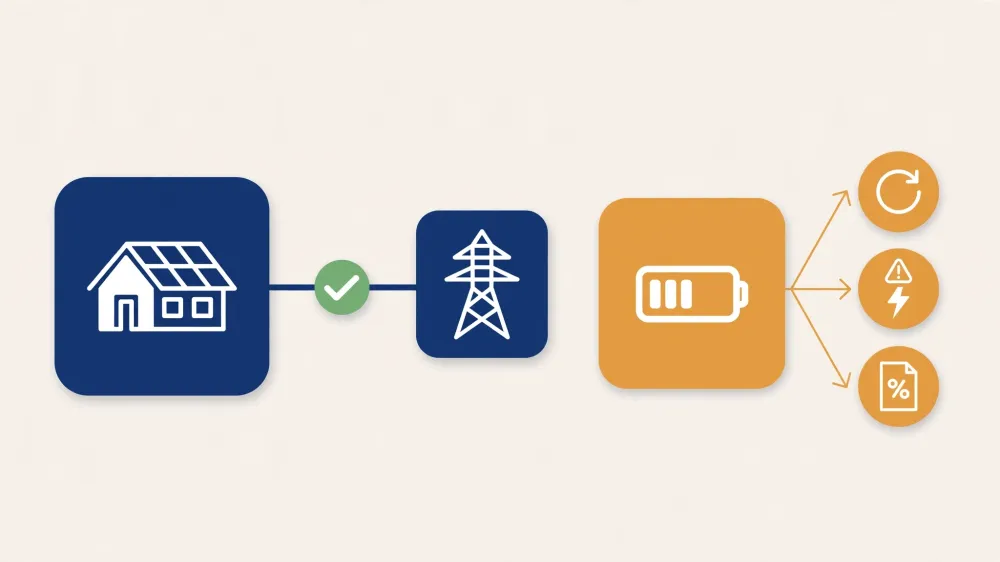
Do you need a battery with solar? No, not to make solar panels work. A standard grid-tied solar system uses the utility grid as its backup: panels feed the home during daylight hours, surplus power is sent out for a credit, and after dark the home draws power back from the grid instead of a battery. The hardware works and interconnects without one. Whether a battery is worth adding to your own home is a separate question, and it turns on three things: how your utility pays for the power you export, how often your area loses power, and who benefits from you not asking the question before you sign a contract.
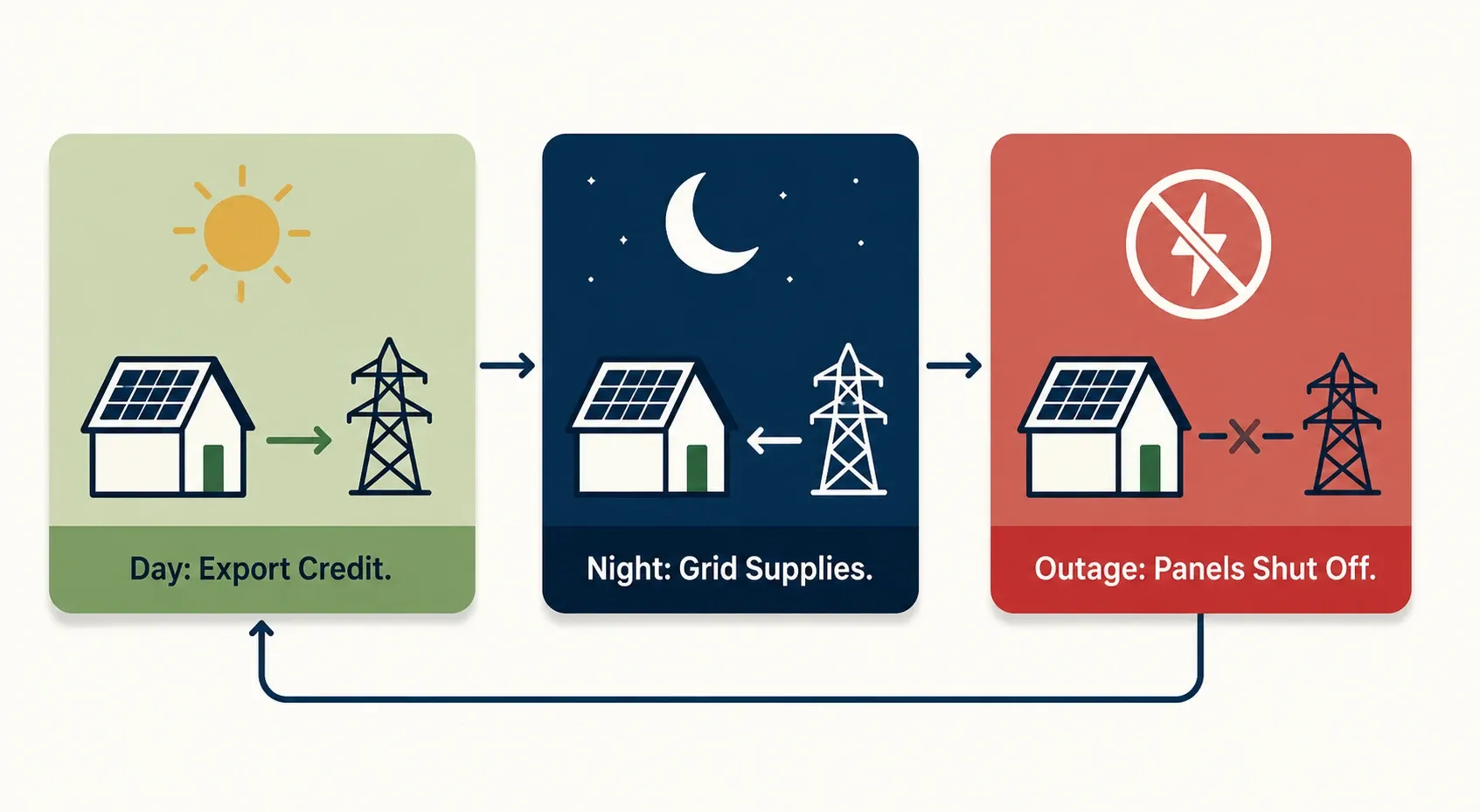
A grid-tied solar system is not built to be self-sufficient. It is built to offset what you would otherwise buy from the utility. During the day, panels typically produce more than the home is using at that moment, so the extra flows onto the grid and gets credited. At night, or on a cloudy day, the home pulls from the grid the same way it always did. No battery, no problem, for that part of the arrangement.
The one thing a battery-less, grid-tied system genuinely cannot do is keep the lights on during a blackout. For safety, inverters on grid-tied systems shut the panels down automatically when utility power goes out, so a lineworker repairing the grid is not exposed to power flowing back from a rooftop system. Without a battery, that shutdown means the panels stop producing the moment the grid does, sunny day or not. That is the one case where the answer leans firmly toward "yes, get a battery": if outages where you live are frequent or long, a battery-less system does nothing for you during exactly the hours you would want it most.
A few years ago, the financial case for a battery was easy to skip in most states. Many utilities credited exported solar close to the full retail rate, so there was little reason to store power at home instead of sending it out and buying it back later. That has been shifting, unevenly, state by state, as regulators redesign how utilities pay for exported power.
California is the case most often cited. Under the framework the California Public Utilities Commission now uses for the state's three large investor-owned utilities, exported solar is credited at an hourly export-credit value tied to the grid's need at that hour, rather than at a flat retail rate, according to the California Public Utilities Commission's net metering and net billing page (read 2026-09-18). That kind of rate design rewards storing midday solar in a battery and using it during the evening peak instead of exporting it for a lower credit. Other states still run closer to the older full-retail model, and some municipal utilities and rural cooperatives set their own rules outside any statewide policy entirely. None of this is settled or the same everywhere, and it changes. Confirm the current export rate and rate structure with your own utility or state public utilities commission before treating any general answer, including this one, as true for your bill.
In practice, a few signals tend to point toward pricing a battery seriously:
And a few signals point toward waiting:
A battery roughly doubles, or more, the size of a typical residential solar contract. That is a fact about the sale, not an argument against batteries, but it is a reason to treat the two decisions, panels and battery, separately instead of letting one carry the other by default. An installer proposing a bigger system with a battery attached is not necessarily wrong about your usage, but the incentive to round up sits on their side of the table regardless of whether the number is right, which is exactly why checking the installer's recommended system size against your own numbers is worth doing before you agree to anything. The starting point for that check is your own annual usage, not the installer's estimate of it. Pulling your actual annual kWh usage from twelve months of utility bills gives you a number to hold any proposal against, battery included or not, and it takes less time than the sales appointment did.
If outages or export rates push you toward a battery, the next decision is how much of the house it backs up, and this is where the safety stakes get real. A battery sized for "essential loads," meaning a defined, limited circuit list such as a refrigerator, some lighting and a few outlets, is not the same product as a battery sized to run the whole panel. Connecting more load than the battery and its backup circuits were designed for can overload the backup system rather than protect the home during an outage, which defeats the reason it was installed.
This is not a homeowner-level judgment call, and it should not be made by a sales rep working from a brochure. Panel and backup-system sizing is done by a licensed electrician, who accounts for the home's actual electrical panel, its circuit loads and local code before deciding what the battery can safely carry. If a battery is part of your plan, ask specifically which circuits it will back up and get that sizing in writing from the electrician of record on the job, before installation, not after the outage that tests it.
Home solar sales, particularly door-to-door and in-home presentations, are exactly the kind of transaction the federal Cooling-Off Rule was written for. Under the FTC's Cooling-Off Rule (read 2026-09-18), a sale made at your home or at a temporary location away from the seller's regular place of business gives you three business days to cancel and receive a full refund, for purchases of $25 or more, and the seller is required to provide the cancellation form at the time of sale. That is a federal floor, not a ceiling. Some states set a longer right-of-rescission period for home-improvement or solar contracts specifically, so confirming exactly how many days your own state gives you, and how the contract itself states the deadline and method, matters more than assuming the federal three days is all you have.
Before that deadline closes on any contract that bundles a battery in with the panels, it is worth working through a short list of questions to ask the installer about the battery specifically: what it backs up, who sizes it, what it costs as a separate line item, and what happens to the price and the proposal if you decline the battery and keep the panels only. An installer who cannot answer that last question cleanly is telling you something about how the two products were bundled.
A battery is not required for solar panels to work, to offset a portion of the bill, or to interconnect with the grid. It becomes worth discussing seriously when outages where you live are frequent, when your utility's export-rate design makes storing your own midday power more valuable than exporting it, or when whole-home backup matters enough to you to have an electrician size it properly. None of those are a default yes. Get the export rate from your own utility, get the backup sizing from a licensed electrician, and treat the battery as a decision made on its own numbers, not as a package deal accepted because it arrived bundled with the panels.
Yes. A grid-tied solar system sends surplus power to the grid and draws power back from the grid when panels are not producing enough. The grid does the job a battery would otherwise do, except during a power outage.
No. Grid-tied inverters shut off automatically when utility power goes out, for the safety of utility line workers repairing the grid, so panels without a battery stop producing during an outage regardless of sunlight.
Not always. Payback depends on your utility's export-rate structure, your electricity price, and how the battery is sized and used, none of which a general claim can answer for a specific bill. Confirm the current export rate with your own utility before treating any payback figure as settled for your home.
No. No state or utility requires a battery to interconnect a solar system. Some utilities' export-rate designs make a battery more financially attractive than it used to be, but that is different from a requirement.
A licensed electrician sizes the panel and backup circuits based on the home's actual electrical panel and the loads the owner wants covered during an outage, not the homeowner and not the sales team.
One email a week with new guides, tips, and solar news. Zero fluff, no sales pitch.