Do I Need a Battery With Solar? The Real Trade-Off

United States only. Sources checked on August 23 and 24, 2026. Permitting, interconnection and disclosure rules are set by your state, your local authority and your utility, so confirm the steps that apply where you live.
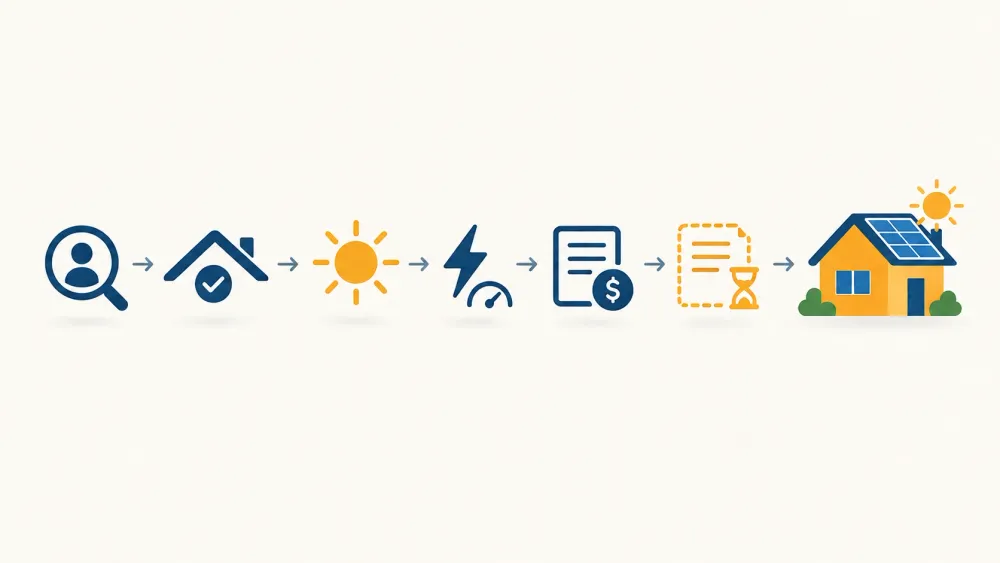
Buying home solar in the United States is a sequence of about eight stages, and the US Department of Energy's own consumer guide compresses them into six: choose an installer, confirm the roof can take the array, work out your solar potential, work out how much electricity you actually use, decide how you are paying, then let the installer obtain permits and arrange inspections. The part that guide states plainly and most sales conversations do not is that the last stage is not yours to hurry: the DOE notes that permits and inspections "can take weeks to months" depending on local regulations. This page walks the same sequence, but organized around the two things that decide whether you get a good outcome: who controls the clock at each stage, and which document you should be holding when it ends.
This is general information about a process. It is not advice to buy, lease or finance solar, and it contains no recommendation about whether solar suits your home. That question comes first, and it is a separate one.
Stage 1. Establish your own usage. The DOE guide is direct about this: "Reviewing your previous electricity bills can help you figure out how much power you need annually and seasonally." Twelve months of bills, with the kilowatt-hours and the rate schedule, is the input to every number anyone will later quote you. Collect it before the first conversation, because a proposal built on an installer's estimate of your usage is a proposal you cannot check.
Stage 2. Establish whether the site works. The DOE guide states that "your home's solar rooftop potential depends on your geographic location, the position of your home in relation to the sun, how much shade you have, and the PV system you and your installer choose," and that "a solar installer, roofing expert, or structural engineer can help you determine your roof's solar suitability." The National Renewable Energy Laboratory's PVWatts tool exists to produce an independent production estimate for an address, and running it yourself before anyone models your roof gives you a reference point you did not buy.
Neither stage commits you to anything, and both are reversible at zero cost. That is not true of most of what follows, which is the reason to do them properly. If you have not yet settled the prior question of whether the economics work for your household at all, whether solar panels are still worth it in the US in 2026 is the page to read before this one.
The DOE's step-by-step guide says to "start by researching qualified, insured installers online or ask for recommendations from people who have gone solar," and to "comparison-shop by asking multiple installers to come assess your roof." Its homeowner's guide adds that "the best way to install solar is through a qualified professional who holds a certification to do so and works with high-quality solar panels," and names the industry-standard certification as the one "awarded through the North American Board of Certified Energy Practitioners (NABCEP)."
Two practical notes on top of that. A certification tells you something about an individual's credential, not about the company's finances or its ability to honor a workmanship warranty in a decade. And the clock at this stage is entirely yours: nothing about a site assessment obliges you to proceed, and any pressure applied at this stage is information about the seller.
You will receive documents in different formats, with different system sizes, different assumptions and different definitions of "price." Comparing them is the single highest-leverage hour in the whole process, and the work is normalization rather than price-hunting: make the scope identical, make the size unit identical, make the price basis identical, and make the production and rate assumptions identical, and only then look at what each one costs. Cost per watt, the number that compares two quotes covers the arithmetic that normalizes for system size, which is the step most people skip.
One structural item belongs here. California requires a standardized document, and any homeowner in any state can ask for the same fields. The California Public Utilities Commission's page on its Solar Consumer Protection Guide, read on August 24, 2026, describes the Contractors State License Board's Solar Energy System Disclosure Document as a mandatory form showing "the total costs for the solar energy system" together with "supporting information that summarizes your financial obligations and provides a standardized bill savings estimate, among other things." If you are outside California, asking a salesperson for a one-page statement of total cost, total financial obligation and the assumptions behind the savings estimate is a reasonable request, and the response tells you a great deal.
The DOE guide sets out the four routes: buying with cash, a loan, a lease, or a power purchase agreement, and it notes that "a purchased solar system can be installed at a lower total cost." Those four routes have genuinely different consequences for ownership, for what happens when you sell, and for who holds the equipment warranty.
The mistake to avoid is letting the payment method be chosen by whoever is selling the hardware, in the same meeting, on the same form. Cash, loan, lease or PPA: how to pay for solar covers the four in full, and how a dealer fee is hidden inside a financed solar quote covers the cost that most often moves between the two decisions without being named.
This is the stage where the process stops being a shopping exercise. What you sign is a contract for a long-lived improvement to your home, and in the case of a lease or a power purchase agreement it can run for twenty years or more.
Before you sign, know what your state requires the seller to give you. California is again the clearest published example: the CPUC page states that solar providers submitting residential interconnection applications in the service areas of Pacific Gas and Electric, Southern California Edison and San Diego Gas and Electric "are required to collect customer initials and a signature on the California Solar Consumer Protection Guide," that "customers must be given time to read the Guide thoroughly before signing," and that Version 4 of the guide was published in 2025. A requirement that you be given time to read something is a requirement worth exercising.
Cancellation rights after signature exist in most states, they are time-limited, and they are set by state law rather than by the contract. Ask what yours are, in writing, before the meeting ends rather than after.
The DOE guide's instruction here is to "give your installer the information they need to obtain the permits and arrange the inspections that your local government requires," and it notes the timeline can run to months. This stage involves at least three parties who do not work for you: the permitting authority, the electrical inspector, and the utility.
The useful thing to establish in advance is not the timeline, which nobody controls, but the responsibility. Ask who submits the permit, who schedules the inspection, who pays if a re-inspection is needed, and what happens to your payment schedule if any of it takes longer than the contract assumed.
Panels on a roof are not a working system. The utility has to approve the connection and give permission to operate, and until it does, in most jurisdictions you may not legally run the system. This stage has its own fees and its own recurring charges, and they are set in a tariff rather than by your installer: utility interconnection fees and solar-specific charges covers the five categories to check and where each one is published.
The interconnection date also matters long after the install, because in some states it is the date that starts a legacy tariff clock. Whatever state you are in, write that date down and keep it with the system paperwork, and confirm with your own utility what it governs on your account.
It will not tell you whether to buy. It will not give you a payback period, a system cost, or a savings figure, because those depend on your usage, your rate, your roof and your state, and a number invented for an article is worse than no number. It also will not tell you which installer to use. What it can do is make sure you know, at every stage, who is holding the clock and what document you should have in hand when that stage ends. The costs that fall between the stages are the ones that surprise people, and the costs a solar quote leaves out is the companion to this page.
How long does the whole process take? There is no reliable national figure, and this page does not print one. The DOE's consumer guide says permits and inspections alone "can take weeks to months" depending on local regulations, and interconnection approval is a separate wait after that. Ask your installer for their recent actual timelines in your specific jurisdiction, not an average.
Do I need a NABCEP-certified installer? The DOE's homeowner's guide names NABCEP as the industry-standard certification and recommends a qualified professional who holds one. It is a credential held by individuals, so ask who on the crew holds it and what role they play on your job, and treat it as one input alongside licensing, insurance and how long the company has traded.
Can I install solar myself? A grid-tied system requires permitting, inspection and utility interconnection approval, and the electrical work is subject to local code. This site does not publish DC wiring or roof-access instructions of any kind. Treat it as licensed work.
What is permission to operate? The utility's approval to energize your system and connect it to the grid. It comes after installation and inspection, not before, and until it is granted the system generally cannot be run. It is also the date that starts a legacy tariff clock in some states, so keep a copy.
Should I wait for prices to fall? This page will not answer that, because it would be a prediction about equipment pricing, interest rates and state policy that nobody can make honestly. What is checkable is whether any specific dated deadline applies where you live, such as a state incentive with a stated end date, and that is a question for your state energy office or revenue department.
One email a week with new guides, tips, and solar news. Zero fluff, no sales pitch.