Will Your Solar Installer Still Exist? Checks You Can Run

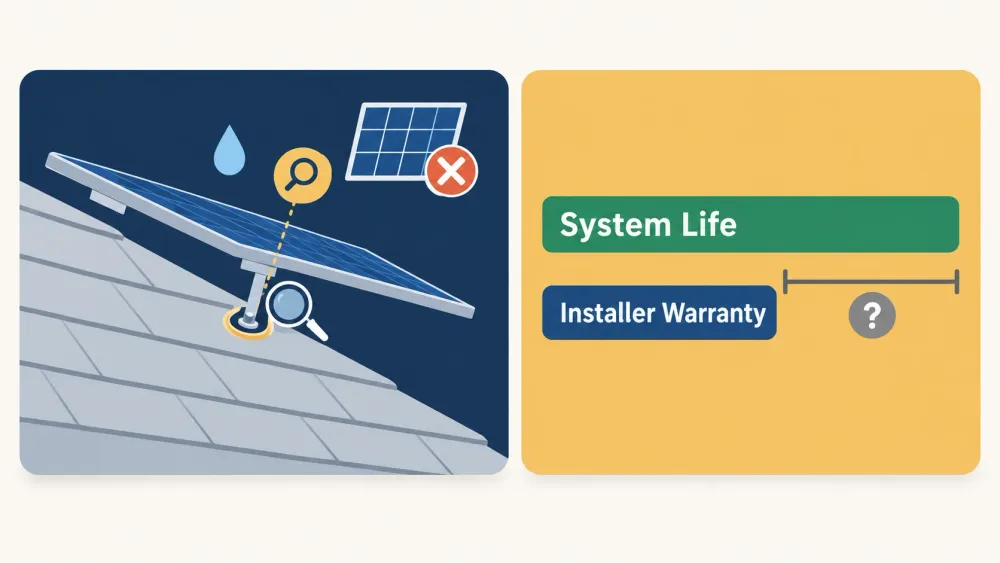
A solar panel roof leak almost never comes from the panels. It comes from the places where the racking is fastened through your roof, because every attachment is a hole that has to be sealed and flashed correctly. Done well, those attachments can stay watertight for years. Done badly, they leak, sometimes only after a few seasons. The bigger risk for a homeowner is often not the leak itself but the paperwork: the installer's warranty on those holes is usually much shorter than the life of the system, and the roof may have its own warranty conditions. Settle who covers a leak, and for how long, before anyone drills.
This is general information for US homeowners. Roof and solar work is done at height and is for licensed, insured contractors. Nothing here is a reason to go on your roof.
A rooftop array sits on rails, and the rails sit on mounts. On most pitched roofs, those mounts are fastened through the roof covering into the roof structure below, and each one is sealed and covered by flashing designed to shed water around it. The panels themselves sit above the roof surface.
So the leak points are the attachments, and sometimes the places where wiring or conduit passes through the roof. A typical array has many of them, which is why the number and placement of attachments is worth seeing on the plans.
Common reasons an attachment leaks, as installers and roofers describe them:
Notice that most of these are workmanship, not equipment. That is why the installer's workmanship warranty, not the panel warranty, is usually where a leak claim goes.
The Federal Trade Commission's consumer guide Solar Power for Your Home (dated April 2022, read October 2, 2026) tells homeowners to compare detailed written bids that include "what warranties apply to the equipment (like the panels and inverters...) and the installation workmanship." For leaks, that second half is the one that matters.
A home solar system can involve several separate promises. They cover different things:
| Warranty or cover | Usually from | Covers a leak at a mount? |
|---|---|---|
| Panel product and performance warranty | Panel manufacturer | No. It covers the panel, not your roof. |
| Inverter warranty | Inverter manufacturer | No. |
| Workmanship warranty, sometimes with a specific roof penetration or leak warranty | The installer | This is usually the one, if the contract says so. |
| Your existing roof warranty | Your roofer and the roofing manufacturer | Possibly, but adding attachments may affect its terms. Ask before install. |
| Homeowners insurance | Your insurer | Depends on your policy and on the cause of the damage. Ask your insurer. |
The gap most homeowners do not see: the installer's workmanship or leak warranty is often much shorter than the time the panels will sit on your roof. Once it runs out, a leak at a mount may be nobody's warranty item. The panels may still be under their long product warranty while the holes holding them in place are not.
Two more gaps are worth naming:
This is the part of the process where a homeowner has real leverage, because nothing has been installed. Ask for these in writing, as part of the contract or attached to it:
Bring these into your questions to ask before you sign a solar contract, and line up warranty terms when you compare solar quotes. A longer, specific leak warranty from one installer and a vague "we stand behind our work" from another is a real difference between two bids, even when the price looks similar.
A short, vaguely worded leak warranty costs the installer almost nothing at the point of sale, because most homeowners never ask about it. The panel warranty is the long, impressive number in the presentation. The workmanship warranty, which is the one that would pay for a leak, is often in the contract's fine print.
If a leak appears after the workmanship warranty has ended, repair means lifting the affected panels, fixing the roof under them and putting the array back, which brings its own costs and scheduling. That is the same removal and reinstall process you would face for any later roof work, and it is one more reason to treat the leak warranty as part of the price you are comparing.
Leaks under an array are hard to see from outside because the panels cover the attachments. Signs inside the house are usually the first clue:
If you see any of these:
If the installer does not answer or disputes the claim, you still have routes. The FTC's guide tells homeowners to check a company's history "with your state and local consumer protection agencies and your state contractors licensing board." Those same offices are a reasonable place to ask how to raise a complaint about an installer. Your contract may also name a dispute process. Rules and remedies vary by state, so check with your state's consumer protection office or an attorney before you act.
Hiring a different roofer or solar company to fix the attachment may affect what the original installer still covers. Ask in writing before you do it, and get the new contractor's own warranty on their repair.
Finding and fixing a leak under a solar array involves working at height on a pitched roof and handling equipment that produces voltage whenever light hits it. That combination is for a licensed, insured solar contractor or a roofer working with one. A homeowner's role is to watch for signs inside, document them, and make the call. Do not climb onto the roof, walk on panels, or disconnect anything to "look."
The panels themselves usually do not. A solar panel roof leak normally starts at a mounting attachment or a roof penetration for wiring. Well-flashed attachments installed into the roof structure are less likely to leak than ones that rely on sealant alone.
Usually the installer, under its workmanship or leak warranty, if the leak is at their work and the warranty is still in force. Check the length and scope of that warranty in your contract. Panel manufacturer warranties do not cover roof leaks.
It can affect it, depending on the roof warranty's terms. Ask your roofer or roofing manufacturer before installation, and ask the installer whether they take responsibility for the area around their attachments.
It varies by installer and is often much shorter than the panel warranty. Read the exact number of years in your contract and whether it covers interior damage as well as the repair.
Sometimes a crew can reach an attachment by lifting one or two panels, but often the affected panels have to come off. That is work for the installer or a contractor qualified for both roofing and solar.
One email a week with new guides, tips, and solar news. Zero fluff, no sales pitch.