Do I Need a Battery With Solar? The Real Trade-Off

United States only. Sources checked on August 23 and 24, 2026. This page contains no market prices, no savings figures and no example dollar amounts, by design.
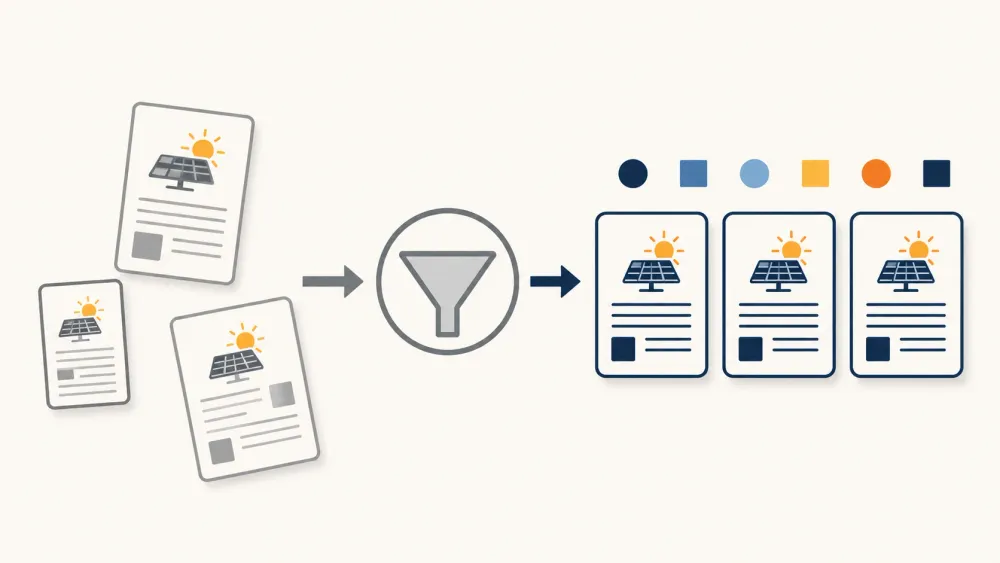
Three solar proposals for the same house will not be comparable when they arrive, and the reason is not price. They will propose different system sizes, quote different definitions of "total cost," assume different amounts of electricity production, and project savings from different assumptions about future electricity rates. The work is normalization: making six things identical across all three proposals before you compare a single number. Compare the prices first and you will pick a winner chosen by whichever installer made the most optimistic assumptions, which is exactly backwards.
This page teaches a method. It contains no prices, no averages and no worked example with invented dollars, because a number invented for an article is not evidence about your quotes. Fill the tables below with figures from your own three proposals.
An installer's proposal is a modeling document. Behind the headline number sit choices: how much of your usage the system is sized to cover, what production the model predicts for your roof, how fast the model assumes your utility rate will rise, how quickly it assumes the panels degrade, and whether the price shown is before or after anything is subtracted.
Change any one of those assumptions and the headline savings number moves substantially, with no change to the hardware and no change to the price. That is why the three proposals in front of you can disagree wildly while all being internally consistent. None of them has to be dishonest for the comparison to be meaningless.
Do these in order. Each one is cheap, and each one makes the next one possible.
Write down, for each proposal, exactly what is inside the price. Panels and inverter, obviously, but also: mounting and racking, electrical work, a main panel upgrade if one is required, roof repair or reinforcement, removal of an old system, permitting fees, interconnection fees, monitoring hardware, a battery, and any trenching or conduit work.
If one proposal includes a main panel upgrade and another does not, the two prices are not describing the same job. Ask each installer, in writing, whether their price includes the items the others listed. This step alone resolves a surprising share of price gaps, and it is where the costs a solar quote leaves out usually hide.
System size can be stated in DC watts, in AC watts, or implied by a panel count and a panel wattage. These are not interchangeable. Convert all three to the same unit, and use the nameplate DC rating unless you have a reason not to, because that is the unit the per-watt arithmetic assumes. Cost per watt, the number that compares two quotes covers the formula and, importantly, what belongs on each side of it.
For each proposal establish two things: whether the number shown is the gross price or a price with an incentive already subtracted, and whether it is a cash price or a financed price.
These are the two most common apples-to-oranges failures. A financed quote can carry a dealer fee inside the stated system price, which raises the real cost before any interest is counted, and comparing that against a cash price from a different installer is not a comparison at all. How a dealer fee is hidden inside a financed solar quote explains the mechanism. Ask each installer for the cash price of the same system, even if you intend to finance, purely so you have a common basis.
Every proposal contains an estimated annual production figure in kilowatt-hours. It comes from a model of your roof, and models differ.
The check available to you costs nothing: the National Renewable Energy Laboratory publishes PVWatts, a public tool that estimates production for a grid-connected system at a given address, and the US Department of Energy's own homeowner guidance points consumers to it. Run your address, with the system size from each proposal, and see which proposals' production estimates sit near an independent model and which sit well above it. You are not looking to prove any of them wrong. You are looking for the one that is optimistic, because an optimistic production estimate inflates every savings figure downstream of it.
This is where the largest divergence usually lives, and it is almost never on the front page. For each proposal, find and write down: the assumed annual utility rate escalation, the assumed annual panel degradation rate, the assumed system life used in any lifetime savings figure, and, for a lease or power purchase agreement, the payment escalator.
The escalator is the one that catches people, because a payment that rises every year can outrun the utility rate it was supposed to beat. What a PPA escalator clause does to your bill covers that mechanism in detail. If you cannot find the assumed rate escalation in a proposal, ask for it in writing. An installer who will not state the assumption behind their savings projection has told you something useful.
California requires this kind of disclosure in a standard form, which is a useful benchmark even if you live elsewhere. The California Public Utilities Commission's page on its Solar Consumer Protection Guide, read on August 24, 2026, describes the Contractors State License Board's mandatory Solar Energy System Disclosure Document as showing "the total costs for the solar energy system" along with "supporting information that summarizes your financial obligations and provides a standardized bill savings estimate, among other things." The same page states that in the PG&E, SCE and SDG&E service areas, providers "are required to collect customer initials and a signature" on the CPUC's guide, and that customers "must be given time to read the Guide thoroughly before signing." That is a California requirement and it does not bind an installer in another state, but anywhere in the country, asking for those same fields on one page is a fair request.
Only now is it worth looking at what you are actually signing up for. For each proposal, record the equipment warranty term, the workmanship warranty term, the inverter warranty term, whether a production guarantee exists and what it pays if production falls short, who honors each warranty if the installer stops trading, and what happens to the agreement if you sell the house.
A price advantage that comes with a shorter workmanship warranty is not a price advantage. It is a transfer of risk to you, priced at whatever the difference is.
Build this before you compare anything. Fill every cell from the proposals themselves rather than from a conversation, and leave a cell blank rather than guessing, because a blank cell is a question to ask.
| Field | Quote A | Quote B | Quote C |
|---|---|---|---|
| System size, DC watts | |||
| Panel make and model, count | |||
| Inverter make, model, type | |||
| Battery included, capacity | |||
| Everything included in the price (list) | |||
| Main panel upgrade included | |||
| Permitting and interconnection fees included | |||
| Price shown: gross or net of an incentive | |||
| Cash price for this system | |||
| Financed price, and any dealer fee | |||
| Cost per watt, from the cash price | |||
| Estimated annual production, kWh | |||
| Independent model's estimate for the same size | |||
| Assumed annual utility rate escalation | |||
| Assumed annual degradation | |||
| Lease or PPA escalator, if any | |||
| Equipment warranty term | |||
| Inverter warranty term | |||
| Workmanship warranty term | |||
| Production guarantee, and what it pays | |||
| What happens if you sell the house | |||
| Cancellation rights and the deadline |
If two proposals cannot be made to fill the same rows, that is the finding. The proposal that resists normalization is the one to ask more questions about.
Four of the rows above are outside any installer's control, and taking their word for them is how a comparison goes wrong at the last step.
The incentive line. Whether a state credit, rebate or exemption applies to you is set by your state's statute or revenue department, not by the proposal that assumes it. Verify each claimed incentive at its source before you let it move a price.
The interconnection and recurring charge lines. What your utility charges to connect the system, and what it charges solar customers every month afterward, is in a tariff approved by your state commission. Ask your utility, by name of document, rather than accepting a figure in a sales proposal.
The cancellation line. Your right to cancel after signature, and how long you have, is set by state law. Ask your state consumer protection office or attorney general's office what applies where you live, and get the deadline in writing before you sign anything.
It does not tell you which quote to accept. It does not print a national cost per watt, a typical system price, or a savings figure, because those depend on your state, your utility, your roof and the quarter you are reading in, and this site does not print numbers it cannot source and date. It does not rank installers, and it does not tell you to buy, lease or finance.
What it does is remove the advantage that goes to whichever proposal was modeled most optimistically. Once all three sheets are filled on the same basis, the comparison is yours to make with your own numbers, and the wider sequence this fits into is set out in how to buy home solar in the US.
Is the cheapest quote usually the worst one? This page will not make that claim, because it is not a checkable fact about your three proposals. What is checkable is whether the cheapest quote has the same scope, the same size, the same warranty terms and the same production assumption as the others. Normalize first, then judge.
How many quotes should I get? The US Department of Energy's consumer guide advises comparison shopping by asking multiple installers to assess your roof. It does not name a number, and neither will we. Three is enough to reveal disagreement between models, which is the thing you are trying to see.
What if the production estimates disagree a lot? Ask each installer what model they used and what shading assumptions went into it, and compare all of them against an independent estimate such as NREL's PVWatts run on your own address. A large gap is not proof of bad faith, but it is a question that deserves a specific answer rather than reassurance.
Should I compare monthly payment instead of total price? Monthly payment is the number a seller can most easily shape, by changing the term, the escalator or the fee structure. Compare it if you like, but never instead of total cost, total obligation over the full term, and the assumptions behind the savings that payment is supposed to beat.
Can I ask an installer for the California disclosure document if I do not live in California? You can ask any installer for a one-page statement of total system cost, your total financial obligation, and the assumptions behind their savings estimate. They are not obliged to use California's form outside California, and the answer to the request is itself informative.
CUSTOMER INPUT NEEDED: Two things. First, a named author or reviewer, since this page guides a five-figure purchase decision. Second, this page would be considerably stronger with a real, anonymized example: if you can supply three actual proposals for the same house with the names and addresses removed, we will build the filled comparison sheet from them. We will not invent one, which is why the table above is blank.
One email a week with new guides, tips, and solar news. Zero fluff, no sales pitch.