Solar Warranty Claim Process: Step by Step (US)

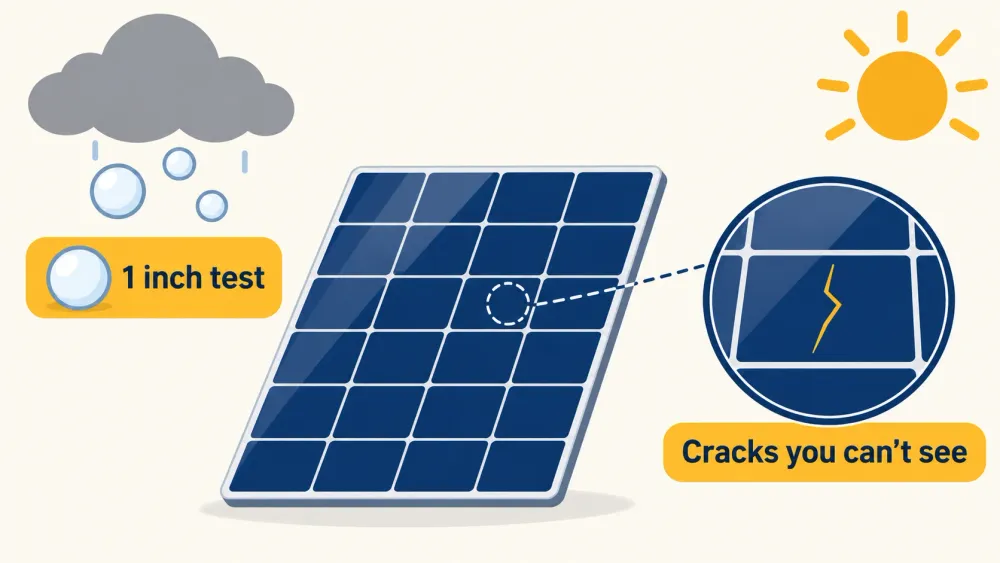
With solar panels, hail damage is a real but limited risk: the Department of Energy's federal energy program says panels have historically survived most of the hail events they have faced. But "hail rated" means less than it sounds. The basic certification test fires 1 inch ice balls at a panel, and the same program says that level is not enough where hail is severe. It also says hail can crack cells without breaking the glass, so a panel that looks fine from the street may still be damaged. After a storm, the safe sequence is to look from the ground, call your installer for an inspection, and check your homeowners policy, because the panel warranty we read excludes hail.
Written for US homeowners with a grid-tied rooftop system. Sources checked November 12, 2026. Nothing here asks you onto a roof or near wiring; inspection and any electrical work belong with your installer or a licensed electrician.
Panel certification for hail comes from the international module standard IEC 61215. The Federal Energy Management Program, the Department of Energy office that advises federal sites on their own solar systems, explains the minimum in its page on hail damage mitigation for PV systems. To be "hail certified," a module must be "visually undamaged and lose less than 5% of power from 11 ice-ball strikes at 51 mph of 25 mm diameter (1") hail."
The standard also lists larger optional tests. FEMP's table sets them out:
| Ice ball diameter | Ice ball mass | Velocity |
|---|---|---|
| 25 mm (required minimum) | 7.54 g | 23 m/s |
| 35 mm | 20.7 g | 27.2 m/s |
| 45 mm | 43.9 g | 30.7 m/s |
| 55 mm | 80.2 g | 33.9 m/s |
| 65 mm | 132 g | 36.7 m/s |
| 76 mm | 203 g | 39.5 m/s |
Three points from the same FEMP page change how a homeowner should read a spec sheet:
FEMP also states that "In severe or very severe hail-prone areas, IEC 61215 10.17 Hail test basic hail certification is not sufficient," and points to tougher tests run by testing labs, including hail sequences using 50 mm balls. FEMP writes for federal facility managers, so its design advice is aimed at large systems, but the test description applies to the same certification printed on residential panels.
We checked how three makers present hail and load ratings in their own installation manuals:
Our reading: a manual or spec sheet that says only "IEC 61215" tells you the panel passed the basic hail test, which FEMP says typically means the 25 mm minimum, nothing more. If a larger size is printed, it is the maker's statement about the tested design. If none is printed, ask the installer or the panel maker for the test report. FEMP advises federal buyers to request proof of a hail test above the minimum from the module manufacturer. For where hail and load ratings sit on a datasheet, see our guide to the mechanical block on a solar panel spec sheet.
The most useful thing in FEMP's page for an owner is not about big hail. It is this: "Hail can cause invisible damage through solar cell cracking at hail diameters and speeds less than that which would break the glass."
FEMP describes this hidden damage as "microcracks that aren't initially detrimental but can spread over time, decreasing production and increasing hot spot and fire risk." Its after-storm advice for federal systems is an infrared, ultraviolet or electroluminescence scan "within one month of the event," and it notes that "EL imaging may be necessary to detect microcracks."
Our reading for a homeowner: intact glass is not proof of an undamaged array. If a storm was large enough to dent cars, gutters or siding near you, ask your installer whether they can arrange imaging, not only a visual look. And keep watching your production data in the months that follow, because a slow decline is one of the ways hidden cracking can show up.
The panel makers' own language sets the boundary here. Qcells' manual says inspections "have to be performed especially after extraordinary events (e.g. storm, hail, high snow loads etc.)" and that "The PV system has to be inspected regularly by certified personnel." Its faults section is blunter: "Do not attempt to fix any problems yourself (e.g., glass cracks, damaged cables)."
A sequence that stays on the ground:
The Qcells limited warranty we read, for its Q.PEAK DUO G9 to G11 panels sold in North America (issued February 1, 2021, read from a distributor-hosted copy), excludes "damage caused by acts of nature or acts of God, including, but not limited to, lightning, hail, frost, snow, storms" among other events. That is one maker's document, and your own panel warranty may be worded differently. Where a warranty excludes storm damage, the next place to look is your homeowners policy.
Insurance has its own terms, including how deductibles apply to storm damage. We cover those in our guide to homeowners insurance and solar panels. If the installer and the panel maker each say the other is responsible, our walk-through of making a solar warranty or workmanship claim explains how to put it in writing.
Snow is a load problem more than an impact problem, and panel manuals express it as a pressure in pascals. Two numbers usually appear:
The Qcells Q.TRON manual we read lists a maximum test load of 8,100 Pa and a maximum design load of 5,400 Pa for pushing loads such as snow, "depending on mounting options." In other words, the rating belongs to the panel as mounted, not to the panel alone. Converting pascals into a depth of snow depends on how dense the snow is, so we do not give a depth figure here. Whether your roof and racking suit your local snow load is a question for the installer's structural design and your local building department.
On clearing, the makers differ. Canadian Solar's maintenance section lists snow among the things regular maintenance should keep off the modules, and says snow "should be removed using a soft brush." Qcells says to remove snow and ice "carefully without force (e.g. with a very soft broom)." REC's cleaning guide notes that "clearing snow build-up from the panels is not essential for maximum performance," because snowfall generally comes at times of year when sunlight is at its lowest. Qcells adds one exception that matters: "Unbalanced loads (e.g. snow overhangs, snowdrifts) which result in locally significantly increased loads must be removed or avoided by technical measures." That is a design and service question for your installer, not a reason to go up on a snowy roof. For what normal winter output looks like with snow cover, see solar production in winter versus summer.
They are tested for it. The required IEC 61215 test uses 25 mm (1 inch) ice balls at 23 m/s, and DOE's federal energy program says that basic certification is not sufficient in severe hail-prone areas. Some makers test to larger sizes and print it; REC's manual lists 35 mm for three of its series.
Yes, according to DOE's Federal Energy Management Program, which says hail can crack cells "at hail diameters and speeds less than that which would break the glass." Finding those cracks may need electroluminescence imaging.
In the Qcells warranty we read, no: hail is listed among excluded "acts of nature or acts of God." Check your own panel warranty, and treat storm damage as a likely homeowners insurance matter.
No. Look from the ground, photograph what you can see, and have your installer inspect. Qcells' manual tells owners not to fix problems such as glass cracks or damaged cables themselves.
FEMP points to NOAA's Storm Prediction Center reports and FEMA's National Risk Index, and cautions that county ratings reflect past storms, so neighboring counties are worth checking too.
One email a week with new guides, tips, and solar news. Zero fluff, no sales pitch.