Solar Panels Hail Damage: Ratings and Storm Checks

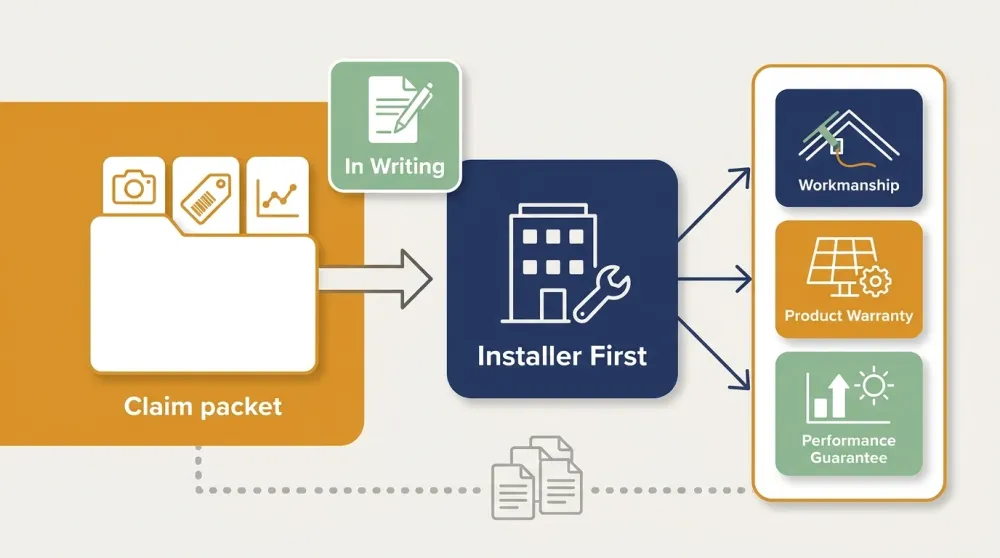
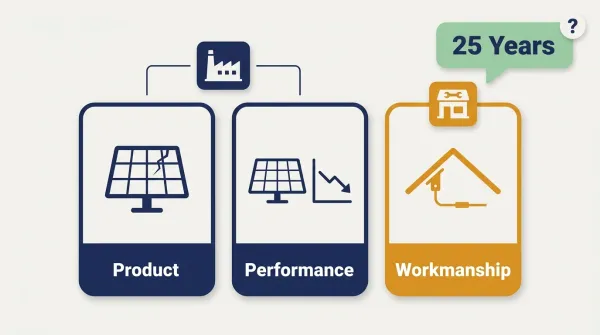
The solar warranty claim process starts with one question: which of your three warranties covers this. Workmanship, from the company that installed the system, covers how the work was done. Product warranties, from each manufacturer, cover the hardware itself. A performance or production guarantee, where one exists, covers how much the system generates. In almost every case you contact the installer first, in writing, with photographs, serial numbers, and your production record attached, because they diagnose the fault and route it to the right party. Keep the paper trail from the first message.
Written for US homeowners with a grid-tied rooftop system. This page describes a claims process in general terms, is not legal advice, and does not tell you whether your own contract covers anything. Your contract and warranty documents decide that, and nothing here involves going on a roof or opening equipment.
The single most common reason a claim stalls is that it was sent to the wrong party, so start here.
| Warranty | Who issues it | What it typically covers |
|---|---|---|
| Workmanship | The installation company | How the system was fitted: mounting, wiring runs, sealing and penetrations, compliance with the permitted design |
| Product | Each equipment manufacturer | A defect in the hardware itself, per that manufacturer's own written terms |
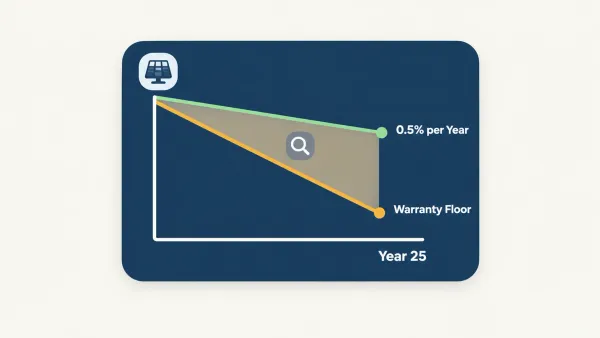
| Performance or production | Varies: the manufacturer for panel output, the installer or financier for system output | Output falling below a stated level, where the contract states one |
Terms, lengths, and exclusions differ for every one of them, and they are set by the document you were given rather than by anything a salesperson said. The Federal Trade Commission's consumer guidance on solar power for your home tells buyers to establish up front "what warranties apply to the equipment (like the panels and inverters) and the installation workmanship," which is exactly the information a claim needs and exactly what most homeowners go looking for only once something has gone wrong.
1. Describe the problem in measurable terms. "Production looks low" is weak. "Production for the last twelve months was X kWh against an estimated annual figure of Y kWh in the signed proposal, with the gap present in a second consecutive year" is a claim. The Department of Energy's homeowner's guide to going solar describes the modeled, site-specific production estimate as the basis homeowners should hold a system to, and that estimate is the figure your claim compares against.
2. Assemble the file before you contact anyone. Your signed contract and every warranty document. The commissioning date, because warranty periods run from it rather than from the day the panels were bolted down. Equipment serial numbers, which are usually on the proposal or the permit paperwork. Dated photographs of anything visible from the ground. An export or screenshot of the monitoring record covering the relevant period.
3. Contact the installer first, in writing. Even when you believe a manufacturer's hardware is at fault, the installer is normally the first stop: they hold the commissioning records, they can determine whether the cause is installation or equipment, and most manufacturer processes expect a qualified party to make that call. Email creates a dated record. A phone call does not, so follow every call with a short email summarizing what was said.
4. Ask for the classification in writing. You want a sentence that says whether this is being treated as a workmanship issue, an equipment defect, or neither, and who is handling it from here. That one sentence is what prevents a claim from circling between two companies for months.
5. Record every response and every silence. Dates, names, what was promised, what date the next step was promised for. If the matter later goes to a state agency or an attorney, this log is the case.
6. Expect a site visit before a resolution. Diagnosis of the system itself is work for the installer or a qualified service company. Do not go up to look, do not open equipment, and do not attempt a reset you read about online. Where the work touches wiring it legally requires a licensed electrician in every state, and self-help can also void the coverage you are trying to claim.
This is the part of the picture that service blogs leave out, and it is worth knowing before a company tells you its own rules are the only rules.
Written warranties on consumer products are governed federally by the Magnuson-Moss Warranty Act. The FTC's businessperson's guide to federal warranty law sets out the parts that matter to you as the person holding the warranty. A warranty must be labeled, and the labels mean something specific: "'Full Warranty' means the coverage meets the federal minimum standards for comprehensive warranties, while 'Limited Warranty' means the coverage does not." Written warranties on consumer products above a low dollar threshold must be made available to consumers before purchase, and the warrantor must "state certain specified information about the coverage of your warranty in a single, clear, and easy-to-read document."
The same guidance covers informal dispute resolution. Where a warrantor operates such a mechanism, it exists to "resolve warranty problems that are at a stalemate" through conciliation, mediation, or arbitration, and it must "inform both parties of the decision" within 40 days of receiving notice. If your warranty document names a dispute mechanism, that is the route it expects you to take, and the timetable is not open ended.
What this law does not do is make every warranty cover everything. It regulates how terms are written and disclosed, not what they promise. Reading the exclusions is still the only way to know what you have.
Exclusions vary, so treat this as a list of things to look up in your own document rather than a statement about your coverage.
Escalate in order, and keep everything in writing.
Start inside the company: ask for the service manager by name and give a reasonable deadline in the email. Then check whether the warranty document names an informal dispute mechanism, and use it if it does.
Outside the company, the free routes come first. The FTC tells homeowners with solar problems to report them "to the Federal Trade Commission at ReportFraud.ftc.gov" or to their "state attorney general." Your state's contractor licensing board is the other free channel, and it is often the more effective one for installation defects, because it holds the license the company needs to keep trading. Many states also run a consumer protection division that mediates directly. Only after those would most people reach a paid route, and a consumer attorney in your state is the person to ask about one.
If the company that installed your system no longer exists, the workmanship warranty generally goes with it while manufacturer warranties on the hardware survive, which changes who you contact and what is realistically recoverable. Our guide on what to do when a solar installer goes out of business covers that situation, and the questions worth asking before signing covers how buyers test for it in advance.
Who do I contact first, the installer or the manufacturer? The installer, in nearly all cases. They diagnose the fault, hold the commissioning records, and usually have the direct relationship with the manufacturer. Going straight to a manufacturer with no diagnosis commonly results in being sent back.
Does my warranty transfer if I sell the house? Manufacturer warranties on equipment commonly transfer with the property, and installer workmanship warranties vary much more, with some requiring notice or a fee. The transfer clause is in the documents, and it is worth finding before you list rather than during escrow.
How long do I have to make a claim? Each warranty states its own term and it runs from a specific date, usually commissioning. Deadlines for related routes are different again: consumer protection complaints and legal claims have their own time limits set by state law.
Can a warranty be voided by cleaning the panels or clearing snow? It can. Several warranties exclude damage caused by the owner, and abrasive cleaning or forcing snow off glass is exactly the kind of act they have in mind. Check the document before touching the array, and remember that the roof itself is the larger risk.
What if the installer blames the manufacturer and the manufacturer blames the installer? Put both responses in writing, then ask each for the classification in a sentence. A stalemate is precisely what a warranty's informal dispute mechanism exists for, and where none applies, a state licensing board or attorney general complaint names both parties at once.
One email a week with new guides, tips, and solar news. Zero fluff, no sales pitch.