Home Battery Installation Location Code: Where It Can Go

United States only. Electrical code, contract-cancellation windows, and utility export rates referenced here are national or California examples; confirm the rule in your own state before acting on it.
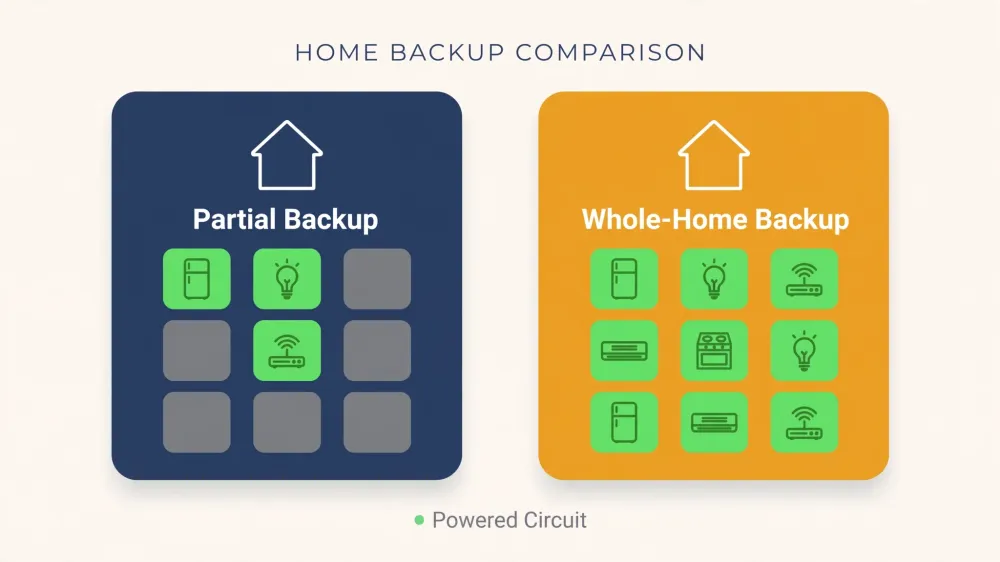
Partial backup, also called essential-loads or critical-loads backup, keeps a chosen set of circuits, the fridge, a well pump, some lights, the internet router, maybe the furnace blower, running through an outage. Whole-home backup is wired to carry the entire panel, including central air conditioning, the electric range, and the dryer, for as long as the battery (and any attached solar) can actually supply that load. The whole home vs partial backup decision is not about which one is "better." It is about what a kilowatt-hour of storage costs, what your panel actually draws when everything runs at once, and who benefits from you assuming bigger is automatically the safer, smarter choice.
Partial backup usually means a licensed electrician installs a second, smaller breaker box, a critical-loads subpanel, and moves a defined list of circuits into it. Only those circuits stay live when the grid goes down. Whole-home backup skips the subpanel and connects the battery system to the main panel itself, so every circuit in the house is a candidate for backup power, subject to how much the battery and inverter can deliver at once.
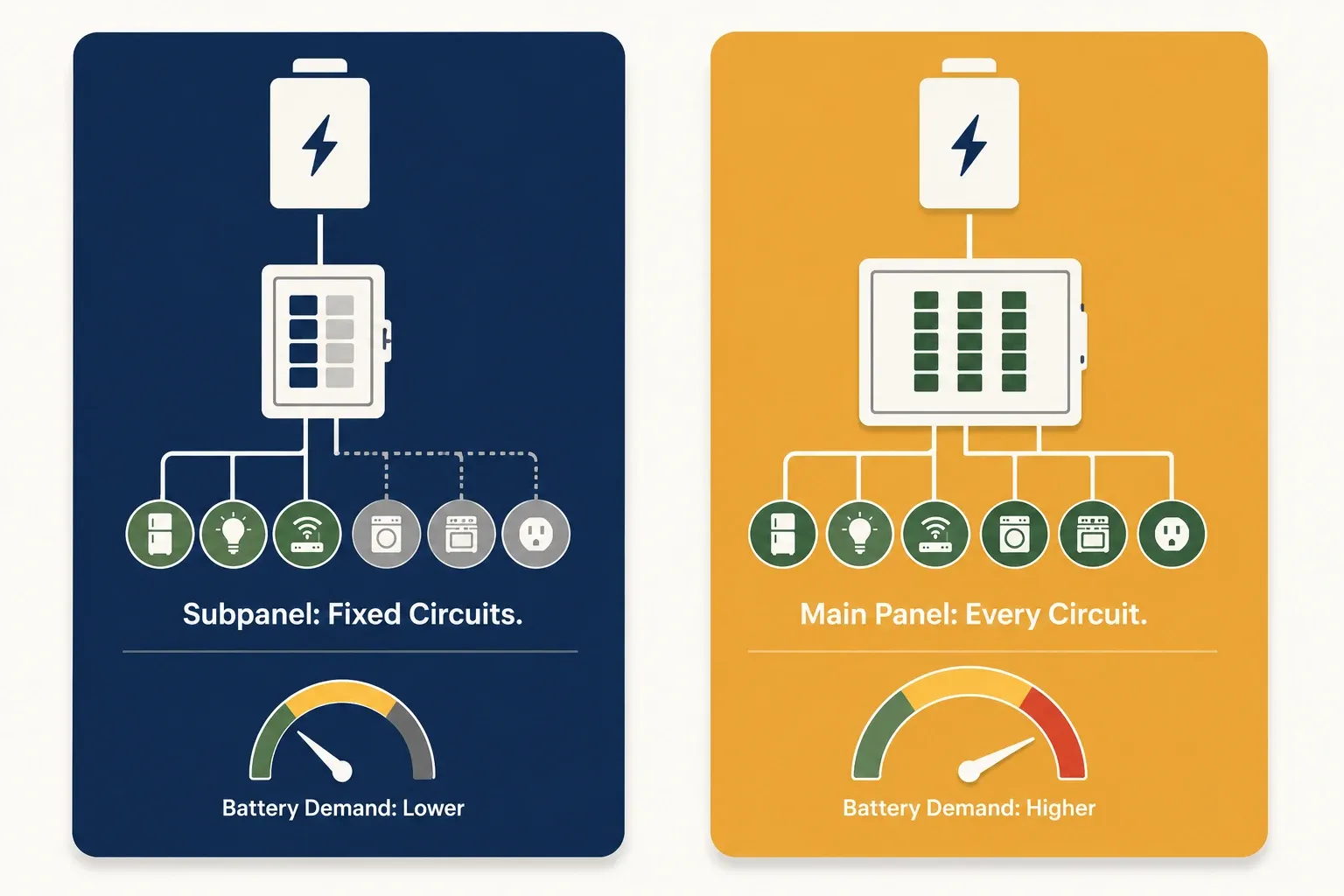
Neither is a brand or a product tier. They are two different ways of wiring the same category of equipment, and the choice changes the electrician's scope of work, the size of battery you need, and what happens the moment demand exceeds supply.
A backup system sized only for essential loads has a hard ceiling: the subpanel and its breakers are sized for the specific circuits assigned to it, not for whatever else a household member plugs into a "backed up" outlet during an outage. Adding a space heater, a window AC unit, or an extension cord run from a non-critical outlet into that subpanel's circuits can push the load past what the wiring and breaker are rated for. The likely result is a tripped breaker or an inverter shutdown. The more serious result, if a circuit or connection is bypassed or modified to force more current through it, is overheated wiring, which is a fire risk, not an inconvenience.
This is not a homeowner wiring task. Deciding which circuits belong on a critical-loads panel, sizing the panel and the inverter to what those circuits actually draw, and making the interconnection to the main panel is done by a licensed electrician, to the National Electrical Code requirements that apply in your state. If you are not sure whether a circuit is on the backed-up panel, the answer is to ask the electrician who installed it, not to test it during an outage.
Wiring the whole panel does not solve the finite-battery problem; it just moves the ceiling from "which circuits" to "how many hours." A battery bank asked to carry an entire home's draw, central air, an electric range, a dryer, several loads running at once, discharges much faster than the same bank carrying only a fridge and some lights. Without solar actively recharging it, a whole-home system can draw down in a matter of hours under normal household behavior, which is a different failure mode than partial backup but still a real one. Whole-home coverage without matching battery capacity and inverter output is a system that looks complete on paper and runs out during the outage it was bought for.
Every proposal will attach a number to this decision, and those numbers vary by region, equipment brand, and installer, so this page will not repeat one as if it were fixed. What is consistent is the shape of the trade-off: partial backup asks for a smaller subpanel, less battery capacity, and a shorter installation, which tends to land in the budget-to-mid-range tier. Whole-home backup asks for enough battery capacity and inverter output to serve full-home demand, plus load-management equipment to keep large appliances from overwhelming the system at the same moment, which tends to land in the mid-range-to-premium tier. Ask each installer to show what changes, in equipment and labor, between the two configurations for your own panel, rather than accepting a single lump number for either.
A larger, whole-home-capable system is a larger contract, and that fact does not by itself make the recommendation wrong. Some homes genuinely need it: a member with medical equipment, a well that supplies the only water source, a climate where losing air conditioning is a health issue. But the installer's recommended size is worth checking against your own numbers first, because the same six assumptions that inflate a solar array's size, consumption data, offset target, future loads, derates, roof geometry, and the rate structure, apply just as directly to a battery backup recommendation. Ask which of those is driving the whole-home number for your proposal, specifically.
Before comparing quotes, work out what your household actually draws, both on average and during the specific appliances you would want backed up. Finding your real annual usage on your own utility bill is the number that anchors this decision, the same way it anchors solar array sizing. A proposal built on an assumed or averaged figure, rather than your own twelve months, can point you toward more backup capacity than your actual household needs, or toward too little if it underestimates a seasonal spike like summer air conditioning.
Backup system contracts, like solar contracts, are frequently signed in the home, at a kitchen table, after a sales visit. The Federal Trade Commission's Cooling-Off Rule gives buyers in that situation a federal right to cancel certain home-solicitation sales within three business days, as described on the FTC's Cooling-Off Rule page (read 2026-09-18). Some states extend that window further or add their own home-solicitation-sale protections, so the federal rule is a floor, not the full answer for every state. Find your own cancellation deadline before you sign, and confirm the exact window with your own state's consumer-protection office or attorney general, since it can differ from the federal minimum.
How your utility compensates exported solar affects whether keeping capacity in reserve for backup, instead of exporting it, is worth more or less to you, and that compensation structure is set state by state and utility by utility. California is one documented example: the California Public Utilities Commission's Net Billing Tariff page (read 2026-09-18) describes the tariff that replaced the prior net-metering structure for new applicants, changing how exported energy is valued there. What that page describes applies to California utilities under that specific tariff; it is not a national rate design. Ask your own utility, or check your state's public utilities commission, what its current export compensation looks like before assuming either backup size changes your bill the way a national article or a neighbor's experience suggests it will.
A short list of questions to bring to the sales conversation is worth having ready regardless of which backup size you are leaning toward. For this decision specifically, ask which circuits are proposed for a critical-loads subpanel and why those were chosen, what battery capacity and inverter output the whole-home option requires to actually carry your largest simultaneous loads, whether load-management hardware is included or a separate line item, and which licensed electrician is performing the panel work and to what code. A proposal that cannot answer the circuit-by-circuit question has not actually finished sizing your system yet.
Sometimes, depending on the equipment and how the initial installation was wired. Adding capacity or converting a critical-loads subpanel to full-panel coverage later is a real option some households choose deliberately to spread the cost, but it depends on your specific battery and inverter model, and it is a question to ask the installer before you sign the first contract, not after.
Central air conditioning is one of the larger simultaneous loads in most homes, so backing it up generally means sizing toward the whole-home end of the range rather than a small critical-loads subpanel. Whether it is included even in a whole-home system also depends on the battery capacity and inverter output specified, since a whole-home connection without enough capacity behind it will not run a large air conditioner for long.
Yes, when the system is designed for it. A battery paired with solar can recharge from the panels during daylight even while the grid is down, which extends how long the backed-up circuits stay powered compared to battery capacity alone. Confirm with the installer that the specific inverter and battery combination supports this operating mode, since not all system configurations do.
The homeowner chooses the priorities, fridge, medical equipment, well pump, communications, and the licensed electrician determines what fits and how it is wired to the code that applies in your state. It is worth revisiting that list if your household changes, since a circuit that mattered when the panel was installed may not be the one that matters years later.
It can, because export compensation changes the relative value of using stored solar energy for backup versus exporting it to the grid. That value is set by your state and your utility, not nationally, so a rate-design claim you read about another state's tariff does not automatically apply to yours. Check your own utility's current tariff or your state's public utilities commission before treating any specific rate figure as your own.
Partial backup covers a chosen set of circuits through a smaller subpanel and asks less of the battery; whole-home backup covers the full panel and asks more of the battery, the inverter, and the wallet. Undersizing a critical-loads panel and then overloading it with unplanned devices is a real risk, and sizing either configuration is licensed-electrician work, not a homeowner project. Start from your own twelve months of usage, check the installer's assumptions, know your contract's cancellation window, and confirm your own utility's rate design before deciding which size actually fits your household.
One email a week with new guides, tips, and solar news. Zero fluff, no sales pitch.