Oversize Solar System NEM 3.0? What to Weigh

United States only. This page quotes no figure, names no utility and gives no benchmark, on purpose. The only number that sizes your system is yours.
Everything downstream in a solar purchase starts from one figure: how many kilowatt-hours your home used over twelve months. Get it wrong and the system size is wrong, the production estimate is being compared against the wrong target, and every savings number in every proposal is built on sand.
It takes about ten minutes to get properly, and most people do it wrong in the same specific way.
A single month is not a twelfth of a year. Household electricity use swings enormously with season, and which way it swings depends on how you heat and cool.
Pick a mild month and multiply by twelve and you will undersize. Pick your heaviest month and you will oversize. Neither error is small.
And a proposal built on your number will inherit your error, which is why an installer who pulls twelve months from the utility and a homeowner who used one bill can arrive at very different sizes and both think the other is wrong.
In order of how good the data is.
The best source, and free.
Almost every US utility offers an online account with usage history, usually as a bar chart by month and often downloadable. Many also offer interval data, showing usage by hour or by day, which is far more useful than a monthly total for anyone on a time-of-use rate.
What to look for once you are in:
If you have them, they carry the same information.
Each bill shows the kilowatt-hours for that billing period. Add twelve consecutive periods.
Two traps: billing periods are not calendar months and vary in length, and some utilities show a rolling average or a comparison to last year which is not your current usage. Read the line labeled in kWh for this period, not the comparison graphic.
If you moved in recently, or the account changed hands, or the online history is short, call and ask for twelve months of usage history for the address. Utilities do this routinely. Depending on the utility and on privacy rules, history from a previous occupant may or may not be available to you.
If the house is new to you and there is no history, say so in every proposal conversation. A proposal built on an assumed usage figure is a proposal built on a guess, and it should be labeled as one.
Add the twelve months. That total is your annual kilowatt-hours.
Two things worth doing with it immediately:
Write down the twelve monthly figures, not just the total. The shape matters: a household with a large summer peak and a household with a large winter peak want different things from a system, and the shape also tells you whether a time-varying rate would help or hurt.
Note anything unusual in the twelve months. An empty month, a construction project, a new appliance, a household member arriving or leaving. If last year was not representative, say so, and consider adjusting.
People routinely pull the wrong number, and these are the four culprits.
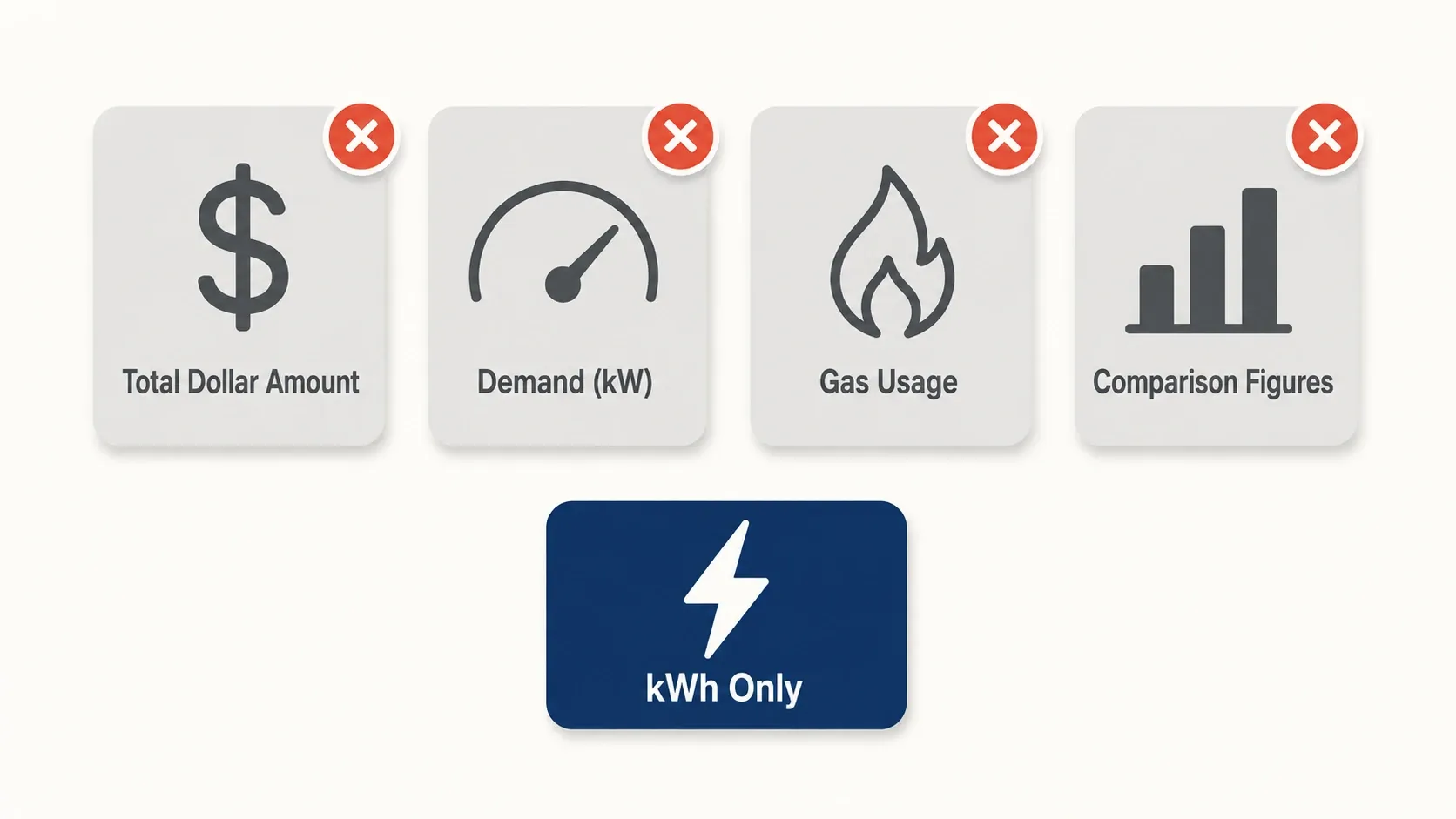
The dollar amount. The total you pay includes fixed charges, taxes and fees, and it is not proportional to usage. You cannot get kWh from dollars without knowing the whole rate structure, and rate structures are more complicated than one number.
Demand, measured in kilowatts. Some bills, particularly on certain rates, show a demand charge based on your highest instantaneous draw. Kilowatts and kilowatt-hours are different quantities: one is a rate, the other is an amount. Sizing uses the amount.
Gas usage. If your utility bills gas and electricity together, gas is measured in different units and is a separate quantity entirely.
Any comparison figure. "Compared to last year", "compared to similar homes", "average daily use". Interesting, and not the total.
Two homes with identical annual totals can want different systems.
A home whose usage peaks in summer afternoons is producing solar at exactly the time it is consuming, which is favorable on almost any tariff. A home whose usage peaks on winter evenings is producing when it is not using and using when it is not producing, which makes the export arrangement decisive.
And the export arrangement is where the money is. What net metering is and why the version you are on matters is the mechanism, and what applies differs substantially by state.
Interval data, if your utility offers it, is what turns this from a guess into an observation.
Two checks that cost nothing.
Does the total look plausible against your bills? Multiply your average monthly bill by twelve and see whether the dollar total is in the range you expect. Not a calculation, a sanity check.
Is anything about to change? An electric vehicle, a heat pump, a new occupant, a home office, a pool. A system sized to last year is sized to last year. If something is coming, that is a conversation to have deliberately rather than to leave to the proposal software.
Worth being clear, because people over-extend it.
It does not tell you whether solar makes sense for you. That depends far more on what you pay per kilowatt-hour and on your export arrangement than on how many you use.
It does not tell you what a system costs, and the costs that do not appear on a headline price are a separate list.
And it does not tell you the system size. Turning consumption into a system size involves your location, your roof and your offset target, and it is the next step rather than this one.
Can I just take one bill and multiply it by twelve? No, and this is the mistake most people make. A single month is not a twelfth of a year, because household electricity use swings enormously with season and which way it swings depends on how you heat and cool. A mild month multiplied out will undersize the system and your heaviest month will oversize it, and neither error is small. A proposal built on your number inherits your error, which is how an installer working from twelve months of utility data and a homeowner working from one bill end up with very different sizes.
What is a normal annual kWh figure for a house like mine? This page gives no benchmark, deliberately. The only number that sizes your system is your own, and a national or neighborhood average invites you to use it in place of the twelve months you can actually obtain. Get the real figure from your utility's online account, from twelve consecutive bills, or by calling the utility and asking for twelve months of usage history for the address, which utilities do routinely.
Which number on the bill am I actually looking for? The kilowatt-hours for that billing period, on the line labeled in kWh, and not the comparison graphic beside it. Four things get pulled by mistake. The dollar amount includes fixed charges, taxes and fees and is not proportional to usage, so you cannot work back to kWh from it without the whole rate structure. Demand is measured in kilowatts, which is a rate rather than an amount, and sizing uses the amount. Gas usage is a different quantity in different units. And any "compared to last year" or "compared to similar homes" figure is interesting rather than your total.
Why keep the twelve monthly numbers instead of just the total? Because two homes with identical annual totals can want different systems. A home that peaks on summer afternoons is producing at the time it is consuming, which is favorable on almost any tariff. A home that peaks on winter evenings is producing when it is not using and using when it is not producing, which makes the export arrangement decisive. The shape also tells you whether a time-varying rate would help or hurt, and interval data, where your utility offers it, turns that from a guess into an observation.
Does knowing my annual kWh tell me whether solar is worth it? No, and it is worth not over-extending the number. Whether solar makes sense for you depends far more on what you pay per kilowatt-hour and on your export arrangement than on how much you use. It does not tell you what a system costs either, and it does not give you a system size, because turning consumption into a size also involves your location, your roof and the offset you are targeting. This figure is the input the later steps run on.
Get twelve consecutive months of kilowatt-hours from your utility's online account, download it if you can, and add them up. Keep the twelve monthly figures and not just the total, because the shape of your usage decides how much your export arrangement matters. Do not use one bill, do not use dollars, and do not confuse kilowatts with kilowatt-hours. If last year was unrepresentative, or if something is about to change, say so out loud rather than letting proposal software assume.
One email a week with new guides, tips, and solar news. Zero fluff, no sales pitch.