Find Your Annual kWh: The One Number Sizing Starts From

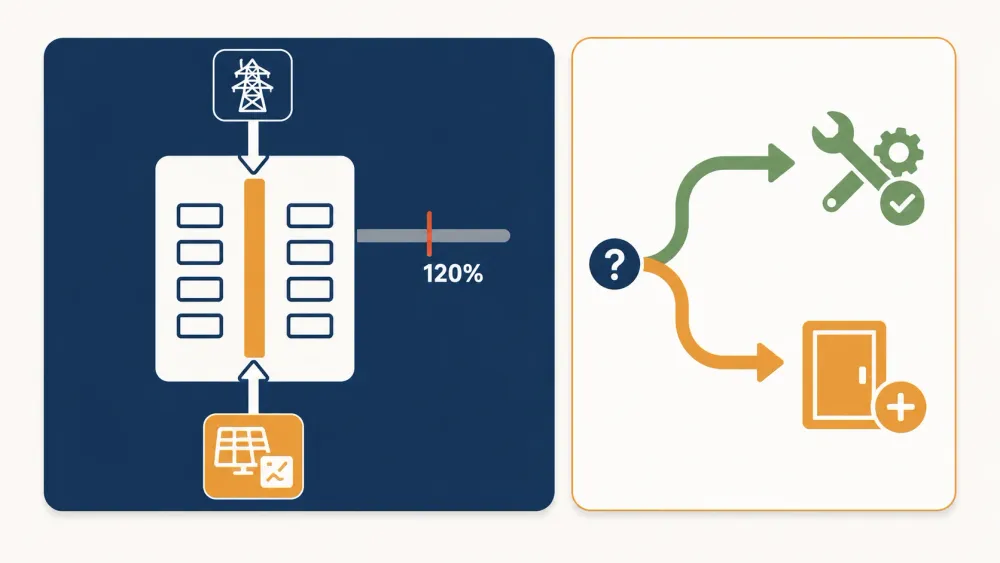
Do you need a panel upgrade for solar? Often not, but sometimes the electrical code leaves no choice. The deciding factor is usually not your home's total amps. It is whether your main panel's busbar can safely carry power from both the utility and the solar inverter at once, which the National Electrical Code limits with what installers call the "120% rule." If the numbers do not fit, there may be cheaper fixes than a new panel. If they still do not fit, or the panel is old or full, an upgrade can be genuine. You can check which case you are in by asking for five specific numbers.
This is general information for US homeowners. Your local building department adopts its own edition of the electrical code and decides what it accepts, and any work on your panel is for a licensed electrician.
A normal home panel is designed for power coming in from one direction: the utility feeds the main breaker, and the main breaker feeds a strip of metal called the busbar, which feeds every circuit in the house. The main breaker protects that busbar from carrying more current than it is rated for.
A grid-tied solar system usually connects to that same busbar through its own breaker, called a backfed breaker. Now the busbar has two sources feeding it: the utility through the main breaker and the inverter through the solar breaker. In the wrong combination, the two can together push more current through part of the busbar than the main breaker alone would ever allow, and the main breaker would not trip because, from its point of view, nothing is wrong. Too much current in a busbar means heat, and heat in a panel is how electrical fires start.
That is why the code puts a ceiling on how much solar can be connected this way. It is a safety rule, not a sales rule, and it is the most common honest reason a quote includes a panel upgrade.
The rule sits in Section 705.12 of the National Electrical Code (the exact subsection number has moved between code editions). The International Association of Electrical Inspectors, in an article by John Wiles on connecting PV systems to the utility (read October 2, 2026), states the load-side limit as: "the sum of 125% of the power source output circuit current and the rating of the overcurrent device protecting the busbar shall not exceed 120% with the busbar ampere rating."
In everyday language, three numbers decide it:
| Number | Where it comes from | Why it matters |
|---|---|---|
| Busbar rating | The panel's label | Sets the ceiling. 120% of this is the most the busbar may see from both sources combined. |
| Main breaker rating | The main breaker itself | Uses up most of that ceiling. |
| Solar output current, times 1.25 | The inverter's spec sheet | Has to fit in what is left. |
An illustration, not your house. Take a panel with a 200-amp busbar and a 200-amp main breaker, a common pairing. 120% of 200 is 240. Subtract the 200-amp main and 40 amps is left for solar. Divide by 1.25 and the inverter output can be up to 32 amps of continuous current. If the system on your quote needs more than that, the panel as it stands does not pass this test.
The rule also comes with placement conditions in this form: the solar breaker generally goes at the opposite end of the busbar from the main breaker. Panels where that is not possible, or where the busbar is rated lower than the main breaker, change the arithmetic.
Note what the table does not include: the size of your house, your total electricity use, or whether the panel "feels" big enough. A 200-amp panel can fail the test for a large system, and a smaller panel can pass it for a modest one. That is why generic advice like "200 amps is always enough" misleads.
The installer has a real case for an upgrade when one or more of these is true:
When the busbar math fails, replacing the whole panel is not the only way through. Depending on your equipment and on what your building department and utility accept, an installer may be able to:
None of these is automatically better. A supply-side connection can be more complex, a smaller main breaker can leave you short later, and a smaller system produces less. The point is that you should be shown the choice and the reason one option was picked.
This is the part most quotes skip. An honest panel upgrade line rests on numbers the installer already has, because their designer needed them to draw the plans. Ask for them in writing:
You do not need to check these yourself on the panel. Ask the installer for a photo of the panel label and the main breaker taken during the site visit. Do not remove any panel cover to look; the parts behind it stay live even with breakers off.
Then compare the answer with the questions to ask before you sign a solar contract, and treat the upgrade as a separate line when you compare solar quotes side by side. If one installer needs an upgrade and another, quoting a similar system for the same house, does not, the difference is worth asking both about.
A panel upgrade bundled inside a solar quote is rarely priced against competition. You shopped the solar system, but nobody shopped the electrical work, and the upgrade line often arrives late in the sales process, when you are already committed in your head. That makes it an easy place for margin, which is why it shows up in our list of the hidden costs solar quotes skip.
There are two reasonable ways to test it. First, ask whether the upgrade can be quoted as its own scope with its own price. Second, ask an independent licensed electrician to quote the same scope, given the same numbers. A real requirement will survive both questions. An inflated one tends not to.
Be fair to the installer, too. Many upgrades are entirely legitimate, and a contractor who refuses to connect to a failing or overloaded panel is protecting you and themselves. The goal is to see the reason, not to assume there is none.
Many pages ranking for this question say a panel upgrade is covered by the federal residential solar tax credit. That advice is out of date for most homeowners: the residential credit (Section 25D) has ended. Our explainer on what changed when the federal solar tax credit expired covers what remains. If a salesperson tells you the upgrade is "covered by the credit," ask them which credit, and confirm with a tax professional before you count on it.
Panel work involves the parts of your home's electrical system that stay energized even with the main breaker off, because the utility side of the panel is always live. Solar adds a second source that can energize circuits whenever light reaches the panels.
Not necessarily, but a 200-amp label does not settle it. What matters is the busbar rating, the main breaker rating and the inverter's output current under the code's 120% rule. A typical 200-amp busbar with a 200-amp main leaves room for a limited solar breaker, so larger systems may need another approach.
It is a limit in Section 705.12 of the National Electrical Code. For a load-side connection, 125% of the solar output current plus the main breaker rating must not exceed 120% of the busbar rating, with placement conditions. Your building department applies the edition it has adopted.
Sometimes. Options include a supply-side connection, a smaller main breaker supported by a load calculation, or a smaller system. Which ones are allowed depends on your equipment, your building department and your utility, so ask the installer which they considered.
The installer's designer and a licensed electrician propose it, and the local building department approves the plans and inspects the work. The utility may also be involved if the service itself changes.
It can. A panel or service upgrade is extra electrical work under the permit and may need coordination with your utility, which can add steps before inspection and permission to operate.
One email a week with new guides, tips, and solar news. Zero fluff, no sales pitch.