Solar Production Winter vs Summer: What's Normal

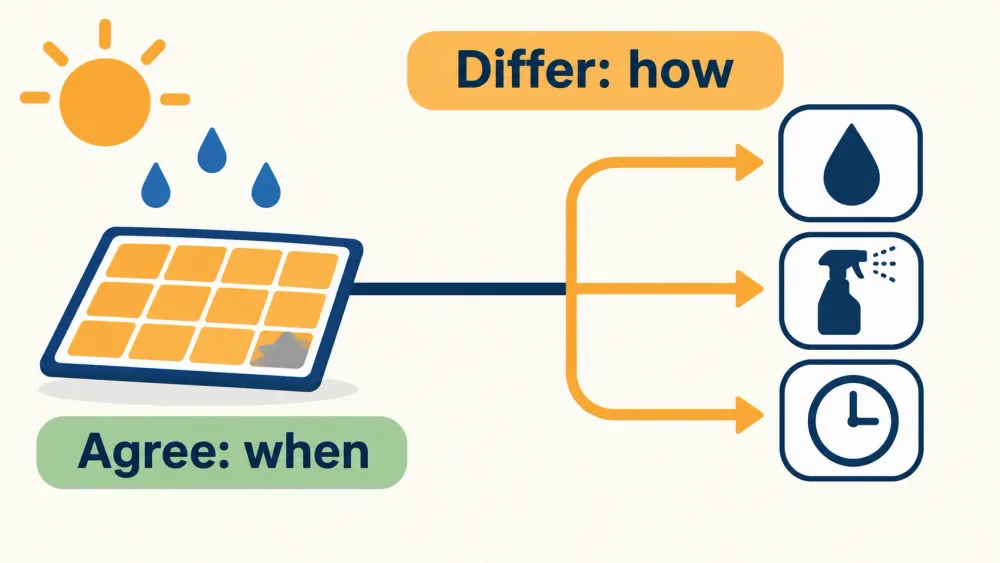
Do solar panels need cleaning? Usually not on a schedule. The three panel makers whose documents we read all say that rain washes a tilted array clean in normal conditions, and all three say to clean when dirt is visible or is shading the cells. Where they part company is how: water pressure, water quality, chemicals, timing, and who should be on the roof. Those rules decide whether a cleaning job is covered by your warranty, so the useful question is less whether to clean and more whose rules apply to your panels.
Written for US homeowners with a grid-tied rooftop system. Sources checked November 12, 2026. This page describes what manufacturers' documents say; it gives no roof access method and no electrical procedure. Work on a roof belongs with your installer or a contractor equipped to work at height.
Panel makers publish installation and maintenance rules, and their warranties tie coverage to those rules. We read five documents from three makers:
Each rule below belongs to the document it comes from. A rule in one maker's manual says nothing about another maker's panels, and your own panels may be covered by a different edition. The model number on your proposal or permit decides which document is yours, and our guide to finding the right spec sheet for your exact panel explains where that number appears.
On the basic question, the documents line up.
Our reading: none of the three sets a cleaning interval, and Canadian Solar's call for regular maintenance comes with no schedule. All three describe cleaning as a response to something you can see, such as a film that rain has not shifted, droppings, or leaves. A low-pitched roof, a dry climate, nearby farmland or construction, or a long gap between rains make that more likely. If your monitoring shows a dip and you suspect dirt, our guide to checking whether your system is underproducing covers the checks you can make from the ground before calling anyone.
This is where general cleaning advice tends to treat every panel the same. The documents set different rules.
| Question | Canadian Solar (US manual, July 2026) | Qcells (Q.TRON NA manual, 2023) | REC (cleaning guide and UL manual) |
|---|---|---|---|
| Water pressure | Recommends "a maximum water pressure not exceeding 4 MPa (40 bar)" | No pressure figure stated in the manual we read | Garden hose at domestic pressure allowed; "pressure or steam cleaners and high pressure hoses" not permitted |
| Water quality | "water with low mineral content, a pH value close to neutral (pH=6~8)" | Not specified | Deionized water ideally; rainwater, tap water or diluted alcohol as a secondary option |
| Dry dirt | "Do not scrape or rub dry dirt away, as this may cause micro scratches." Recommends compressed air for soft dirt such as dust | Tells cleaners not to scratch dirt off, and to use no abrasive materials | Avoid scratching; soft sponge, microfiber cloth or soft brush |
| Chemicals | Only substances Canadian Solar explicitly approves; long list of banned substances | Isopropyl alcohol allowed selectively on stubborn dirt and stains, within one hour of their appearing | Mild biodegradable detergent allowed; isopropyl alcohol under 10 percent; no acid or alkali detergent |
| Timing | "Avoid cleaning during the hottest hours of the day, in order to prevent thermal stress on the module." | Clean only cooled modules; "Do not clean modules with water if there is a risk of frost." | Clean when panels are cool, such as early morning; "only water at ambient temperature should be used" |
| Who does it | Electrical or mechanical maintenance "by qualified personnel only" | "Module cleaning has to be done by qualified personnel" | Assess safety and access first; use fall protection at height |
Two of these differences are large enough to matter in practice.
Pressure. Canadian Solar's manual gives a recommended ceiling of 4 MPa, which is 40 bar. REC's documents give no figure; they allow a garden hose at household pressure and prohibit pressure washers outright. The Qcells manual we read gives no pressure figure at all. A contractor who pressure-washes every brand the same way is following one maker's tolerance at best.
Chemistry. REC allows a mild biodegradable detergent and dilute isopropyl alcohol. Canadian Solar allows only substances it has explicitly approved, and bans a long list including alcohols and degreasers. Qcells allows isopropyl alcohol for stubborn stains, but only "within one hour after emergence." A cleaning product that is permitted on one brand can be the reason a claim is refused on another.
Each maker connects cleaning to coverage in its own words.
Our reading: the safest cleaning is the one that follows your own maker's page, and the person doing it should have that page before starting. That is also the record you want if a module later fails and the manufacturer asks what was done to it. For how the product warranty differs from the installer's workmanship warranty, see our explanation of the three kinds of solar warranty and what each covers.
The makers do not treat cleaning as a chore for anyone with a ladder.
Canadian Solar's cleaning section opens with a safety warning: "Cracked or broken modules represent an electric shock hazard due to leakage currents, and the risk of shock is increased when modules are wet." REC's guide gives the same warning about damaged panels and adds: "Never at any point stand on, walk on, lean on or apply pressure to the panels." Qcells warns of a risk of falling and says: "Never access the installation area alone or without taking adequate security precautions. Please commission a trade specialist."
Where this page stops. If you can see a cracked panel, a damaged cable, or a scorch mark, nobody should clean or touch that array; that is a call to your installer. If the array is on a roof, the cleaning is work at height on a live electrical system, and it belongs with your installer or a contractor equipped and insured to work at height. Canadian Solar's manual also tells the person cleaning to make sure the circuit is disconnected first. Isolating a solar circuit is electrical work for a licensed electrician or the installer, and this page does not describe it.
If you do decide the array needs cleaning, these questions turn the makers' rules into something you can check:
Keep the cleaner's invoice with the method written on it. If a warranty question comes up later, our guide to making a solar warranty or workmanship claim explains how to put the record in front of the right company.
Snow is a different question from dirt, and the makers do not agree on it. Canadian Solar's manual says snow should be removed with a soft brush and Qcells says to remove it carefully without force, while REC's cleaning guide says clearing snow is not essential for maximum performance, because snowfall generally comes when sunlight is at its lowest. For whether winter snow cover is a problem at all, see what normal winter production looks like. This page does not suggest clearing snow from a roof.
In the documents we read, rain is the expected cleaner for a tilted array. Canadian Solar ties that to a tilt of at least 15 degrees, and REC notes that flatter installations need more cleaning. Clean when dirt or debris is visible and rain has not removed it.
It depends on the maker, which is why a general answer misleads. REC prohibits pressure and steam cleaners and says their use will invalidate the warranty. Canadian Solar recommends staying at or below 4 MPa (40 bar). The Qcells manual we read states no pressure figure but excludes cleaning damage from its warranty. Check your own maker's document.
Canadian Solar recommends low-mineral water with a near-neutral pH of 6 to 8. REC prefers deionized water at ambient temperature and accepts rainwater or tap water as a secondary option. The Qcells manual we read does not specify water quality.
Cleaning itself does not, in these documents. Damage from cleaning that breaks the maker's rules can. Canadian Solar and REC say so directly, and Qcells excludes damage caused by cleaning tools or agents from its product and performance warranty.
The makers' documents point to qualified personnel and safety precautions, and Qcells tells owners to commission a trade specialist. On a roof, that is the right call. A ground-mounted array is still an energized electrical system, so the same maker rules and the same caution about damaged panels apply.
One email a week with new guides, tips, and solar news. Zero fluff, no sales pitch.