Do Solar Panels Need Cleaning? What 3 Makers Say

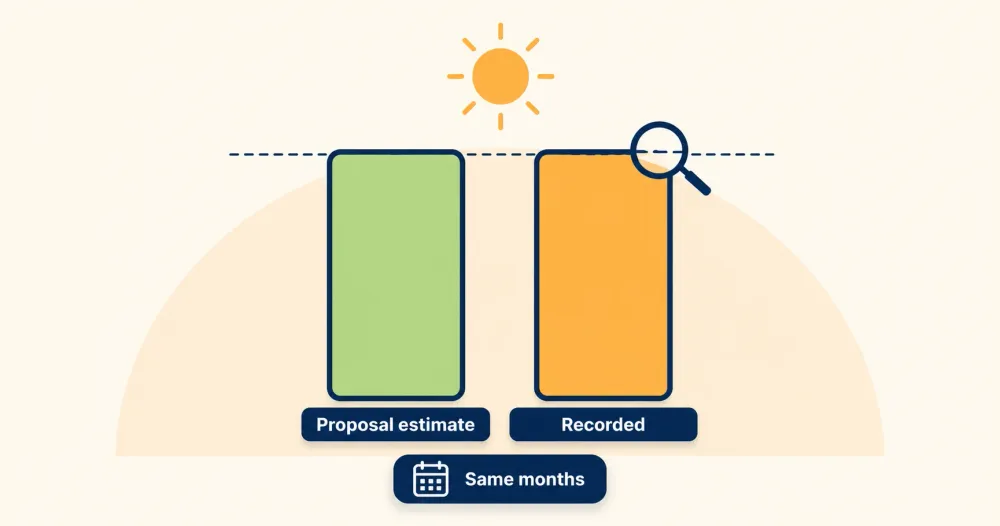
Solar panels not producing enough power is settled by one comparison: recorded production against the estimated annual production in your signed proposal, for matching months, rather than against a feeling or a neighbor's figure. Before calling anyone, confirm four things. That the gap is in generation and not only in reporting. That you are comparing like periods. That nothing new is shading the array. And that the panels are not visibly soiled or damaged. All four can be done from the ground, in about half an hour, with paperwork you already have.
This is written for US homeowners with a grid-tied system. Nothing here involves climbing onto a roof or opening any part of the system, and nothing here should.
There is exactly one benchmark that is yours: the estimated annual production, in kilowatt-hours, printed in the proposal you signed. That figure was modeled for your location, roof pitch, orientation and shading. The Department of Energy's guide for homeowners going solar points at the PVWatts tool for exactly this reason, because production is estimated for a specific site across a full year rather than inferred from a panel's nameplate rating.
Three benchmarks that are not yours, and that mislead people constantly:
If your proposal never showed the inputs behind its estimate, that is worth knowing in itself. Our guide on whether a production estimate is realistic covers which inputs move the number, and peak sun hours by state explains why a national average is useless as a personal benchmark.
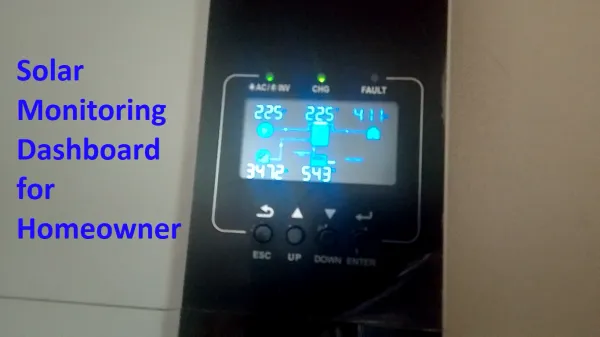
Monitoring depends on your home internet and on a communication device somewhere in the house. When that link drops, the app shows gaps or zeros while the system keeps generating perfectly well. The test is the utility side: if your meter still recorded exports during the period the app shows as missing, generation continued and the problem is reporting. This distinction prevents a great many unnecessary service calls, and it is the first thing a competent installer will ask you about.
Pull your production totals for the last twelve months and set them beside the estimated annual figure from the proposal. If you have more than a year of history, also compare each month against the same month a year earlier. Weather years differ, so a single low month is weak evidence while a twelve-month total that falls short is strong evidence. Write both numbers down with the dates they cover. You will need them later in exactly that form.
Trees grow. Neighbors build. A satellite dish, a new vent, a chimney extension or a parapet next door can put a shadow where there was none. Shading does not reduce output in proportion to the area it covers, because of how panels and strings are wired together, so a small new shadow can cost more than it looks like it should. Walk the perimeter on a clear day near solar noon and look up from several angles. Our article on solar panels and shade trees sets out how much shade starts to matter and what the realistic options are.
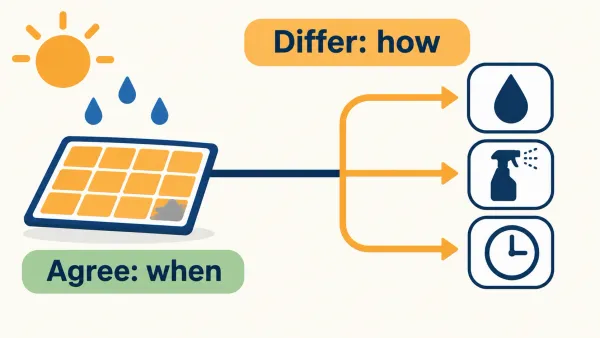
Pollen, dust, agricultural or construction debris, bird droppings and leaf litter all cut output, and in most climates rain handles the general case. What rain does not clear is a localized deposit, a nest, or debris lodged at a lower edge. From the ground, with binoculars if you need them, look for dark patches, a hazy film, cracked or clouded glass, a scorched or discolored area, a panel sitting out of alignment, or conduit hanging loose. Photograph anything you find, with the date.
Do not go up to deal with any of it. Falls are a leading cause of serious injury in home maintenance, and a wet or dusty panel surface is slick. Cleaning and physical inspection are jobs for your installer or a contractor equipped to work at height.
| What you observe | Usually normal | Worth reporting |
|---|---|---|
| Winter output far below summer | Yes, the annual estimate already assumed it | Only if clear spring days are also weak |
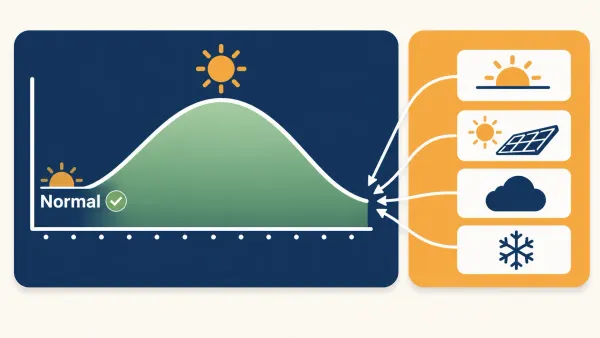
| A flat top on the midday curve | Common by design when the system reaches its rated output | If the flat section lengthens year over year in the same season |
| A cloudy week with low totals | Yes | If clear days in the same week are also low |
| Short daily gaps in the app | Usually a connectivity issue | If the utility meter also shows no export |
| One roof section behind a matching section | No | Yes, over several weeks of comparable conditions |
| Zero on a clear day, all day | No | Yes, immediately |
| Twelve-month total under the signed estimate | No | Yes, in writing, with both figures |
On how much decline is acceptable with age, do not take a figure from an article, including this one. Your panel warranty document states the output percentage the manufacturer guarantees for each year of its term, and your production guarantee, if you have one, states the threshold that triggers a remedy. Those two documents hold the only numbers that mean anything in a dispute.
This is where most homeowners lose, and it has nothing to do with the technology. A message saying output looks low invites a reassuring reply. A message built from documents invites a visit. Send it by email rather than by phone, and keep the thread.
Then look up two deadlines before you wait any longer: the notice period in your production guarantee, and the claim window in your workmanship warranty. Our breakdown of the clauses that decide a production guarantee explains what the measurement window and the weather adjustment actually do, because a claim filed after the window closes is worth nothing however correct it is.
Stated plainly, because this is the part that hurts people.
Do not get on the roof. Do not open, probe, test or disconnect anything on the DC side of the system, including rooftop disconnects, combiner boxes, conduit and connectors. A solar array produces voltage whenever daylight falls on it, regardless of whether the system is switched on or a breaker is off, which is not the hazard most homeowners are used to. Do not open the main service panel. Work of this kind belongs to a licensed electrician or your solar contractor.
If you smell burning, see scorching or arcing, see exposed conductors, or see a panel or mount that has physically moved, keep people away from the area and call your installer, your utility, or in an emergency the fire service. Do not investigate it yourself.
Equipment warranties are separate from the installer. Panels and inverters are warranted by their manufacturers, and those claims are made directly, using the model and serial details in your commissioning paperwork. Workmanship is the installer's, and where the installer no longer exists that cover may be unavailable, which is one reason the paperwork matters more than people expect at signing. Our guide on what to do when a solar installer goes out of business sets out the routes that remain, including state contractor licensing boards. For a dispute about what you were sold rather than what was built, the FTC's page on solar power for your home directs complaints to "the Federal Trade Commission at ReportFraud.ftc.gov" or "your state attorney general."
Compare twelve months of recorded production against the estimated annual production in your signed proposal, for matching dates. A shortfall across a full year, with no new shade and no visible soiling or damage, is the evidence worth acting on.
Weather years differ, trees grow, and panels decline slowly with age. Soiling and a partial equipment fault produce the same symptom, which is why the ground checks come before the service call.
Soiling reduces output, and a heavy or localized deposit does more damage than a general film. Rain clears most ordinary dust in most climates. Cleaning is work at height and belongs with a contractor, not the homeowner.
No. It involves roof access, slick surfaces and equipment that the wrong method can damage, and the manufacturer's instructions govern what may be used. Ask your installer.
Ask for the finding in writing, with the figures they used. Then read your production guarantee for its threshold and notice deadline, because that document, not an opinion, defines what counts as a shortfall.
One email a week with new guides, tips, and solar news. Zero fluff, no sales pitch.