Oversize Solar System NEM 3.0? What to Weigh

United States only. Last reviewed September 11, 2026. This page gives no panel count per car, on purpose.
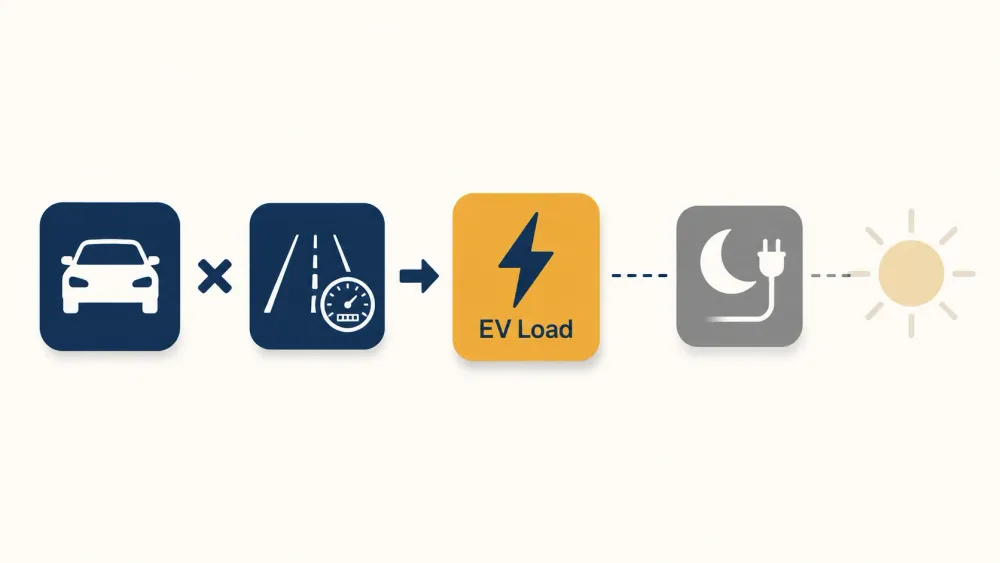
Sizing solar for an electric car comes down to one number you can work out before you buy: annual miles multiplied by the car's energy use per mile. The federal fuel economy label states that use as kilowatt-hours per 100 miles, and fueleconomy.gov publishes it for every rated model. Add that to your household consumption and you have the EV's share of the load. Whether to build for it now or leave room to add panels later depends mostly on what your utility pays for exports, because most cars charge after dark, when the panels produce nothing.
Everything a proposal needs about the car comes down to this.
Annual miles driven × kilowatt-hours per mile = annual kilowatt-hours for the car.
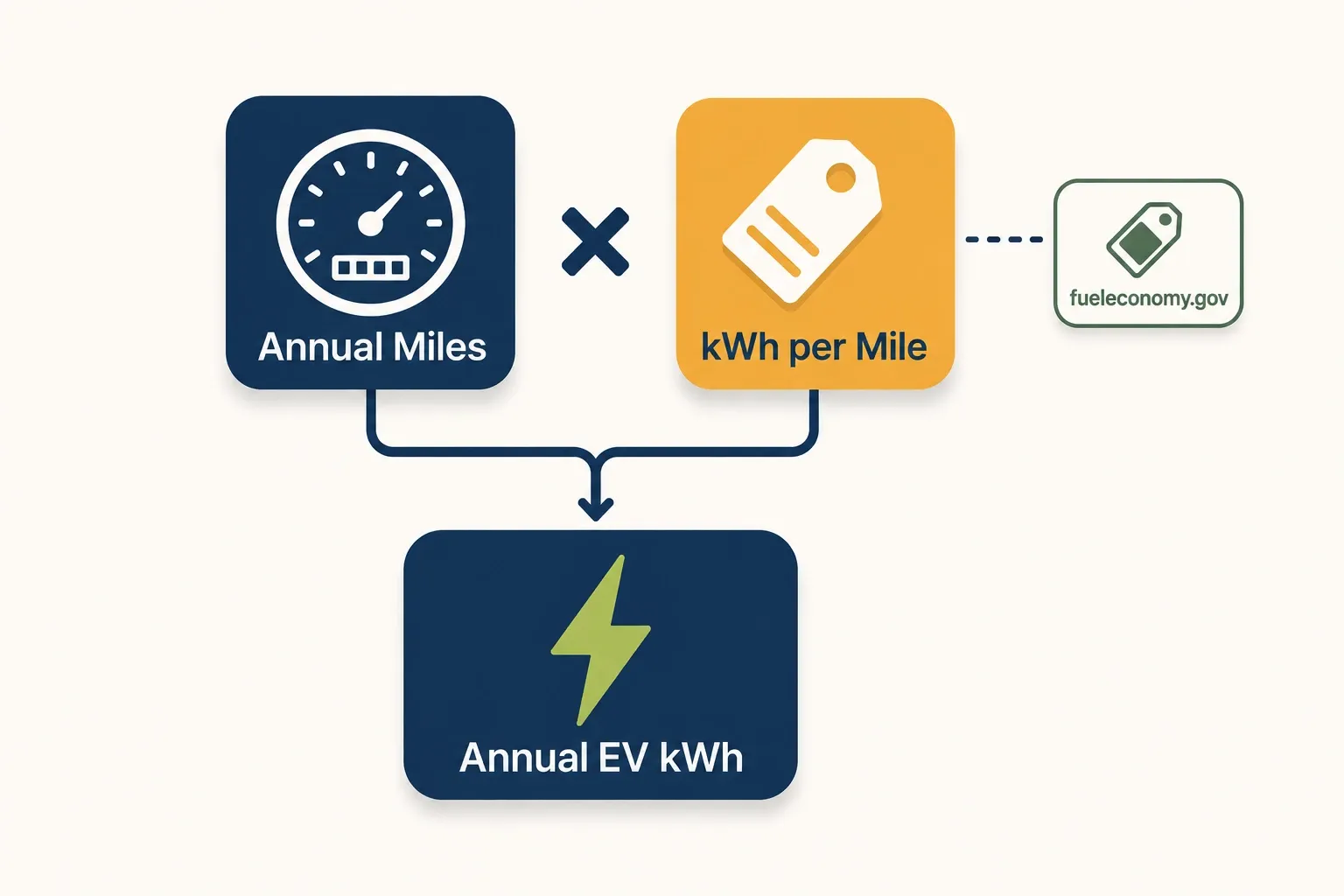
Both numbers are available before the car is in the driveway.
Annual miles. Your current car's service records, odometer readings a year apart, or an insurance declaration will give a reasonable figure. If the EV will replace a car, use that car's mileage. If it will be an extra car, the household's total driving may rise.
Kilowatt-hours per mile. The federal label gives it directly. fueleconomy.gov, the Department of Energy and EPA site, read on September 11, 2026, explains that the kWh/100 miles value "tells you how many kilowatt-hours the vehicle would use to travel 100 miles," and that it "relates directly to the amount of electricity used, and thus to cost." Divide by 100 for a per-mile figure.
If you have not chosen a car, run the calculation for two or three models you are considering. The spread between them tells you how much the choice of car moves the solar question, and it is often larger than people expect, because vehicle size and type change energy use a great deal.
The same fueleconomy.gov page is candid about the limits. It calls the value "an estimated rate of consumption" and says actual results can differ "due to a number of factors, such as how you drive and maintain your vehicle, how much you use air conditioning and other accessories, the weather, road conditions, how much the vehicle is loaded, and other factors."
Neither adjustment needs a precise number at this stage. The point is to size against a realistic estimate and to read any proposal that uses the bare label figure as slightly optimistic.
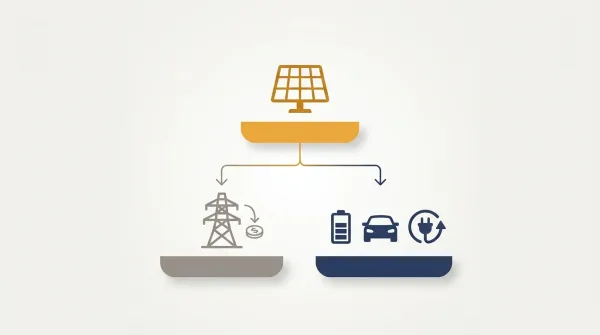
Solar panels produce in daylight. Most home EV charging happens in the evening and overnight, after the car comes home. So in most households, very little of the car's energy comes directly from the panels at the moment they produce it.
What connects the two is your utility's export arrangement.
This is the single most important question in the whole decision, and it is set by your state and your utility. How net metering differs by state is the place to start, and your utility's current tariff is the document that settles it.
Charging during the day, when the car is home, changes the picture. So can a time-of-use rate that makes overnight charging cheap. Both are household specifics, and a proposal should ask about them rather than assume.
For a car you have not bought, the real decision is not "how many panels for an EV." It is whether to build that capacity now or design the system so it can grow.
This page does not say which is right for you. It says the answer rests on three things you can find out: your export tariff, your confidence in the mileage estimate, and how much space the roof has left.
If you are leaning toward waiting, the design can still make a later addition easier. Worth asking, and worth getting in writing:
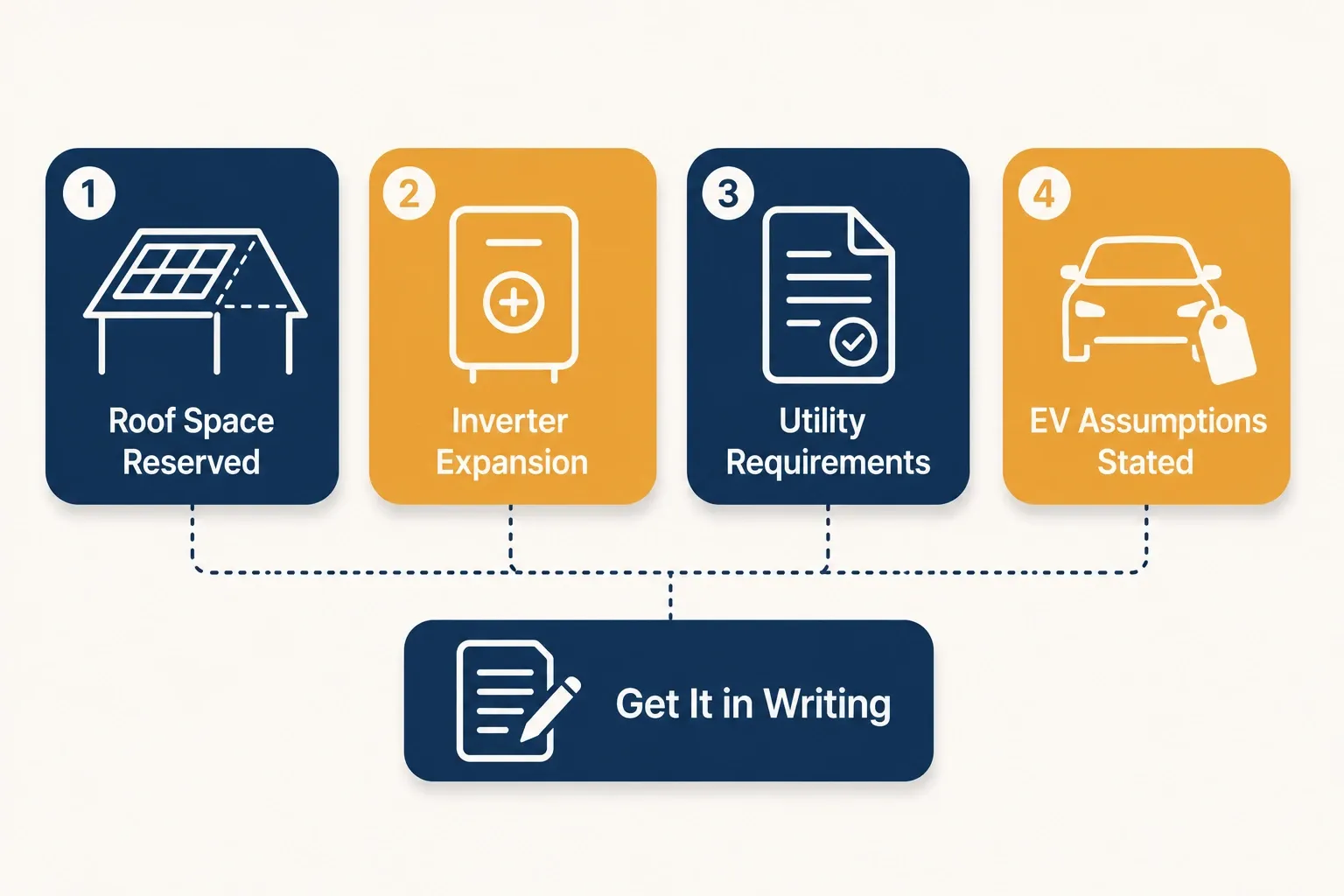
When comparing proposals, putting them on the same basis matters more than usual: one quote may include a future car and another may not, and their sizes and prices will not be comparable until you know. And checking the production estimate against your own run of PVWatts, the free calculator from the National Laboratory of the Rockies, confirms that the extra capacity actually produces the extra kilowatt-hours the car needs.
A solar system does not include an EV charger, and the charger is its own electrical project.
The Department of Energy's Alternative Fuels Data Center, read on September 11, 2026, says many drivers meet daily needs by charging overnight with Level 1 equipment, "requiring no additional cost or installation," while Level 2 equipment suits longer commutes and larger batteries. It recommends using "a certified electrical contractor," notes that "appropriate permits may be required," and says some homes "might have insufficient electric capacity for Level 2 equipment," which an electrician can assess. The same agency cites SAE J1772 as a standard US charging equipment should comply with; the connector your vehicle uses is listed in its specifications.
Installing a Level 2 charger is licensed electrical work, and so is any work in the service panel. If the solar and the charger are both planned, telling the electrician and the installer about both at the start lets one assessment cover the panel's capacity for each. Nothing in this article involves touching a vehicle's high-voltage system, a rooftop array's DC wiring, or the home's panel.
Enough to produce the car's annual kilowatt-hours at your address. Multiply annual miles by the car's kWh per mile from the federal label on fueleconomy.gov, then divide by production per kilowatt at your address from PVWatts to get the added system size. The panel count depends on the wattage of the panels offered.
No. Panels produce in daylight, and most home charging happens after dark. What links them is your utility's export arrangement: daytime exports earn credits that offset nighttime charging. How much those credits are worth depends on your state and utility.
It depends on your export tariff, how confident you are in the mileage, and how much roof space remains. Adding capacity during the original install tends to cost less per watt than a later project, while oversizing against an uncertain car can mean exporting surplus at a low value. An installer can design for a later addition if you ask.
The Department of Energy's Alternative Fuels Data Center recommends a certified electrical contractor, notes that permits may be required, and says some homes may lack the electrical capacity for Level 2 without changes. It is licensed electrical work, separate from the solar installation.
The EV's load is annual miles times kWh per mile, and the federal label gives the second number for any rated model. Adjust for climate and charging losses, add it to your household consumption, and divide by production per kilowatt at your address. Because most charging happens after dark, your export tariff decides how well panels "cover" the car. For a car you have not bought, the choice is between sizing now and designing to add later, and both are reasonable depending on the tariff, the mileage and the roof. The charger is a separate job for a licensed electrician.
One email a week with new guides, tips, and solar news. Zero fluff, no sales pitch.