Do I Need a Battery With Solar? The Real Trade-Off

US guide. Reviewed on August 10, 2026. Solar pricing varies by state, utility, and installer, so treat the figures below as a method to apply to your own quotes, not as a market price.
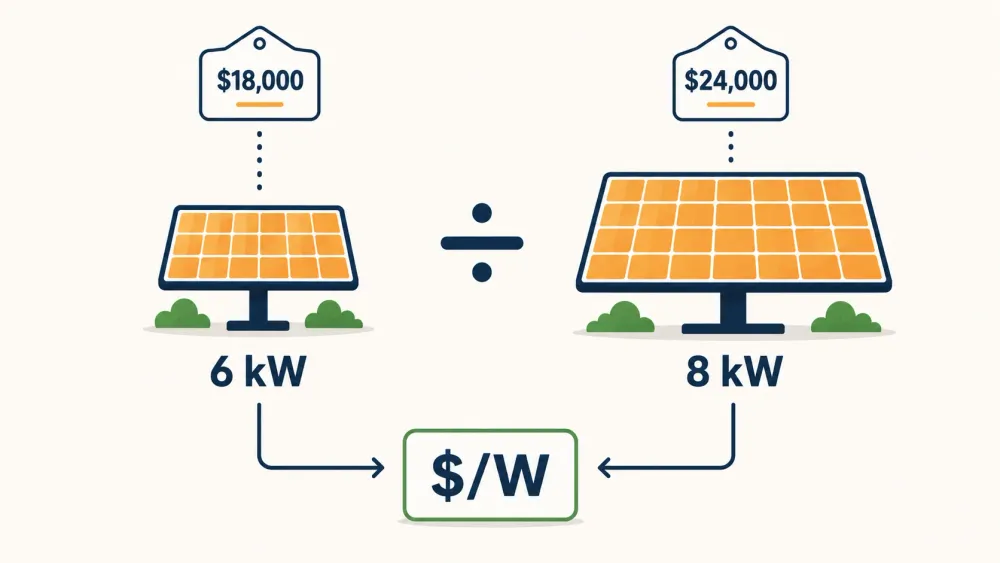
Solar cost per watt is a quote's total price divided by the system's size in watts. It is the number that lets you compare two proposals for differently sized systems, because the two headline totals alone cannot do that job. A homeowner holding an 8 kW quote and a 6 kW quote cannot tell which is the better deal from price alone; cost per watt is what makes the two proposals comparable.
If you have not yet worked out whether solar is worth pursuing for your home at all, is solar still worth it in the US in 2026 is the broader question this comparison sits inside.
The formula is simple on purpose: total system price divided by system size in watts. What makes it useful is that it strips out the one variable that makes two quotes impossible to compare directly, which is size. A bigger system almost always has a bigger total price, so a lower total price does not automatically mean a better deal, and a higher total price does not automatically mean a worse one. Cost per watt normalizes both quotes to the same unit, so the number in front of you actually reflects what you are paying for a given amount of solar capacity, not just how large the system happens to be.
This matters because installers rarely propose identical system sizes to the same homeowner. Roof space, shading, panel wattage, and how aggressively an installer sized the system to your usage all vary quote to quote. Two quotes that look far apart on the total price line can turn out to be close, or reversed, once each is reduced to a per-watt figure.
Cost per watt = total system price ÷ system size in watts (DC).
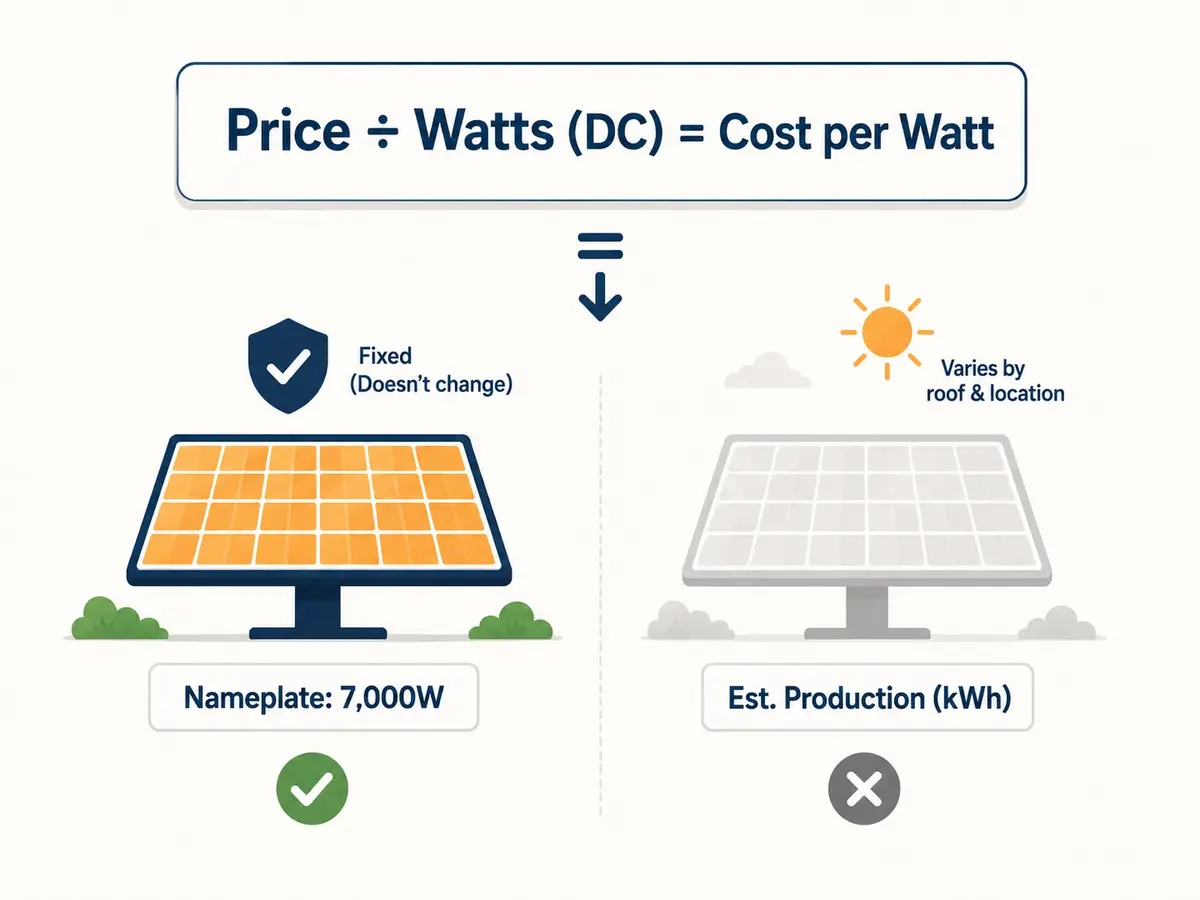
The denominator is the system's nameplate rating, the combined rated output of the panels under standard test conditions, expressed in watts DC. It is not the same as the system's estimated annual production in kilowatt-hours, which depends on your roof's orientation, shading, and local sun hours. A 7,000-watt (7 kW) system is 7,000 watts regardless of how much electricity it is expected to produce where you live; use the nameplate wattage, not the production estimate, for this calculation.
The numerator is where quotes actually differ, and where a fair comparison breaks down if you are not careful. "Total system price" should mean everything you are being asked to pay for that system: equipment, installation labor, permitting and interconnection fees, and any required roof or electrical work the quote bundles in. What it should not silently include, without you noticing, is financing cost. A cash quote and a financed quote are not naturally on the same footing, because a loan-based quote can carry a dealer fee baked into the stated price, which raises the per-watt figure before any interest is even considered. See how a dealer fee inflates a financed solar quote before you compare a cash number against a financed one directly. It also matters whether the price shown is before or after any incentive is applied; with the federal residential credit under Section 25D expired as of December 31, 2025, a 2026 purchase quote has no federal credit to subtract, but a state or utility incentive might still create a real gap between a quote's gross and net price. See what changed when the federal tax credit expired for the current picture, so you know which figure, gross or net, you are actually comparing.
Suppose one quote's total price is smaller than another's. On its own, that tells you almost nothing about which is the better value, because the smaller number might belong to a smaller system. A system sized to cover less of your usage will typically show a lower total price than a system sized to cover more of it, even if the smaller system is the objectively worse deal on a per-watt basis. Comparing two totals side by side, without accounting for size, can point you toward the wrong quote for reasons that have nothing to do with price competitiveness at all.
This is exactly the problem cost per watt exists to solve. It is not a replacement for looking at the total price, since the total is still what you will actually pay. It is a second number, calculated alongside the total, that tells you whether the price you are paying is a competitive rate for the capacity you are getting. For general context on what a full system typically costs before incentives, see what home solar actually costs in the US.
The numbers below are invented for illustration only. They are not a claimed market price, a typical quote, or anything to expect on your own bill. Run the same formula with your own two quotes and your own numbers.
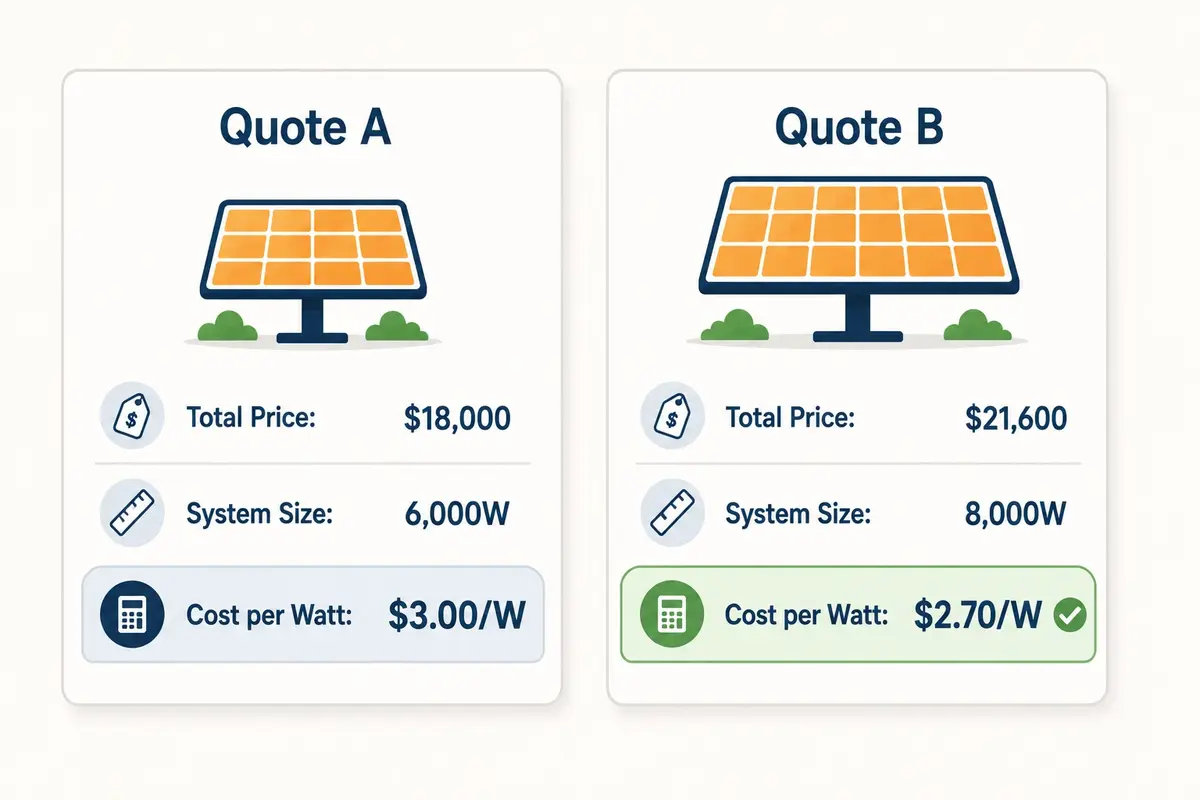
Suppose Quote A prices a 6,000-watt (6 kW) system at $18,000, and Quote B prices an 8,000-watt (8 kW) system at $21,600.
| Quote A (illustrative) | Quote B (illustrative) | |
|---|---|---|
| Total price | $18,000 | $21,600 |
| System size (DC) | 6,000 W (6 kW) | 8,000 W (8 kW) |
| Cost per watt | $18,000 ÷ 6,000 = $3.00/W | $21,600 ÷ 8,000 = $2.70/W |
Looking only at the total price, Quote A looks cheaper by $3,600. Once each quote is reduced to cost per watt, Quote B is actually the better rate for the capacity it delivers, at $2.70 per watt versus $3.00 per watt. Neither conclusion is "right" in isolation; the total price tells you what leaves your bank account, and cost per watt tells you what you are paying for each unit of capacity. A real comparison needs both, plus confirmation that each illustrative total includes the same categories of cost, equipment, labor, permitting, and interconnection, and not one quote quietly folding in a financing fee that the other does not carry.
A lower cost per watt is not automatically the better quote, because the formula has no way to see what you are actually buying. It does not distinguish between panel efficiency tiers or between a basic and an extended warranty. It does not reflect the difference between an installer with a strong permitting and interconnection track record in your area and one with a weaker one, and workmanship quality never shows up in a price-per-watt figure at all. Two systems at an identical cost per watt can be very different purchases once warranty length, equipment tier, and installer reputation are factored in.
It also is not the same figure that shows up in other parts of the solar decision. Cost per watt feeds into your net system cost, which is one half of the solar payback period formula, but payback depends just as much on your own electricity usage and rate, which cost per watt says nothing about. Similarly, when a system's value shows up in home resale research, it is often expressed in the same per-watt unit, which is why whether solar increases home value is worth reading as a separate question from what you paid to install it. Cost per watt answers exactly one question, price competitiveness for a given size, and no more.
A single, current, nationally representative cost-per-watt figure could not be confirmed with a named, dated source at the time this article was written. Figures circulating online for 2026 vary by a wide margin depending on the source, the quarter of data behind them, and whether the number is stated before or after incentives, which makes any single figure printed here without that context unreliable rather than useful.
Two organizations do track this figure with methodology attached: the National Renewable Energy Laboratory (NREL) publishes periodic residential solar cost benchmark research, and the Solar Energy Industries Association (SEIA), with Wood Mackenzie, publishes a quarterly U.S. Solar Market Insight report that tracks residential system pricing. If you want a national reference point, check either source directly for its current release and confirm its publication date and whether its figure is stated before or after incentives, rather than relying on a secondhand restatement. Your own two quotes, compared on a per-watt basis, remain more useful for your decision than any national average.
Is a lower cost per watt always the better quote? No. It tells you which quote charges less per unit of capacity, not which one uses better equipment, carries a stronger warranty, or comes from a more reliable installer. Treat it as one input alongside warranty terms, equipment specifics, and installer track record, not as the whole decision.
Does cost per watt include the federal tax credit? Not unless a quote states it does. The federal residential credit under Section 25D expired December 31, 2025, so a 2026 purchase quote has no federal credit to apply in the first place. Confirm whether the total price you are dividing is the gross price or a price that already reflects a state or utility incentive, since mixing the two across two quotes gives a misleading comparison. See what changed when the credit expired.
What is a normal cost per watt in the US right now? This article does not state one. Reported figures vary widely by source, region, and data quarter, and a number without a named, dated source is not reliable enough to print here. Check NREL's residential cost benchmark research or SEIA's U.S. Solar Market Insight report directly for a current, dated figure, and confirm whether it is stated before or after incentives.
Does a financed quote's cost per watt include the dealer fee? It depends on the installer, and quotes are not consistent about this. A dealer fee tied to loan financing can be built into the stated system price, which raises the per-watt figure before interest is even considered. Ask directly whether the price you are dividing includes a dealer fee, and see how a dealer fee inflates a financed solar quote for how that changes a comparison against a cash quote.
Is cost per watt the same as cost per kWh? No, and confusing the two is a common mistake. Cost per watt measures what you paid for a unit of system capacity (nameplate wattage). Cost per kWh measures what electricity costs, either from your utility or, over a system's life, from the solar system itself. They answer different questions and are not interchangeable.
One email a week with new guides, tips, and solar news. Zero fluff, no sales pitch.