Oversize Solar System NEM 3.0? What to Weigh

United States only. Last reviewed September 11, 2026.
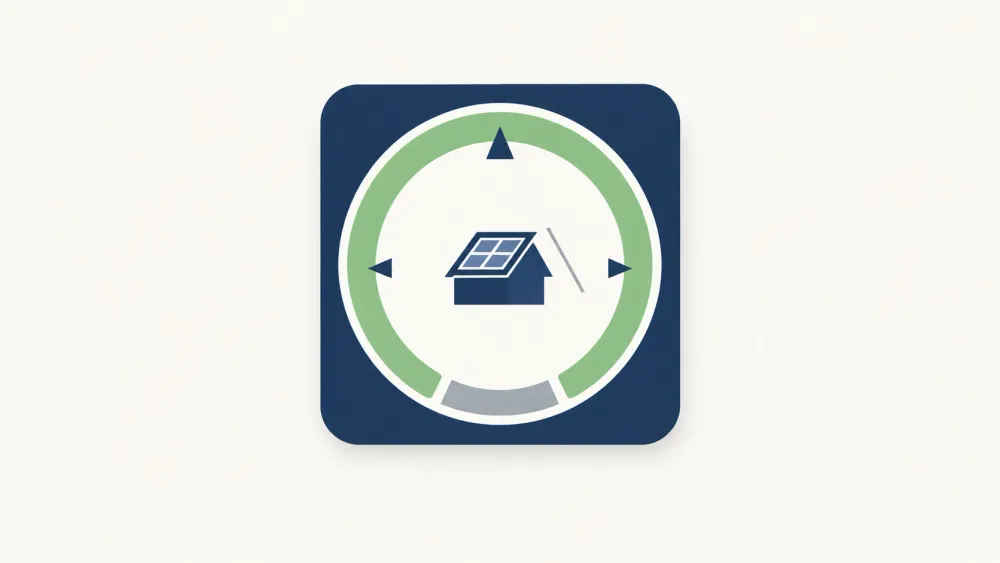
A south facing roof is the reference point for solar in the US, not a requirement. The Department of Energy's homeowner guide, read on September 11, 2026, says panels "typically" perform best on south-facing roofs with a slope between 15 and 40 degrees, "though other roofs may be suitable too." A national lab chart shows a wide band of directions and tilts collecting close to the maximum available sunlight. For a west- or east-facing roof, the honest answer is a modeled number for your own address, and on some tariffs the timing of a west roof's output matters as much as its total.
In the continental US, the sun sits in the southern half of the sky at midday all year. A panel facing south and tilted toward it meets the sunlight most squarely over the course of a year, which is why every production tool and every installer treats due south as the starting point. The public calculator PVWatts, run by the National Laboratory of the Rockies, uses a direction convention where 180 degrees means due south, 90 means east and 270 means west.
"Best" in this sense means one thing: the most kilowatt-hours over a whole year. It does not mean the most valuable kilowatt-hours, and it does not mean the only workable roof.
The most useful public chart on this comes from the Department of Energy's Building America Solution Center, run by Pacific Northwest National Laboratory. Its page on solar orientation, last updated in 2014 and drawing on a 2001 study of tilt and azimuth effects across US locations, states that for a location where the ideal tilt is around 30 degrees:
Read carefully, that is a statement about sunlight arriving at the panel surface, for locations with an ideal tilt near 30 degrees. It is not a production guarantee, it does not describe every US location, and the study behind it is old. What it does establish is the shape of the curve: near south and near common roof pitches, the penalty is small, and it grows as the roof turns toward due east, due west and north.
Many pages publish a single penalty percentage for east, west and north roofs. We could not trace those figures to a primary source, so they are not repeated here. Your own roof's penalty takes two runs of a free tool to find, as set out below, and it will fit your house better than any national figure.
For most homes pitch matters less than direction, for two reasons visible in the chart above: a wide range of tilts collects close to the maximum, and most residential roofs already fall inside that range.
This is the part most direction articles skip.
A south roof maximizes annual energy. A west roof produces less over a year, and more of what it does produce arrives later in the afternoon. Whether that trade is good or bad depends on your tariff, not on physics.
This page does not claim west beats south on any tariff. It claims that on a time-varying tariff the comparison has to be made in dollars by hour, not kilowatt-hours by year, and a proposal that reports only annual production has not made it.
East-facing roofs produce more in the morning. North-facing roofs in the continental US collect the least, and usually only a low pitch makes them worth modeling at all. Both are questions for the model, not for a rule of thumb.
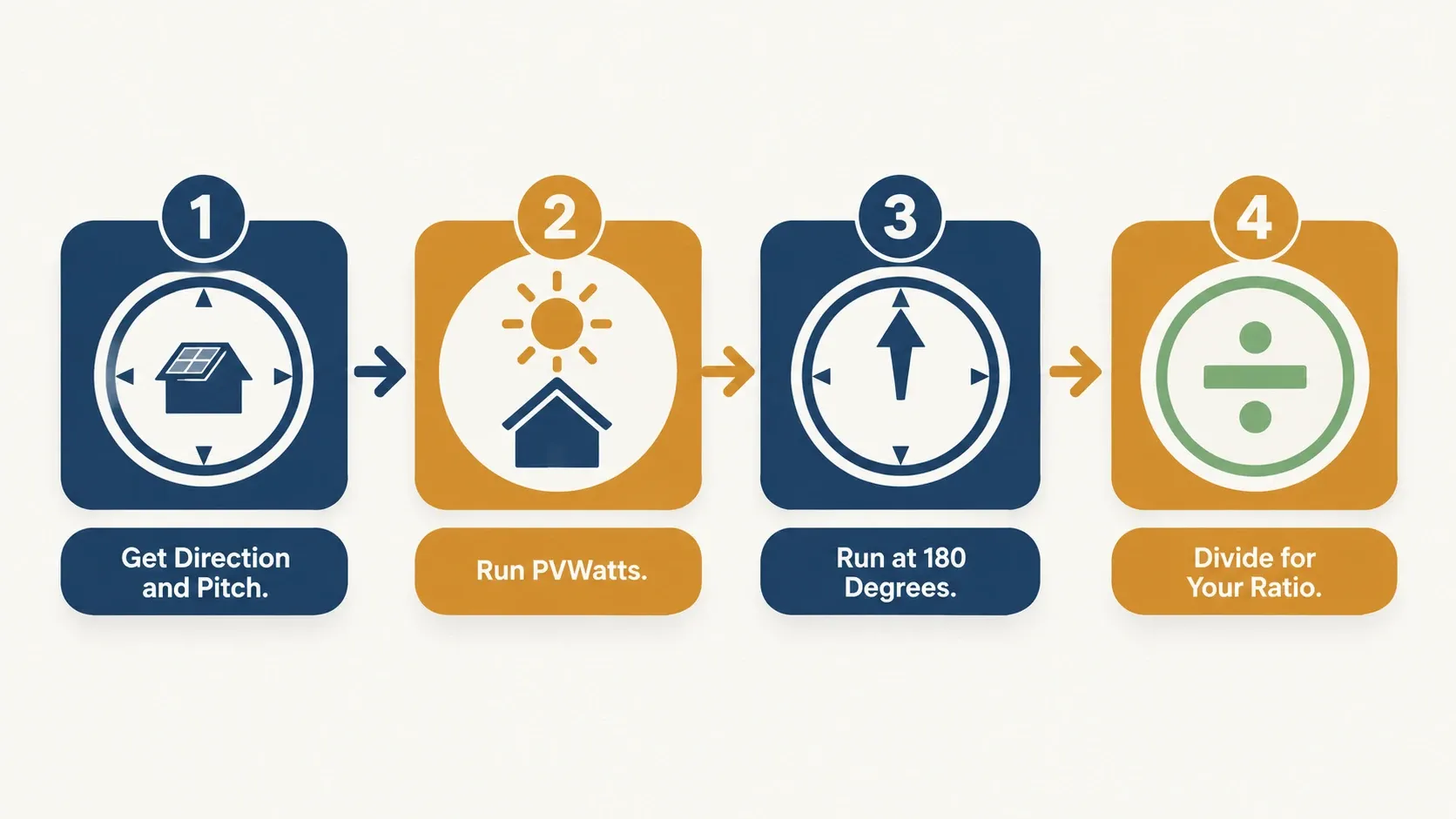
If you have two usable roof planes, run each one separately. A proposal that splits panels across planes should show production for each, and a realistic production estimate should land near what you get.
Do not go up on the roof to measure anything. NIOSH, the CDC's occupational safety institute, states in an April 2026 bulletin that "falls from elevation remain the leading work-related cause of death in construction," and names roofing among the tasks where many falls occur. Roof measurement, layout and mounting are the installer's work. The electrical side of a rooftop array carries DC voltage whenever light reaches the panels, and wiring and connection belong to a licensed electrician.
Direction affects a quote in three places, and each is worth checking.
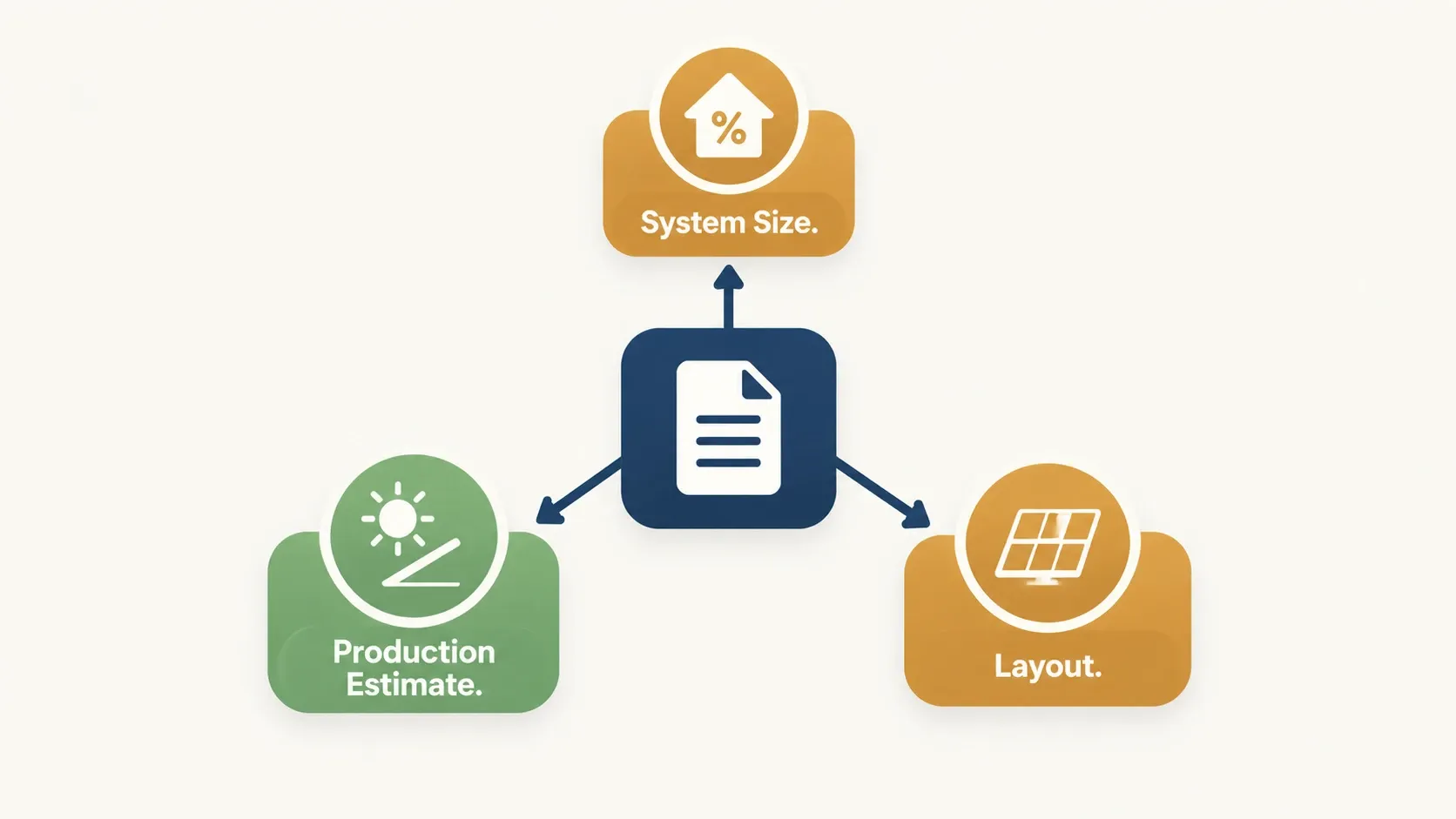
System size. A less favorable direction produces less per kilowatt, so it takes more kilowatts to reach the same annual energy. Cost per watt is what makes two systems of different sizes comparable.
Production estimate. The proposal should state the azimuth and tilt it modeled for each plane. If it does not, ask for them.
Layout. When the south plane is small, some installers fill it and then add panels on east or west planes. That can be sensible, and each added panel should be modeled on its own plane rather than averaged into the south figure. The questions to ask before you sign include how production was modeled plane by plane.
A good direction does not make a roof a good candidate on its own. Shade, roof age and condition, available space and, above all, your electricity rate and export terms decide whether the system pays. A south roof under heavy tree cover can produce less than an unshaded west roof next door. The direction question is one input, and it is the easiest one to model.
No. The Department of Energy describes south-facing roofs as typically best and says other roofs may be suitable too. A national lab chart shows a wide range of directions and tilts collecting 90 to 100 percent of available sunlight in locations with an ideal tilt near 30 degrees. Your own roof's penalty can be modeled in minutes with PVWatts.
It produces less over a year than a south roof at the same pitch, and more of its output comes later in the day. Under time-varying rates or export credits, later production can be worth more per kilowatt-hour. Whether it is on your tariff is a calculation in dollars by hour, not a general rule.
The Department of Energy's guide describes a slope between 15 and 40 degrees as typical of the best-performing roofs, and a national lab chart shows a due-south array collecting close to the maximum across a much wider tilt range where the ideal tilt is near 30 degrees. Very low and very steep roofs raise installation questions more than production ones.
Run PVWatts twice for your address at your roof's tilt with a one-kilowatt system: once at your roof's actual direction and once at 180 degrees, due south. The ratio of the two annual results is your direction penalty, from the same weather data.
South is the reference, not a rule. The Department of Energy describes south-facing roofs between 15 and 40 degrees as typically best and other roofs as possibly suitable, and a national lab chart shows a wide band of directions and tilts collecting close to the maximum. Your roof's own penalty is two PVWatts runs apart. On a time-varying tariff, compare directions in dollars by hour, not only in kilowatt-hours by year. And leave the roof itself to the installer.
One email a week with new guides, tips, and solar news. Zero fluff, no sales pitch.