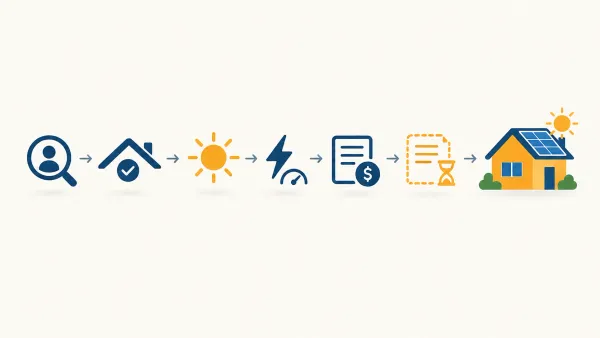
How to Buy Solar Panels in the US: The Whole Process

Tile roof solar installation is possible on clay and concrete tile, but it is slower, more labor-heavy and riskier for the roof than a job on asphalt shingle. Tiles crack under foot traffic, the waterproofing sits on the underlayment beneath them, and every mount has to pass through that layer and be flashed. The real question for a homeowner is not "can it be done" but "who pays when a tile breaks, and how is the roof kept watertight for the life of the system." Those answers belong in the contract before anyone climbs a ladder.
This guide covers the four roof types that most often complicate a solar install in the US, how installers mount on tile, and the contract terms that decide whether your roof comes out of the job in the condition it went in.
A shingle roof is a flexible sheet you can walk on. A tile roof is a layer of heavy, brittle pieces laid over the part that actually keeps water out: the underlayment, a membrane fastened to the roof deck. The tiles shed most of the water and protect that membrane from sun and weather, but the membrane is the last line of defense.
That arrangement creates three problems for a solar crew:
Industry pages that rank for this topic agree on the first two points. Fewer of them mention the third, and almost none tell you who carries the cost of it.
There are three common approaches. Your installer should tell you, in writing, which one they plan to use on your roof and why.
The crew lifts the tiles where each mount will go, fastens a base plate to the rafter below, flashes it, and runs a hook out between the tiles. The tile above usually has to be notched or ground so it can sit back down over the hook. Done well, the roof looks almost untouched. Done badly, a tile rests unevenly on the hook and can crack later, especially under wind load.
Here a whole tile at each mount point is swapped for a flashed metal piece shaped like the tile, with the mount built in. The advantage is that no original tile has to be cut to fit a hook. The trade-off is that the replacement pieces need to match your tile profile, and the installer needs to stock them.
On some jobs, a roofer removes the tiles from the whole area under the array and replaces that section with composition shingle, flashed at the edges where it meets the remaining tile. The panels are then mounted as they would be on a shingle roof. This trades some appearance for a simpler mounting surface, and it adds roofing labor to the job. The removed tiles are sometimes kept as spares for future repairs, which is worth asking about.
None of these methods is "the right one" for every house. Clay and concrete tile behave differently, and older roofs may need underlayment work no matter which mount is chosen. What matters is that the method is named in your quote so two bids can be compared on the same terms, which is the whole point of normalizing quotes before comparing them.
Tile gets the most attention because it is common in sunny Southern and Western states. It is not the only roof that changes the job.
Slate is heavy, brittle and long-lived. Like tile, it cracks under foot, and replacement slates have to be matched. Many solar crews do not work on slate at all and will either decline or bring in a slate roofer. If a company quotes a slate roof at the same per-watt price as a shingle roof, ask how they plan to handle breakage, because that price may not include it.
Wood shake splits, and some installers will not mount on it. Local fire rules may also matter in wildfire-prone areas. The installer and your local building department are the ones to confirm what is allowed on your specific roof.
Flat roofs avoid the tile problem but bring their own. Panels may be tilted up on racking, held down by ballast (weight) or by anchors through the membrane. Ballast adds load the roof structure has to carry. Anchors add penetrations in a roof that drains slowly, which raises the stakes on flashing. A structural review is common on these jobs.
This is the one "unusual" roof that often makes solar easier. Clamps can grip the raised seams so the panels attach without drilling through the roof. If you have standing-seam metal and an installer proposes penetrating mounts anyway, ask why.
A tile, slate or flat-roof job usually costs more per watt than the same system on shingle, because the extra time and the roofing work are real labor. That is legitimate. What is not legitimate is a low headline price that quietly excludes the tile work and leaves it for a change order after you sign. Roofing extras are one of the hidden costs of solar panels that quotes often skip, so look for them on the line items rather than assuming they are included.
Tile can also change how many panels fit. Hooks and mounts have to land on rafters and between tile courses, and setbacks still apply, so the usable area may be smaller than a flat measurement of the roof suggests. If a proposal looks tight, check whether the quoted system will physically fit your roof space once those constraints are applied.
On a tile roof, a broken tile is almost guaranteed somewhere in the job. The question is whose problem it becomes.
A contract that is silent on breakage lets the installer argue later that a cracked tile was "pre-existing." A contract that says the installer will "repair damage caused by installation" without saying how damage is identified is barely better, because nobody documented the roof before work started. And a workmanship warranty that covers the electrical system but excludes roof penetrations leaves you holding the leak risk on the one part of the job most likely to leak.
The company that writes those gaps into a contract is not necessarily acting in bad faith. But the gaps only ever favor one side, and it is not yours.
Ask for each of these to be written into the contract or an attached scope of work, not promised verbally:
These questions sit alongside the general list of questions to ask before you sign a solar contract. On a tile roof they are not optional extras.
Nothing in this guide is a set of instructions. Working on a tile roof is work at height on a surface that breaks underfoot, and fastening into rafters and flashing penetrations is roofing work. Wiring the array is electrical work. Both belong to licensed contractors.
The US Occupational Safety and Health Administration's fall protection page (read October 2, 2026) states that "falls are among the most common causes of serious work related injuries and deaths," and that fall protection is required at six feet in the construction industry. That is the standard the crew on your roof is held to. It is also a good reason for a homeowner not to climb up to "check the tiles" during or after the job. If you want to see the work, ask for photos, or ask whether a roofer can inspect from a ladder or a safe access point. If you see cracked tiles from the ground, stop and call the installer; do not go up to look.
The US Department of Energy's "Walk Me Through It" guide for consumers going solar (read October 2, 2026) puts the roof question the same way: "A solar installer, roofing expert, or structural engineer can help you determine your roof's solar suitability." For a tile, slate, shake or flat roof, that assessment should happen before you sign, not after the crew arrives.
If an installer will not put these in writing, that is information too.
Yes. Clay and concrete tile roofs can carry solar panels, but the job takes more labor and carries more risk of broken tiles than a shingle roof. The installer should name the mounting method and take responsibility for breakage in the contract.
Usually, because of the extra labor and roofing work involved. The difference varies by roof and installer, so compare quotes that name the same mounting method rather than headline prices alone.
Whoever the contract says pays. If the contract is silent, you may end up arguing about it afterward. Ask for breakage, matching tiles and a pre-install photo record to be written into the scope before signing.
It depends on the terms of your roof warranty. Ask your roofer or the roof manufacturer directly before signing, and ask the solar company who will warrant the roof penetrations.
Standing-seam metal is often easier, because clamps can attach to the seams without drilling through the roof. Other metal profiles may still need penetrating mounts, so ask the installer which applies to your roof.
One email a week with new guides, tips, and solar news. Zero fluff, no sales pitch.