Solar Panels and Shade Trees: How Much Shade Is Too Much?

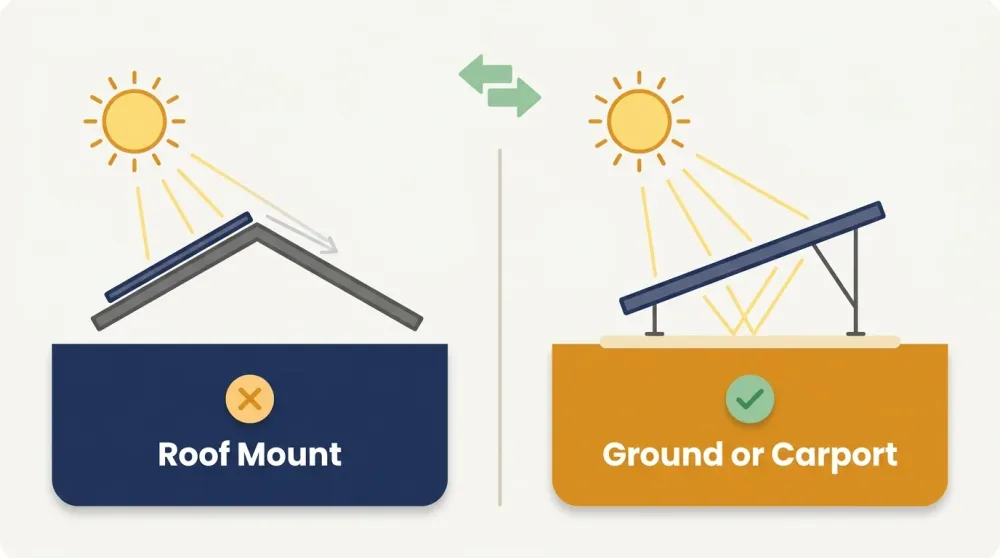
Short answer: Bifacial solar panels can collect light on their back as well as their front, but the back side only helps if light actually reaches it. That depends mostly on how reflective the surface underneath is and how much space sits between the panel and that surface. On a typical home, where panels are mounted close to a dark shingle roof, the rear side sees little light, so any extra output is likely to be small. Bifacial panels for a home make the most sense on ground mounts, carports or tilted racks over bright surfaces, not on a standard pitched roof.
That does not make a bifacial panel a bad panel. It means the "two sides" pitch deserves a specific question before it justifies anything on your quote.
A standard, or monofacial, panel has cells that collect light from the front only. The back is covered by an opaque sheet. A bifacial panel lets light reach the cells from the rear as well, so reflected or scattered light hitting the back can add some output.
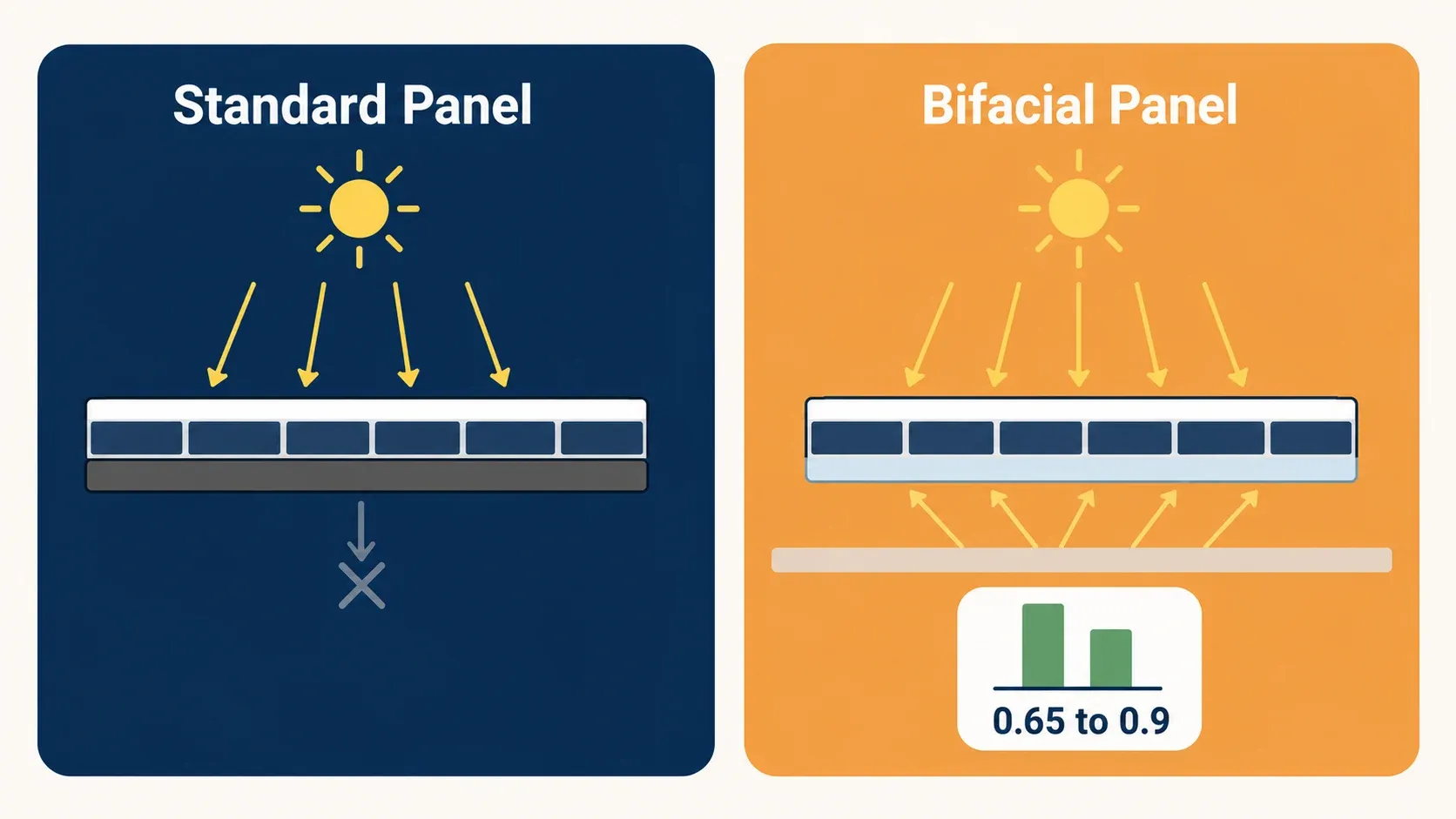
The rear side is usually less efficient than the front. The federal lab behind the PVWatts calculator describes this in the documentation for its PVWatts Version 8 calculator API (read September 27, 2026). It defines "bifaciality" as "the ratio of rear-side efficiency to front-side efficiency," and says it is "typically a value between 0.65 and 0.9 provided on the bifacial module datasheet."
In plain terms: even when light does reach the back, the back converts it less efficiently than the front. And the NLR documentation adds an important line: "The bifaciality does not affect the solar irradiance on the rear of the module." A high bifaciality number on a datasheet cannot create rear-side light that the installation does not deliver.
Three physical factors matter far more than the panel itself.
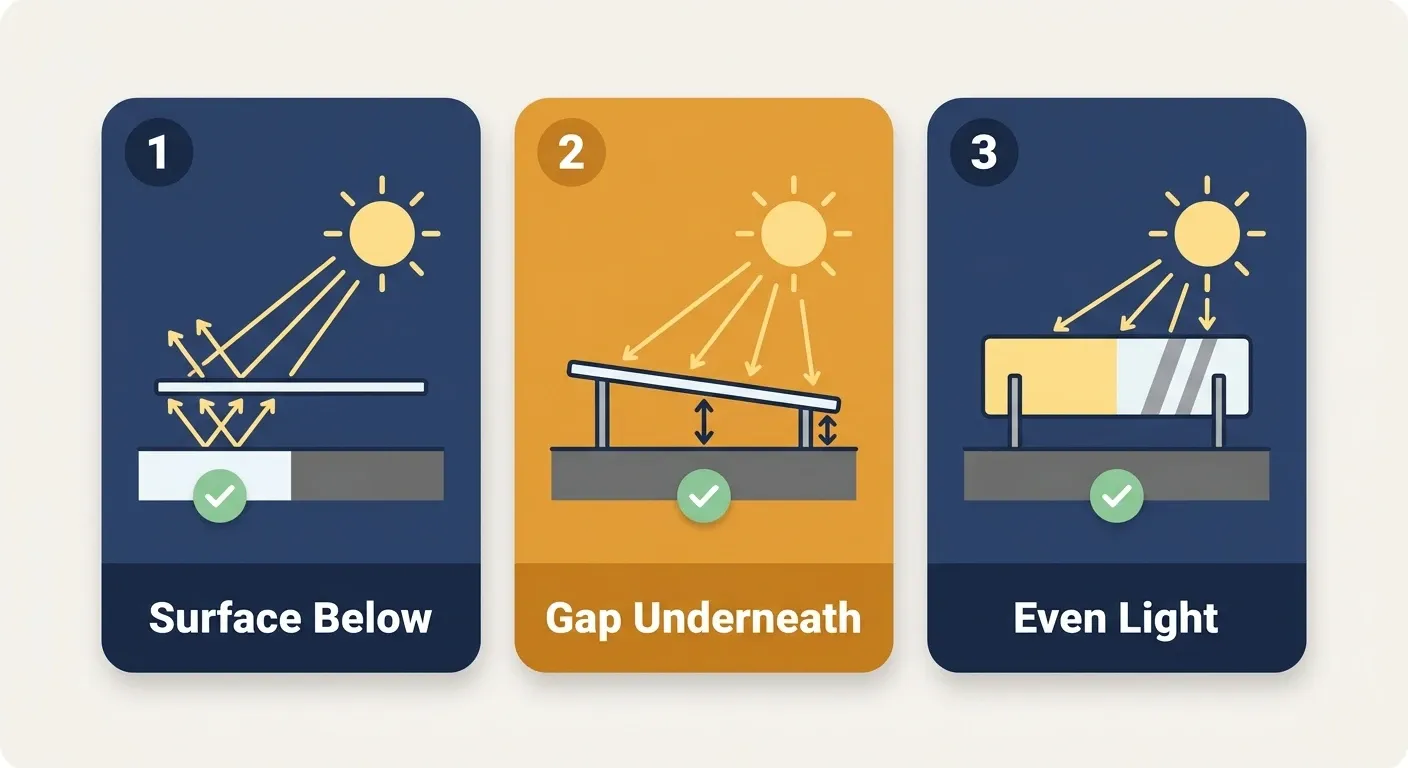
Reflectivity is called albedo. The NLR PVWatts documentation describes albedo as ground reflectance, where 0 means "completely non-reflective" and 1 means "completely reflective." A bright surface bounces more light toward the back of the panel than a dark one.
A 2024 study in the journal Heliyon by Garrod and colleagues tested a bifacial panel in the UK over grass and over a reflective material, and found that the panel's normalized efficiency was generally higher over the reflective material. Most residential shingles are not a bright, reflective surface.
Light has to get into the gap behind the panel before it can reflect up. NLR's bifacial_radiance modeling toolkit lists "albedo, tilt, pitch, clearance height, and module-to-module spacing" as the settings that shape rear-side light. Clearance height is on that list for a reason. Rooftop arrays are usually mounted only a few inches above the roof surface.
Uneven light on the rear side causes its own losses. pv magazine USA reported in March 2020 on an NREL study that found "annual mismatch losses of up to 2% in rooftop systems mounted close to the surface, falling to less than 0.5% for rooftop systems with higher ground clearance." Close mounting works against a bifacial panel twice: less light reaches the back, and what does reach it is less even.
Put those factors together and a typical pitched residential roof is close to the worst case for a bifacial panel:
| Factor that drives rear-side gain | Typical pitched shingle roof | Where bifacial is better placed |
|---|---|---|
| Surface reflectivity | Usually dark shingles | Light gravel, snow, pale concrete or a white membrane |
| Space under the panel | A few inches | Ground mounts, carports, pergolas, tilted racks |
| Even lighting on the back | Uneven at low clearance | More even at higher clearance |
| Light reaching the back from open sides | Little, rows sit tight to the roof | More, with open space around the array |
We looked for a published, independently measured figure for bifacial gain on a typical flush-mounted US shingle roof and did not find one we could verify from a primary source. Industry articles quote a range of small percentages, but we are not going to repeat a number whose origin we cannot confirm. What the physics and the published modeling tools agree on is the direction: less clearance and a darker surface mean less rear-side benefit.
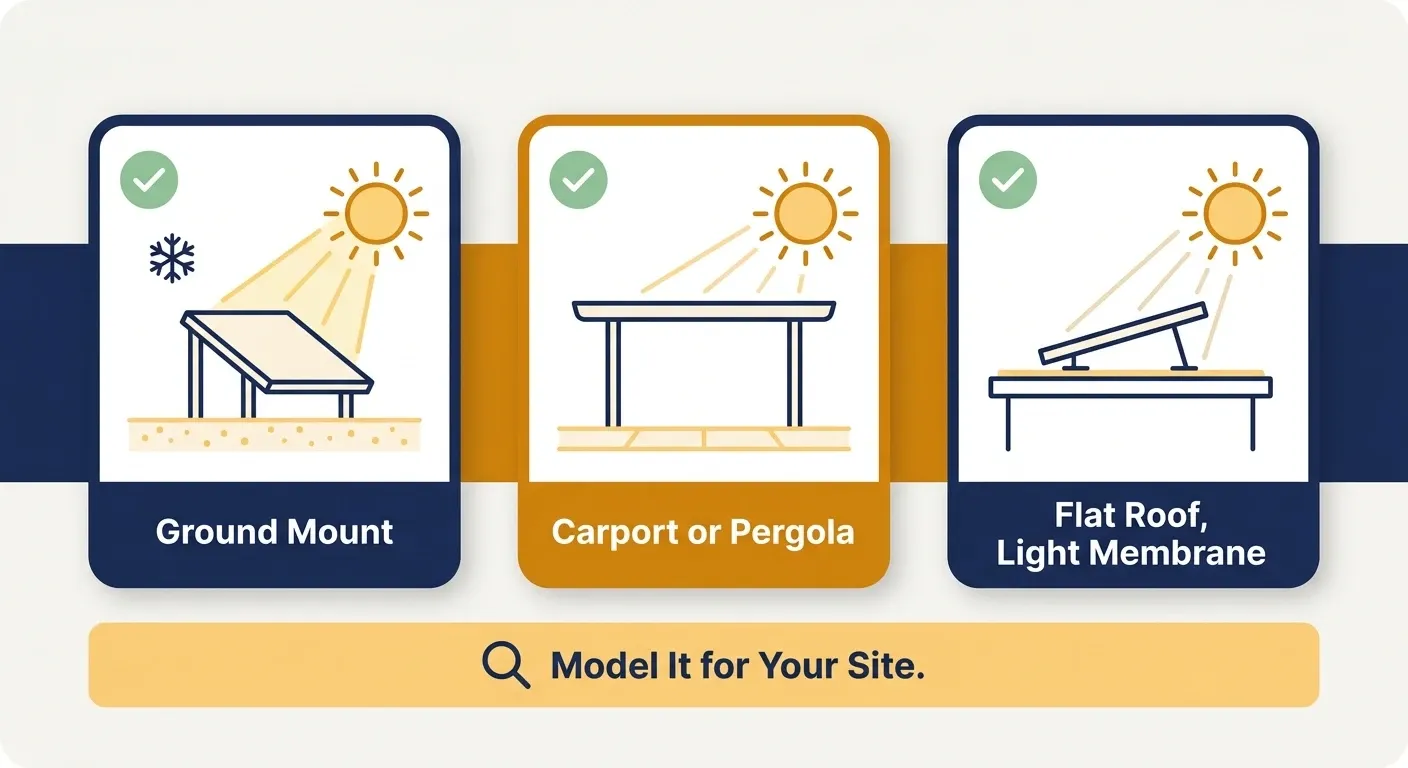
The same factors point to the cases where the back side has a real chance to contribute:
Even in those cases, the gain depends on the specific site. The only way to know is to model it with the actual clearance and surface, not to assume a number.
This is the part most bifacial guides skip. If an installer is pushing bifacial panels as a reason for higher production, the production estimate on your proposal should show it.
The NLR PVWatts Version 8 documentation lists a "bifacial module option" and "new inputs for specifying albedo" among the changes in that version. That means a modeled estimate can include bifacial gain, and if it does, it depends on an albedo value someone chose.
So ask three things:
If the estimate counts no rear-side gain, the bifacial feature is not being priced into the production number, and the comparison comes down to the other specs and the cost. Our guide on whether your solar production estimate is realistic walks through the rest of the inputs worth checking.
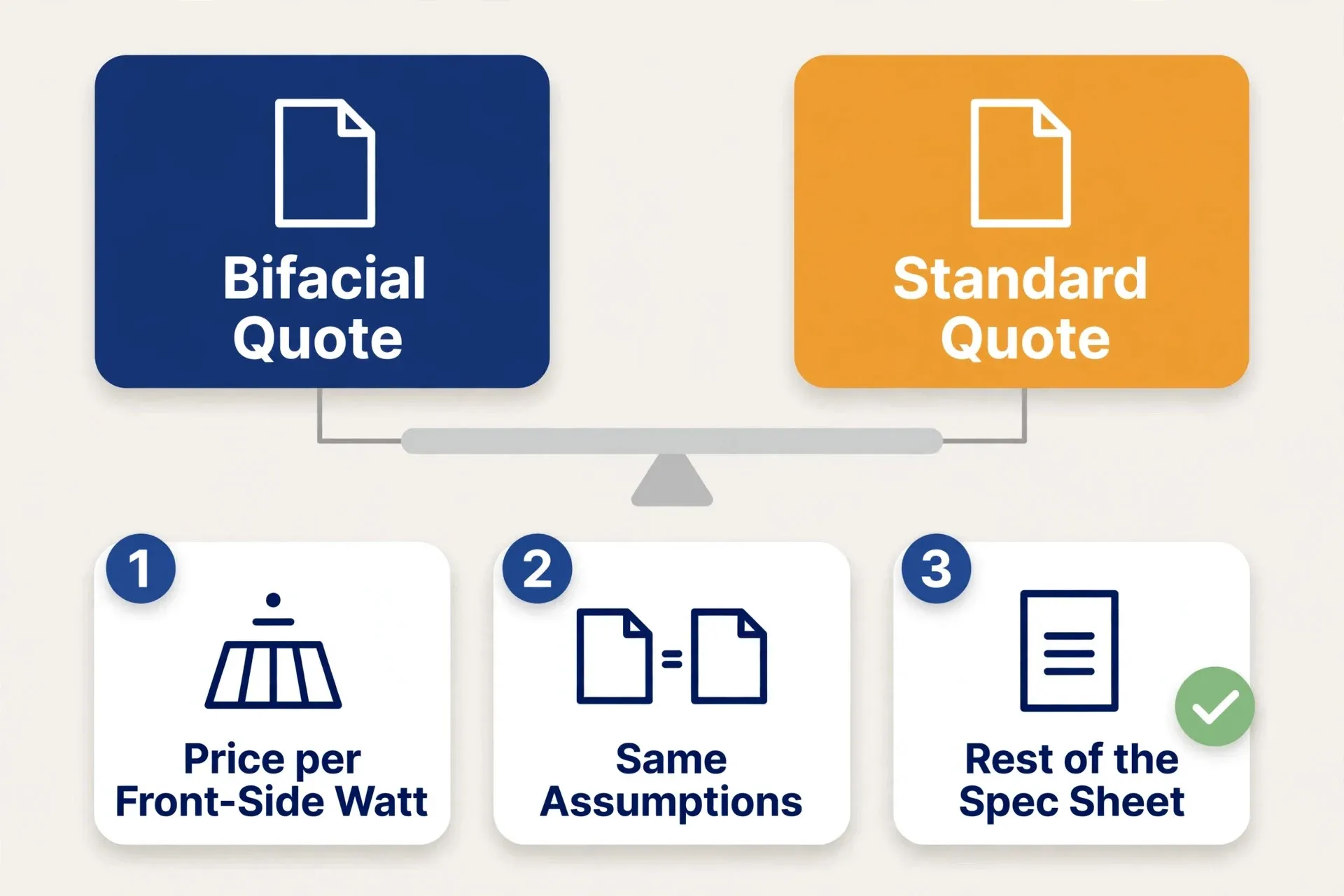
A fair comparison puts both quotes on the same footing:
Our broader guide on how to compare solar quotes shows how to normalize two proposals before judging either. Roof direction and pitch also matter more to output than whether the back of the panel is glass, as our piece on south facing roof solar explains.
"Two sided" sounds like twice the collection surface, and that impression does a lot of work in a sales conversation. The people who benefit from the buyer not knowing how little light reaches the back of a flush-mounted panel are those who would like the feature to carry a higher price or a rosier production number.
That is not an argument against the panel. A bifacial panel may be a perfectly good product with good front-side specs, and it may be what an installer happens to stock. It is an argument against paying for, or being persuaded by, a rear-side benefit your roof cannot deliver. Any installation work, including whether a roof can take a raised or tilted rack, is a question for a licensed installer and, where structure is involved, a qualified professional, not a homeowner decision made from a datasheet.
On a typical pitched roof with panels mounted close to dark shingles, the rear side receives little light, so the added output is likely to be small. Bifacial panels have a better case on ground mounts, carports or tilted racks over bright surfaces. Whether they are worth it depends on your site and the price difference on your quote.
They work, because the front side performs like a normal panel. The back side contributes little when the panel sits a few inches above a dark roof, since not much reflected light reaches it and what does is uneven.
It is the ratio of the rear side's efficiency to the front side's. NLR's PVWatts documentation says it is typically between 0.65 and 0.9. It does not change how much light reaches the back of the panel.
Ask the installer whether the production estimate includes rear-side gain and what albedo and clearance it assumed. Ask for the estimate without rear-side gain as well, so you can compare it fairly with a quote for standard panels.
They do best with clearance under the panel and a reflective surface below, such as light gravel, snow, pale concrete or a white roof membrane. Ground mounts and elevated structures like carports tend to provide both.
One email a week with new guides, tips, and solar news. Zero fluff, no sales pitch.