Oversize Solar System NEM 3.0? What to Weigh

United States only. Last reviewed September 11, 2026.
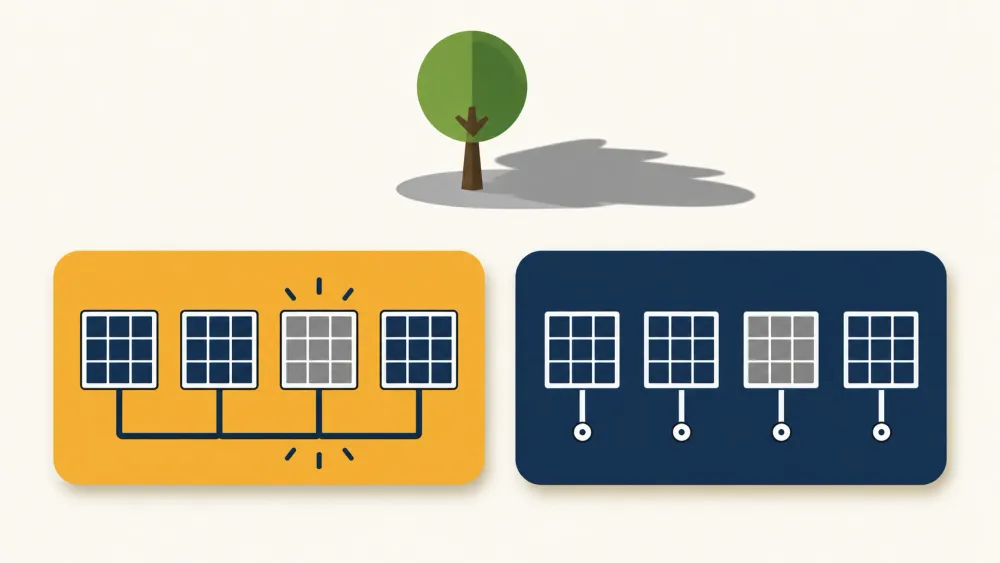
Whether a tree costs you one panel or a whole row depends mostly on how the system is wired, not on the tree. On a string inverter, panels share one circuit, so shade on one panel can pull down the others in its string. With microinverters, the Department of Energy states, "shading or damage to one panel will not affect the power that can be drawn from the others." How much shade is too much is a modeled number for your roof, by month and by hour, and the Department of Energy's own homeowner guide says heavy shade from nearby trees can make rooftop panels a poor fit.
A solar panel is made of cells wired in series, and panels themselves are commonly wired in series into a string. In a series circuit, the current is limited by the weakest part. Shade one part and the rest of the chain is held back with it.
Panels are built with bypass diodes, which let current route around a shaded section of a panel instead of stalling it. That helps, but the bypassed section contributes nothing while it is shaded.
The practical result is that partial shade is non-linear. A shadow covering a small share of an array's area at the wrong moment can remove a larger share of its output at that moment, depending on where the shadow falls and how the panels are connected.
The Department of Energy's page on inverter basics, read on September 11, 2026, describes the two main layouts.
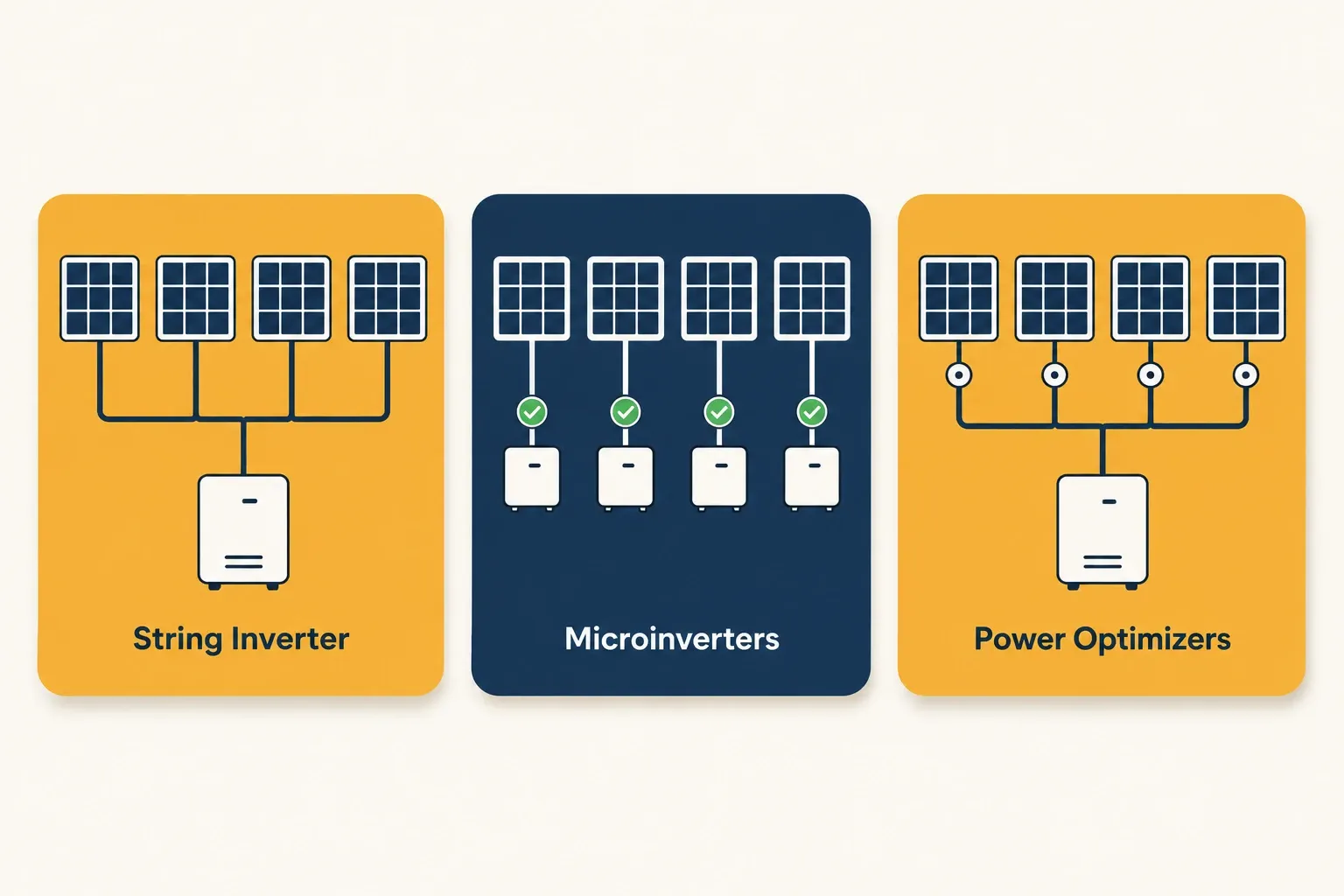
A third option, power optimizers, attaches electronics to each panel while keeping a central inverter. It aims at the same problem: letting each panel work at its own best operating point instead of the string's.
This is why "do I lose the whole system or one panel" has no single answer. On a shaded roof, the electrical design is part of the shade answer, and a proposal for a shaded roof should say which design it uses and why. This page does not rank equipment or brands. What matters is that the proposal models the design it is actually selling.
Shade enters a production estimate as a loss, and someone chose the number.
The public calculator PVWatts, from the National Laboratory of the Rockies, lists shading among its system losses and defines it as "reduction in the incident solar radiation from shadows caused by objects near the array such as buildings or trees." Its default shading value, per the calculator page read on September 11, 2026, "represents an array with little or no shading." A roof with trees is not that roof, and an estimate that leaves the default in place has not modeled your trees.
Installers typically assess shade with measurements on site or with software that models the surroundings in three dimensions, and report it as solar access or shade loss, often by month. Ask for that report. It should tell you:
Whether a proposal's production estimate is realistic depends heavily on this one input. If the proposal carries a production guarantee, the shade assumption is part of what that guarantee is measured against, so it is worth reading before signing.
Shade is not constant, which is why a single "shaded" or "unshaded" label is not enough.
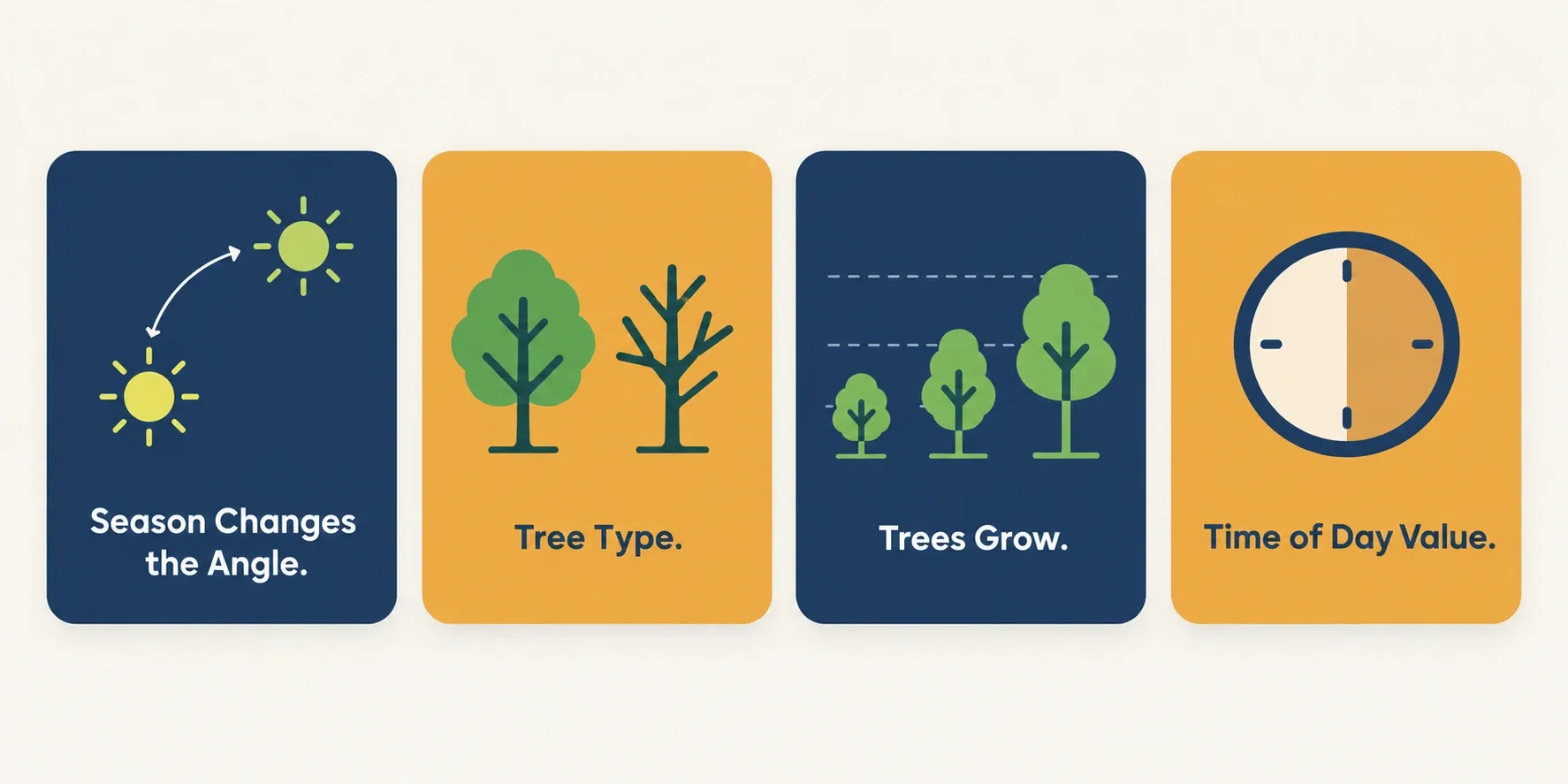
The sun's path changes through the year. In winter the sun sits lower in the southern sky and shadows are longer. In summer it is higher. A tree that clears the array in June can shade it in December, and obstructions to the east or west behave differently again.
Deciduous and evergreen trees behave differently. A tree that drops its leaves casts a thinner shadow in winter, and an evergreen casts roughly the same one all year. Bare branches still cast shade, just less.
Trees grow. A system is expected to run for decades. An estimate made against a young tree's current height describes this year, not year fifteen.
Morning and late-afternoon shade usually costs less energy than midday shade, because less sunlight arrives at those hours anyway. On a tariff that values afternoon production highly, though, shade on the west side can cost more money than its energy share suggests. Your electricity rate decides how much each shaded hour is worth.
There is no universal threshold, and pages that print one are describing a different roof. The workable test has three parts.
A heavily shaded roof is one of the specific cases where solar may not be worth it. That conclusion is a legitimate outcome, and a proposal that never raises it on a visibly shaded roof deserves a question.
Tree work near a house is dangerous work at height, and it often happens near power lines.
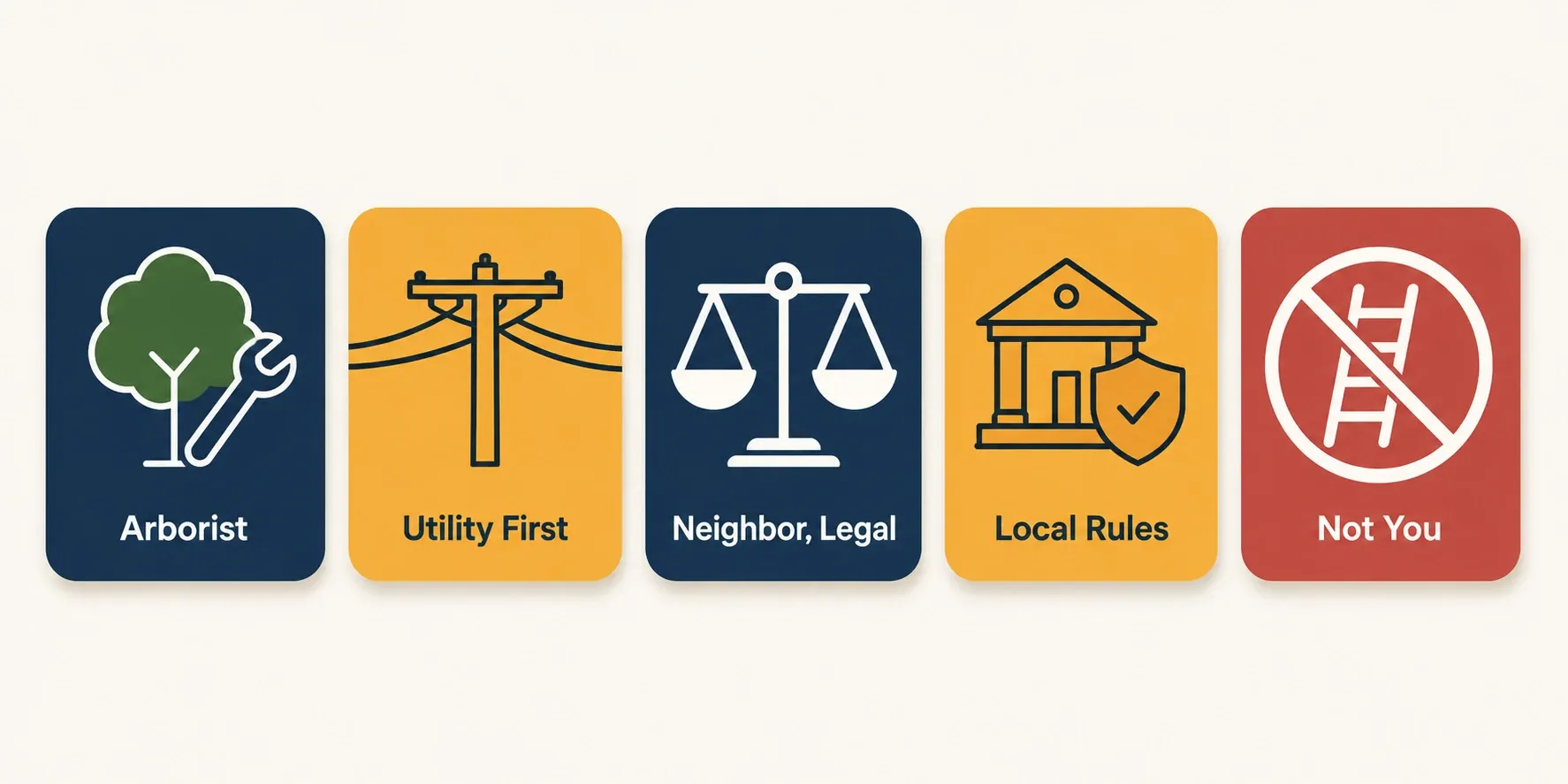
Do not climb onto the roof or into a tree to assess shade yourself. NIOSH, the CDC's occupational safety institute, states in an April 2026 bulletin that "falls from elevation remain the leading work-related cause of death in construction," and names roofing and ladder work among the tasks where many falls occur. Shade can be assessed from the ground with software and site measurement by the installer. A rooftop array carries DC voltage whenever light reaches it, and any electrical work on it is for a licensed electrician.
Not the whole system, but it can reduce the output of other panels. On a string inverter, panels share one series circuit, so a shaded panel can hold back the string it is in. With microinverters, the Department of Energy states that shading on one panel will not affect the power drawn from the others. Power optimizers address the same problem while keeping a central inverter.
They produce less, and how much less depends on how much of each panel is shaded, when, and how the system is wired. Diffuse light still produces some output. The only useful answer for a specific roof is a shade report and a production estimate that applies it.
That is a trade-off between the energy the trees cost, what the trees provide, and local rules. Modeling the system with and without the trees shows the difference in production. Any trimming or removal near a house belongs to a qualified, insured arborist, and anything near power lines needs the utility first.
Ask each installer for the shade report behind their proposal: which panels, which months, which hours, and what loss was applied. Compare the shaded estimate with an unshaded PVWatts run for the same roof. If the loss makes the system uncompetitive on your electricity rate, the roof may not suit rooftop solar, which the Department of Energy's own guide acknowledges.
Shade costs more than its area suggests, because panels in a string share one circuit, and microinverters and optimizers limit that at a cost. Shade enters every production estimate as a loss someone chose, and PVWatts' own default describes a roof with little or no shading. Ask for the shade report by panel, month and hour, check it against your own run, and price the result. Leave tree work to an arborist, power lines to the utility, and the roof to the installer.
One email a week with new guides, tips, and solar news. Zero fluff, no sales pitch.