Time of Use Battery Savings: Does the Math Add Up?

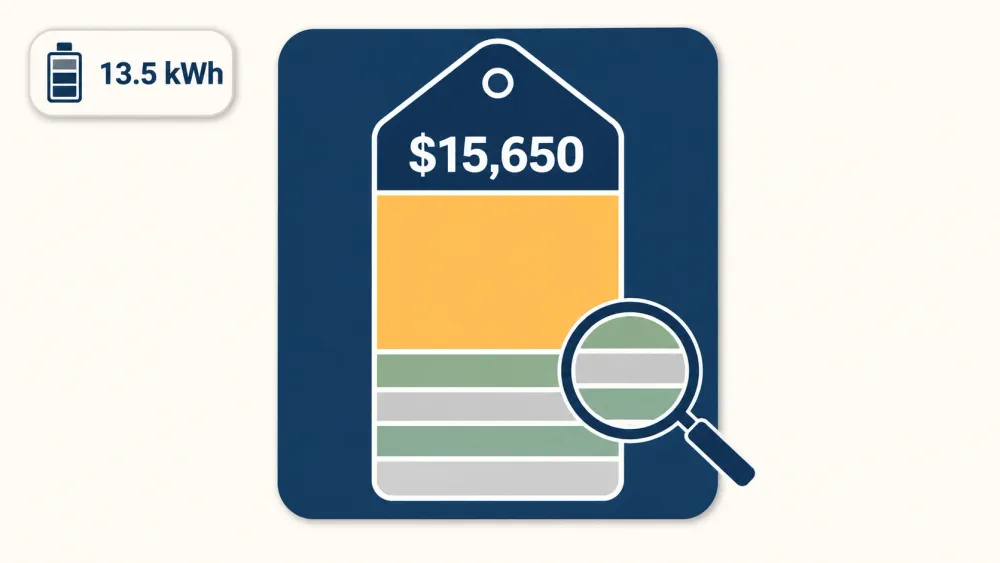
A current national benchmark for home battery cost 2026 is about $15,650 installed for 13.5 kWh of storage, before any incentive, based on EnergySage marketplace quotes from the first half of 2026. That works out to roughly $1,160 per kilowatt-hour of capacity. Backing up a whole house costs far more: EnergySage's cost guide puts whole-home backup at about $34,000. And a battery bought with cash or a loan in 2026 gets no federal tax credit, because the IRS says the Residential Clean Energy Credit is not available for property placed in service after December 31, 2025.
That $15,650 is an average of quotes, not a price anyone has to honor, and the battery itself is only part of it. This page breaks the installed number into the pieces a quote can hide, shows how much scope moves the total, and names who benefits when the pieces stay bundled. It covers the United States only. Incentives and utility rules differ by state and change, so confirm anything local with your own state and utility before acting on it.
EnergySage is an online marketplace where homeowners collect installation quotes, and its solar battery cost guide (updated July 13, 2026, read September 24, 2026) is the most recent public source of installed battery prices this page could verify. Every figure below is before incentives.
| What EnergySage reports | Figure | Basis |
|---|---|---|
| Typical installed cost | About $15,650 | 13.5 kWh, marketplace quotes from the first half of 2026 |
| Whole-home backup | About $34,000 | Stated in the cost guide; no capacity given |
| Equipment share of the price | 50 to 60 percent | "Typically," per the guide |
| Highest and lowest cost per unit of capacity | Delaware highest, Arkansas lowest | Based on EnergySage quotes |
Two cautions before you use any of it. First, 13.5 kWh is the amount EnergySage describes as what a typical home needs to keep essential devices running during an outage. It is not a whole-house figure, and treating it as one is how a buyer ends up surprised by the second quote. Second, the roughly $1,160 per kWh above is simple division of EnergySage's two numbers, not a separate statistic, and an average of marketplace quotes is a benchmark for checking a quote, not a forecast of yours.
The guide lists what pushes a battery quote up or down: how much storage you need, the type of inverter, whether the battery is added to an existing solar system or installed with new panels, which incentives are available, whether the electrical panel needs an upgrade, and which installer you choose. Most of those are decided by your house, not by the battery.
If equipment is typically 50 to 60 percent of the price, as EnergySage states, then 40 to 50 percent of what you pay is something other than the battery. That share is where two quotes for the same battery drift apart, and where a single bottom-line number can hide the most.
| Layer of the price | What it usually covers | What to get in writing |
|---|---|---|
| The battery and its controls | Battery units, the equipment that lets them run the house during an outage, monitoring | Usable capacity in kWh, continuous power in kW, warranty conditions |
| Backup wiring | A critical-loads subpanel for essential-loads backup, or equipment at the main panel for whole-home backup | Exactly which circuits are backed up, and who sized them |
| Electrical upgrades | A main panel upgrade if the existing panel cannot accommodate the system | Whether it is included, or still "pending site visit" |
| Permits and paperwork | Building and electrical permits, inspection, any utility review your utility requires | Whether fees are inside the price or billed separately |
| Labor, design and margin | Installation labor, engineering, sales and overhead | A cash price with the battery as its own line item |
EnergySage's guide makes the point about the second row directly: the critical load panel itself isn't costly, but "the electrical work required to install one can add up." That sentence is the whole reason to ask for backup wiring as its own line.
None of this is do-it-yourself territory. Installing a battery and connecting it to your home's main panel is work for a licensed electrician, done under the permits your local building department requires, and the sizing of the backup circuits belongs to the electrician, not to the homeowner or the salesperson.
The two headline figures, about $15,650 for 13.5 kWh aimed at essential devices and about $34,000 for whole-home backup, show how much scope moves the price: the whole-home figure is more than twice the essential-loads one. An essential-loads design backs up a chosen list of circuits, such as the refrigerator, some lights, the internet router and a few outlets. A whole-home design is expected to carry the entire panel, which takes more capacity, more power output and usually equipment that stops large appliances from drawing at the same moment.
This is also where the safety risk sits. A system sized only for essential loads has a hard ceiling, and running extra appliances on backed-up circuits during an outage can overload it. The mild outcome is a tripped breaker or a system shutdown in the middle of the outage it was bought for. The serious outcome, if anything is modified to force more current through a circuit, is overheated wiring, which is a fire risk. Deciding which circuits go on backup, and sizing the panel and battery to them, is a licensed electrician's job. When a quote offers both scopes, ask the installer to show what changes in equipment and labor between them for your own panel, rather than choosing from a brochure.
Dividing each quote by its storage capacity turns two differently sized proposals into one comparable number. It is the same normalize-then-compare method that works for panels, explained step by step in how to compare solar quotes. Two details keep the division honest:
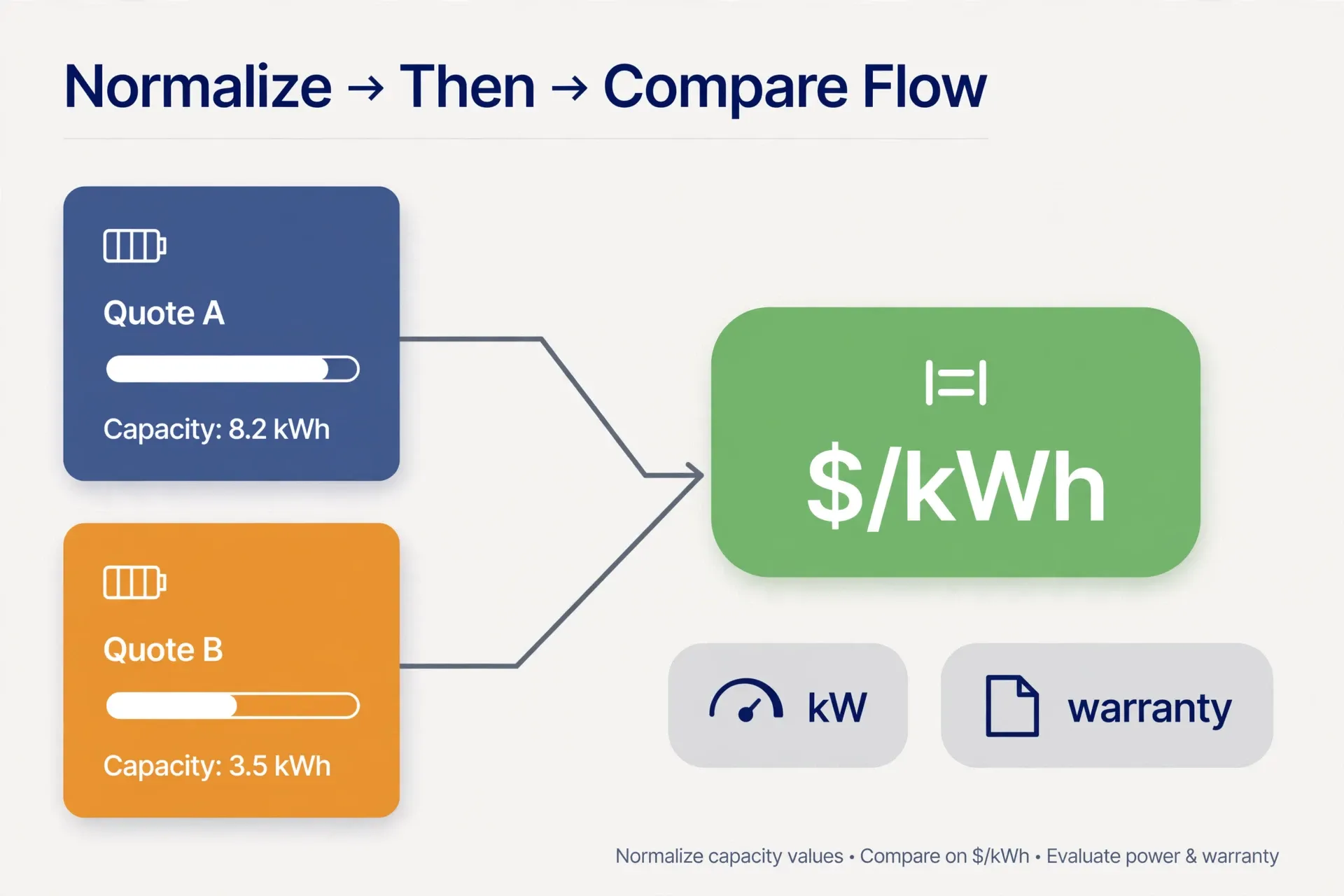
Warranty terms belong in the comparison too. Ask what conditions limit the warranty, not just how many years it lists, and get the answer in the contract rather than the brochure.
From 2023 through 2025, a homeowner who bought a qualifying battery could claim the federal Residential Clean Energy Credit on it. The IRS page for that credit (last updated July 4, 2026, read September 24, 2026) lists battery storage technology with a capacity of at least 3 kilowatt-hours as a qualifying expense beginning in 2023, and states that the credit "is not available for any property placed in service after December 31, 2025."
Two practical consequences follow. The IRS wording turns on when the property is placed in service, so a battery installed in 2026 falls after that line as the page states it, whenever the contract was signed. And any proposal that still subtracts a federal credit from the price of a battery you would own is showing you a number you cannot claim. Ask for the price with no federal credit applied, and compare that.
Leases and other third-party-owned arrangements are a separate case, because the owner of the equipment is a company, not you, and a different section of the tax code applies to it. How the 48E credit works on a residential lease covers what that means and what you trade for it. None of this is tax advice; your own position is a question for a qualified tax professional.
EnergySage's guide is direct about timing: "If you install storage at the same time as your solar panel system, you save money by getting the electrical work completed simultaneously. If you retrofit a battery to an existing solar panel system, you'll pay extra for labor, wiring, and in some cases, equipment."
That is a real saving, and it is also the strongest sales argument for bundling a battery into a solar contract. Both things are true at once. The honest version of the bundle is one where the battery still appears as its own priced line, so you can see exactly what declining it would change before you decide.
A battery adds a large sum to a solar contract, and everyone paid on the sale earns more on a larger contract. That does not make a battery a bad purchase. It does mean three common presentations deserve a second look.
It cannot tell you your price. Marketplace averages blend many homes, installers and states, and only a site visit turns them into a quote: whether your main panel needs an upgrade, where local code lets the battery go, and which circuits your household actually needs. It also does not say whether a battery pays for itself for you. That depends on your utility's rate design and how often your power goes out, not on the purchase price alone, and no general article can promise a saving on your bill. Treat the figures here as a check on a quote, dated to when they were read, and expect them to move.
About $15,650 installed for 13.5 kWh before incentives, based on EnergySage marketplace quotes from the first half of 2026, which is roughly $1,160 per kWh of capacity. Whole-home backup costs considerably more; EnergySage's cost guide puts it at about $34,000.
Not for a battery you own that was placed in service after December 31, 2025, according to the IRS page for the Residential Clean Energy Credit. Leased batteries sit under different rules because the leasing company owns them. Confirm your own situation with a qualified tax professional.
Because the equipment is typically only 50 to 60 percent of the installed price, according to EnergySage. Backup wiring, panel upgrades, permits, labor and installer margin make up the rest, and those vary by house, installer and state.
EnergySage says installing storage at the same time as solar saves money because the electrical work is done once, while retrofitting a battery onto an existing system adds labor, wiring and sometimes equipment.
A licensed electrician sizes the backup circuits and the system to your panel and the loads you want covered. You choose the priorities; the electrician decides what fits safely under the code that applies where you live.
One email a week with new guides, tips, and solar news. Zero fluff, no sales pitch.