Do I Need a Battery With Solar? The Real Trade-Off

Reviewed on August 5, 2026, against the Consumer Financial Protection Bureau's published findings on solar financing. Covers US residential solar loans only.
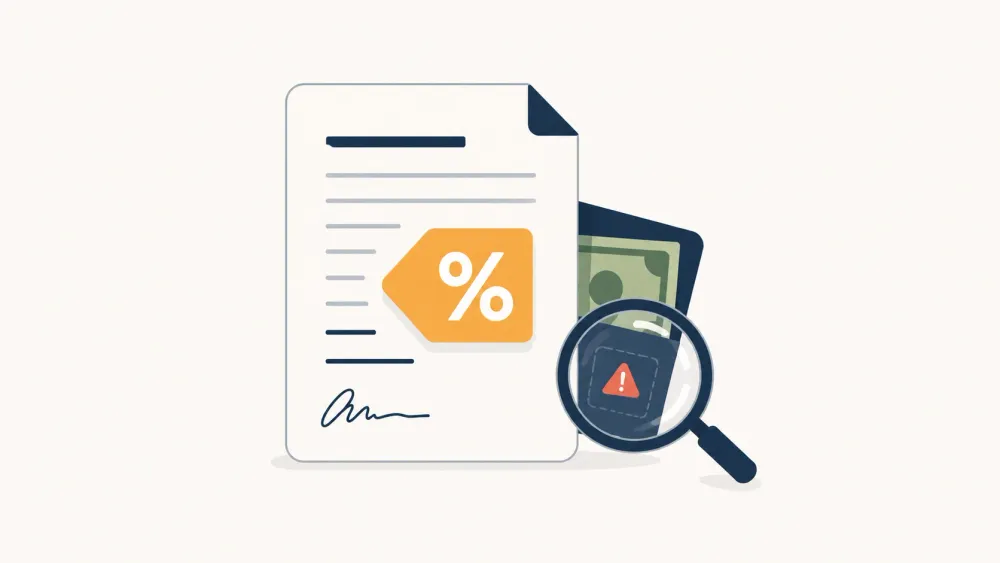
A solar loan dealer fee is a charge a lender adds to the amount you finance, in exchange for letting the installer advertise a lower interest rate than the loan actually carries. Because that fee is folded into your loan principal rather than itemized as a separate cost, the total loan price for a system in the United States commonly comes in higher than the cash price for the identical equipment and installation, even though nothing physical changed.
That gap is the whole subject of this article. If you have not yet settled whether solar makes financial sense for your home at all, the broader economics question this fee sits inside is the place to start.
Three terms matter here, and they get used loosely, so define them once. The cash price is what the installer charges for the system if you pay outright, with no lender involved. The financed amount is the total your loan is written for, which becomes the balance you owe and pay interest on. The advertised rate is the interest rate the installer or lender markets to you, often prominently, sometimes as a promotional figure.
For a cash purchase, those first two numbers are the same. For a loan, they frequently are not. The difference between them, when one exists, is the dealer fee. It exists because solar lenders routinely charge the installer for the right to offer a loan product at an attractively low rate, and installers commonly pass that charge on by financing it into the loan rather than paying it out of pocket or itemizing it as a separate cost to you. The mechanism is not exotic and it is not, by itself, illegal. What makes it worth understanding is that it is easy to miss unless you know to look for it, and it changes what the loan actually costs you compared to what the advertised rate implies.
The simplest way to see the mechanism is as an equation: financed amount equals cash price plus dealer fee. The fee does not appear as its own entry on the payment schedule you see month to month, and it is rarely presented to you as "dealer fee" in plain language. Industry and regulatory sources use several different names for the same underlying charge, including program fee, lending fee, finance fee, platform fee, and original issue discount, in addition to dealer fee itself. Whatever the label, the effect is identical: your starting loan balance is higher than the cash price of the system, and your monthly payment, and the total interest you pay over the loan term, are calculated on that higher balance.
This is why two homeowners can be quoted the same advertised rate on paper and end up financing meaningfully different amounts for the same size system, depending on how large a dealer fee each installer's lender arrangement carries.
The advertised rate and the true cost of the loan are not the same thing once a dealer fee is involved, and the reason comes down to how the fee is structured. Instead of the lender charging you a higher interest rate to cover its costs and the installer's margin, the lender collects that money upfront from the installer, who recovers it by financing a larger principal than the cash price. The rate printed on your paperwork can look competitive, even aggressively low, while the total amount you are actually paying back, principal plus interest, reflects a system that cost more to finance than it cost to buy outright.
This is the specific pattern that makes the advertised rate an incomplete number on its own. A rate by itself does not tell you whether the loan is financing the exact cash price of the system or a meaningfully larger amount; only comparing the financed amount to a genuine cash quote tells you that. How financing changes the underlying cost across cash, loan, lease, and PPA structures is worth reading alongside this if you have not compared all four yet.
The Consumer Financial Protection Bureau (CFPB) is the named federal authority on this specific mechanism, and its findings are the only figures this article will state, because they are dated, sourced, and attributable to a named agency rather than to an installer's marketing or an unverifiable industry estimate.
In its Issue Spotlight on solar financing, published August 2024, the CFPB reported that lenders and installers frequently build dealer fees into the loan principal without clearly disclosing them as a markup over the cash price, and that these fees are typically not reflected in the annual percentage rate (APR) disclosed to borrowers under the Truth in Lending Act (TILA). The Bureau's report states that dealer fees typically range from 10 to 30 percent of the cash price, and that in some cases lenders' markups can increase the loan principal by 30 percent or more above the cash price.
Those figures belong to the CFPB's August 2024 findings specifically, not to this article as an independent claim, and not as a current 2026 average. Fee structures, lender partnerships, and disclosure practices change, and no source available at the time of writing confirms an updated figure. Rather than restate a stale percentage as if it were current, the honest position is to name the mechanism, name the source, and tell you to verify the actual figure on your own paperwork, which the next section covers directly.
Ask for these in writing, before signing anything, from the same installer for the same proposed system:
An installer or lender that cannot or will not produce these in writing has told you something useful on its own.
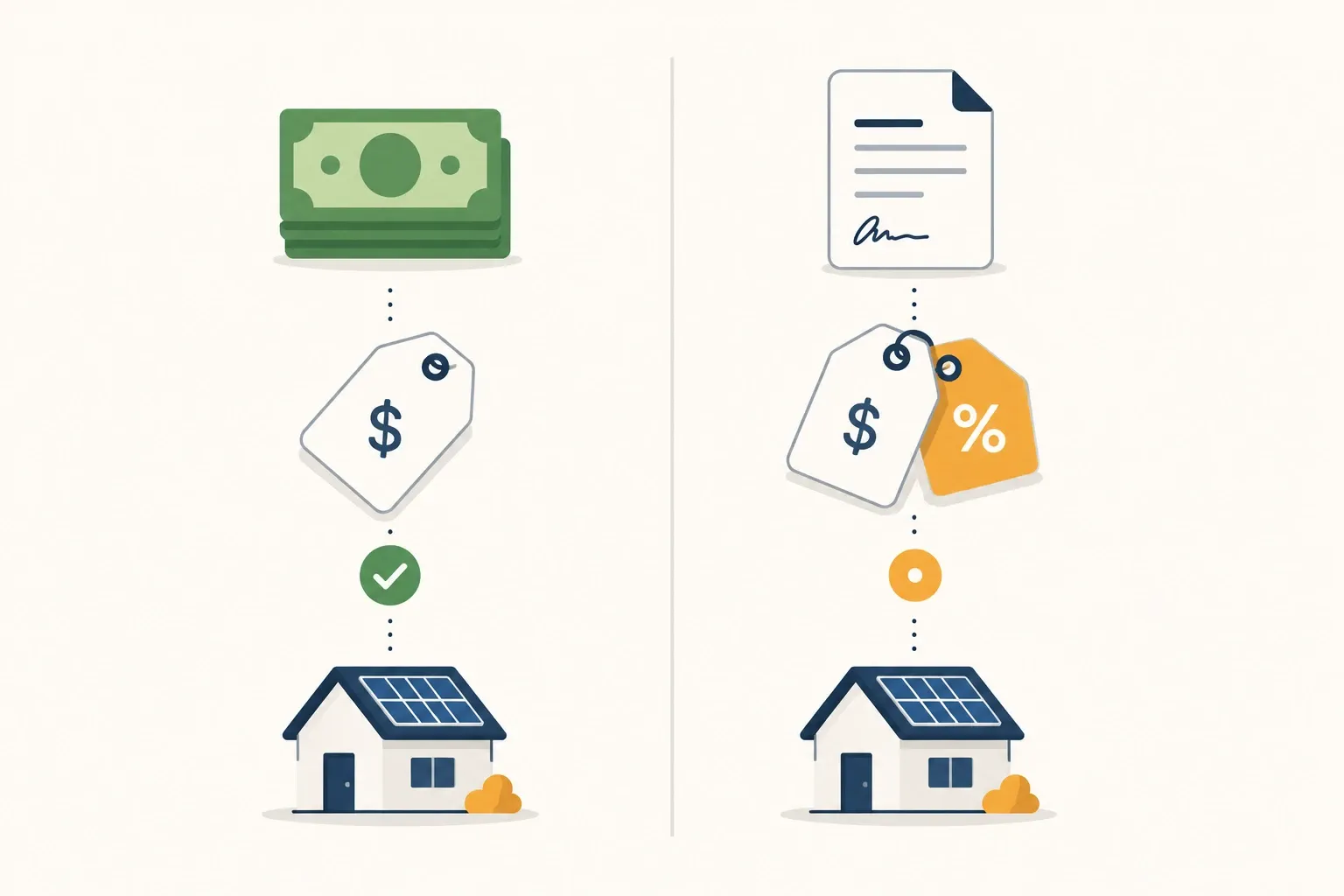
The advertised rate is not a fair comparison point by itself, because it does not account for the dealer fee sitting inside the financed amount. Compare the structure of each offer instead.
| Cash purchase | Loan with a dealer fee | |
|---|---|---|
| What you're quoted first | Price of the system itself | An advertised rate, often before the price |
| What determines your total cost | The cash price alone | Financed amount (cash price plus any dealer fee) and interest over the loan term |
| Where the fee shows up | Nowhere; there is no lender fee | Folded into the principal, not usually itemized |
| What to request before comparing | A written cash-price quote | A written financed-amount figure, separate from the advertised rate |
Once you have both a genuine cash-price quote and a financed-amount figure from the loan offer, for the identical system, the gap between them is what to interrogate before you decide. Comparing on a cost-per-watt basis is a more stable way to sanity-check whether either quote is priced fairly for the system size, and once you know your actual financed cost, recalculating your payback period with that real number, not the cash price, gives you the figure that actually applies to a financed purchase.
Is a solar loan dealer fee illegal? No. It is a legal, widespread practice in solar lending. The CFPB's concern, documented in its August 2024 Issue Spotlight, is around disclosure: that the fee is often not itemized to the borrower and is typically not reflected in the APR disclosed under the Truth in Lending Act, not that the fee itself is unlawful.
Can I ask my installer to remove the dealer fee? You can ask, but a fee that is already built into a lender's rate structure is not always something an installer can simply strip out of that specific loan product. A more useful ask is for an alternative offer, from the same or a different lender, that shows the rate and financed amount with no dealer fee included, so you can compare the true total cost of each option.
Does every solar loan carry a dealer fee? Not necessarily. Loan products and lender arrangements vary. The only way to know for a specific offer is to ask directly whether the financed amount differs from a written cash-price quote for the identical system, and if so, by how much and under what name.
How can I tell if my loan already includes a dealer fee? Compare the amount your loan is financing to a written cash-price quote for the same system from the same installer. A gap between the two is the pattern the CFPB describes; the loan paperwork itself, specifically the Truth in Lending Act disclosure, is where to look for how that gap is characterized.
Does paying cash avoid this fee entirely? Paying cash removes the loan and therefore removes any loan-attached dealer fee, since there is no lender involved. That does not automatically mean the cash price itself is competitive; it should still be checked on a cost-per-watt basis against what a system of that size reasonably costs.
One email a week with new guides, tips, and solar news. Zero fluff, no sales pitch.