Essential Loads Panel: Choosing Which Circuits to Back Up

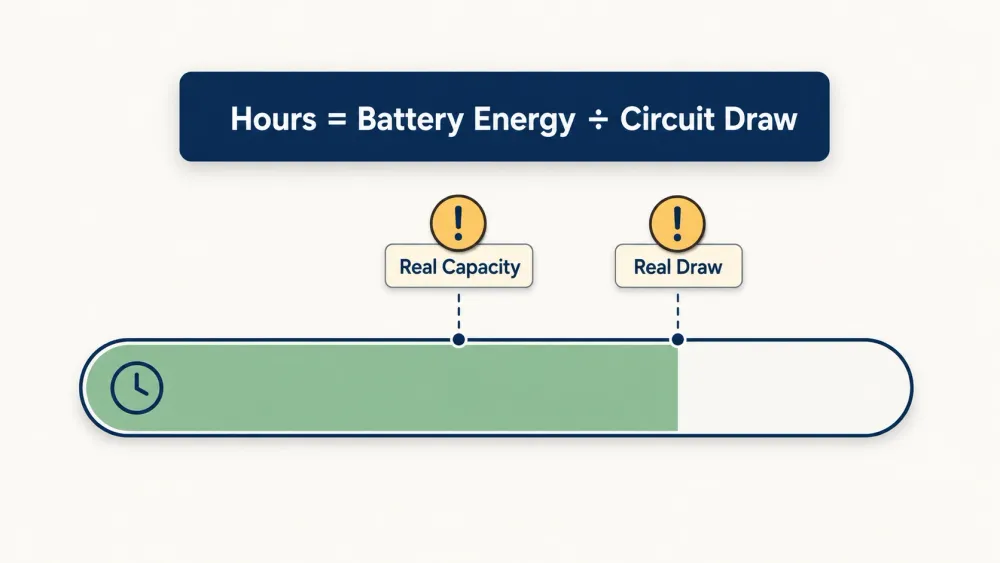
How long does a home battery last in an outage? Divide the energy it holds by what the backed-up circuits draw. The U.S. Energy Information Administration puts the average residential customer's 2022 use at 10,791 kWh, about 29.6 kWh a day, so a full 13.5 kWh battery would carry an average whole home for about 11 hours at best. Limited to essential circuits, the same battery lasts longer. Without solar, that is the ceiling; with panels set up to recharge it during an outage, sunny days can extend it.
That answer is only as good as three numbers runtime claims often leave out: how much energy the battery actually has when the outage starts, how much power it can deliver at once, and how long your outages really last. This page works through each. It is about hours during an outage, not the battery's lifespan in years. It covers the United States only, and none of it is installation guidance: what a battery backs up, and how it is sized, is decided by a licensed electrician.
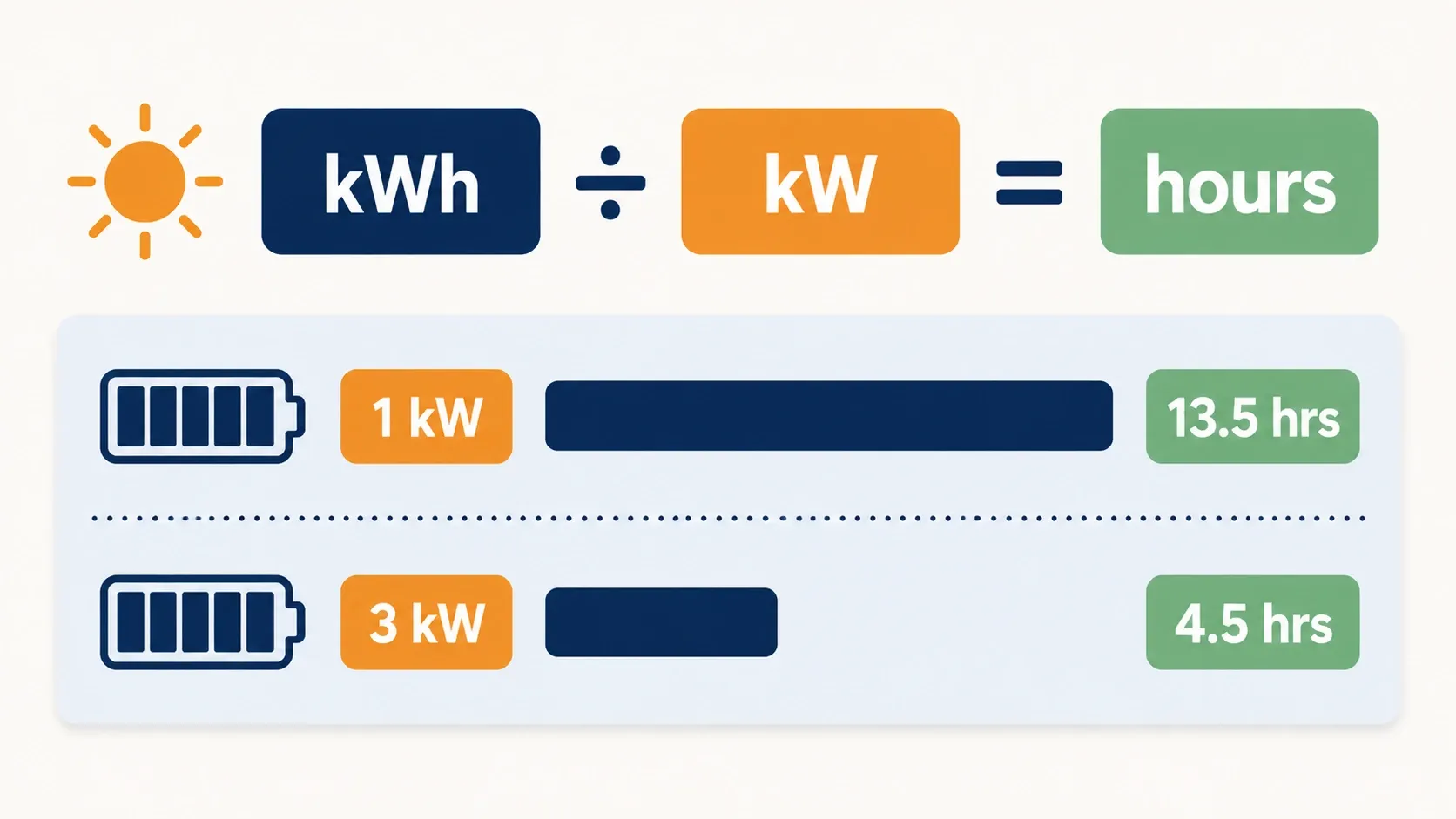
Runtime in hours equals the energy available in kilowatt-hours divided by the average load in kilowatts. A kilowatt-hour is an amount of energy; a kilowatt is the rate at which it is used. A 13.5 kWh battery feeding a steady 1 kW load lasts about 13.5 hours. Feeding 3 kW, about 4.5 hours.
The EIA's household electricity FAQ (read September 24, 2026) gives the average: 10,791 kWh sold to a U.S. residential customer in 2022, about 899 kWh a month. Spread over a day, that is about 29.6 kWh, or an average draw of about 1.23 kW. The same page lists the extremes: Louisiana had the highest use per residential customer at 14,774 kWh, and Hawaii the lowest at 6,178 kWh.
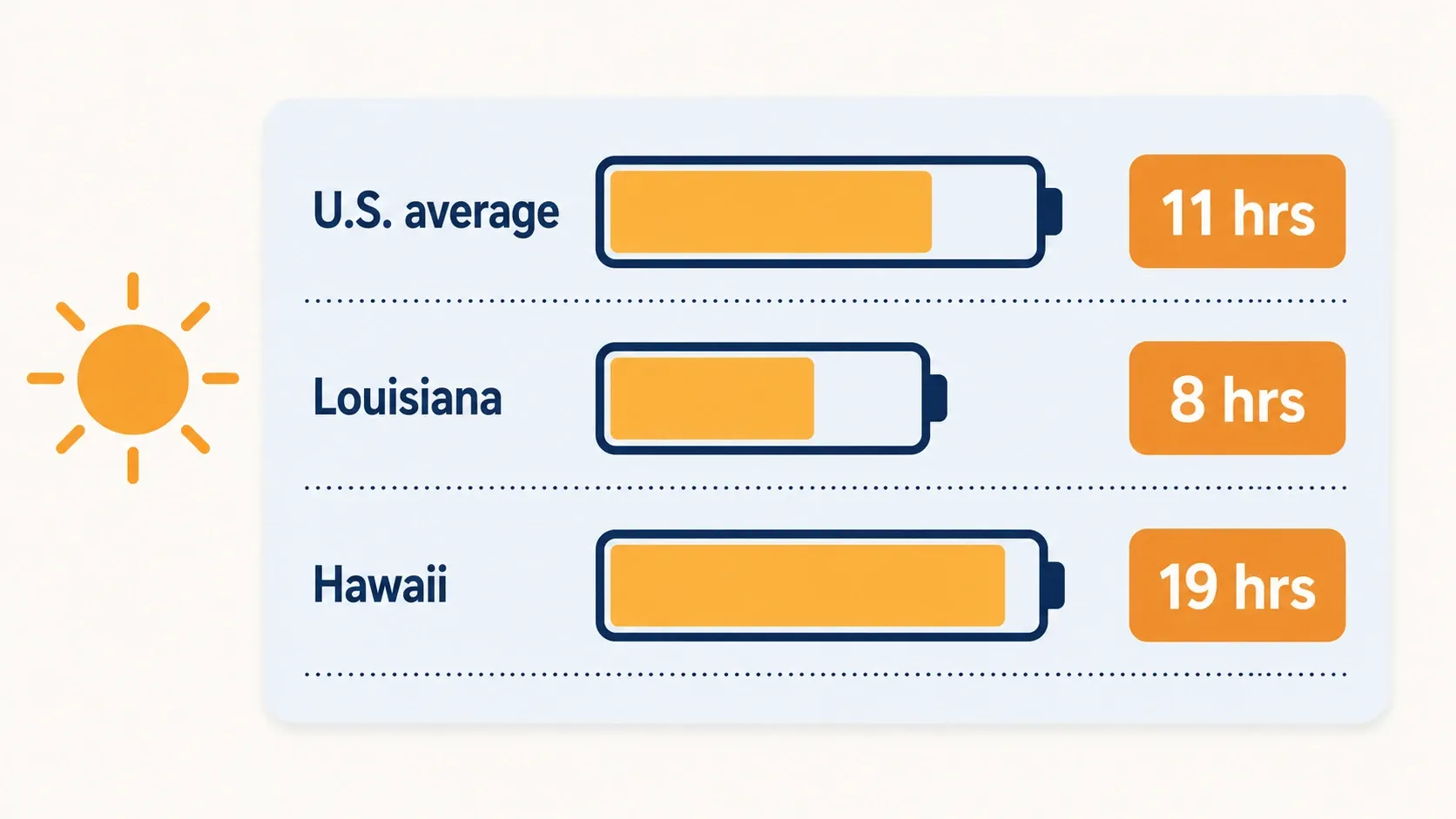
Here is what those averages mean for a 13.5 kWh battery, the size EnergySage's cost guide (read September 24, 2026) describes as what a typical home needs to keep essential devices running during an outage.
| Household | Yearly use (EIA, 2022) | Daily average | Full 13.5 kWh battery lasts about |
|---|---|---|---|
| U.S. average | 10,791 kWh | 29.6 kWh | 11 hours |
| Louisiana average, highest state | 14,774 kWh | 40.5 kWh | 8 hours |
| Hawaii average, lowest state | 6,178 kWh | 16.9 kWh | 19 hours |
This is an illustration, not a forecast. It assumes the whole home stays on, the battery starts full, no solar recharges it, and no energy is lost converting stored power into household power, all of which flatter the result. A yearly average also hides the months that matter: a summer air-conditioning month or a winter electric-heat month can run well above it. Finding your annual kWh on your own bill gets you your real number, and your highest month is the one to plan around.
The battery's usable capacity is the ceiling, not the starting point. What matters is how much of it is there at the moment the grid drops.
A battery that sits full waiting for an outage starts at the top. Many do not. A battery that also runs every evening to cut a time-of-use bill, or answers calls from a utility program, spends part of each day partly empty. Many systems let the owner set a backup reserve, a share of capacity held back for outages. If the reserve is set at half, a 13.5 kWh battery that has done its evening work starts an unexpected outage with 6.75 kWh, and every figure in the table above is cut in half.
Ask the installer what the reserve will be set to, who can change it, and whether any program you enroll in can draw below it. Home battery rebates in 2026 covers what those programs ask of your battery in exchange for their payments.
Capacity decides how long a battery runs. Power decides what it can run at the same moment. A battery system has a continuous power rating in kilowatts, and if the loads switched on together exceed it, the system trips or shuts down rather than running them.
The Annual Technology Baseline published by the National Laboratory of the Rockies, read September 24, 2026, models a representative residential battery as a 5 kW, 12.5 kWh system and calls it a 2.5-hour system. That label is the formula in miniature: run flat out at 5 kW, 12.5 kWh is gone in two and a half hours. Run at 1 kW, the same battery lasts more than twelve.
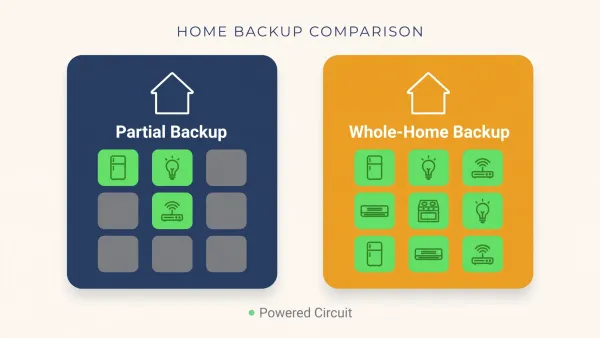
Large loads are where both limits bite. Central air conditioning, electric ranges, clothes dryers and electric water heaters draw heavily, and motors such as compressors and well pumps also pull a brief surge when they start. A whole-home backup design has to be sized for those loads, often with equipment that stops several from starting at once. An essential-loads design usually leaves them off entirely.
A battery is only short if the outage is long, so your outage history matters as much as the battery's size. The EIA's review of 2024 power interruptions (published December 1, 2025, read September 24, 2026) found that U.S. customers averaged 11 hours of interruptions in 2024, nearly twice the average of the decade before. Major events such as Hurricanes Beryl, Helene and Milton accounted for 80 percent of those hours, and interruptions not triggered by major events routinely average about two hours a year.
Outside major events, then, the average customer's interruptions add up to about two hours a year, which a full 13.5 kWh battery covers several times over even at average whole-home use. The hours that drive the national figure come in long, storm-driven stretches: customers in South Carolina averaged nearly 53 hours of interruptions in 2024, while customers in Arizona, South Dakota, North Dakota and Massachusetts averaged under two. A battery sized for the ordinary interruption will not necessarily survive the storm, and the storm is the outage a backup purchase is really insuring against.
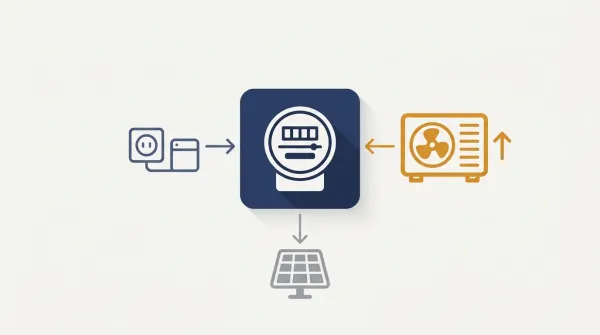
A grid-tied solar system with no battery shuts down when the grid does, so panels alone do nothing during an outage. With a battery and equipment configured to allow it, panels can recharge the battery during daylight while the grid is down, which turns a fixed reserve into one that partly refills each day.
How much it refills depends on the size of the array, the season and the weather on the days in question. Peak sun hours by state explains what the published sunshine tables average away, and it is the average that misleads here: a multi-day outage is often caused by weather, and the days it lasts are not guaranteed to be sunny ones. Treat solar recharge as a way to stretch an outage, not a promise to outlast any outage.
A backup system sized only for essential loads has a hard ceiling. The circuits moved onto a critical-loads panel, and the battery and wiring behind them, are sized for the specific loads the electrician planned. Running extension cords from a backed-up outlet to a space heater or an extra appliance during an outage can overload that design. The mild outcome is a tripped breaker or a system shutdown partway through the outage. The serious outcome, if a breaker or connection is modified to force more current through a circuit, is overheated wiring, which is a fire risk.
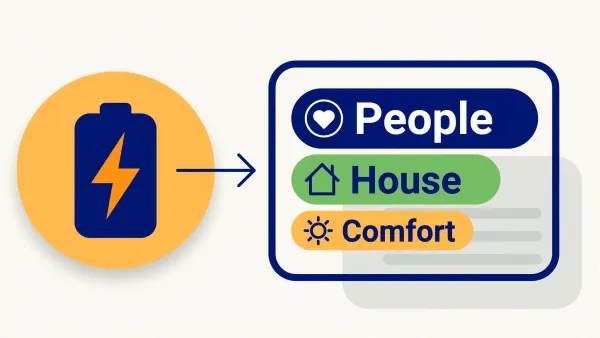
Sizing the panel and the backup system is done by a licensed electrician, not the homeowner and not the salesperson. The homeowner decides priorities, such as the refrigerator, a well pump, communications or medical equipment. The electrician decides what fits and how it is wired to the code that applies where you live. If anyone in the house depends on powered medical equipment, tell the electrician at the start, and ask your utility whether it offers any registration for customers with medical needs.
Five pieces of information replace the averages above with your house:
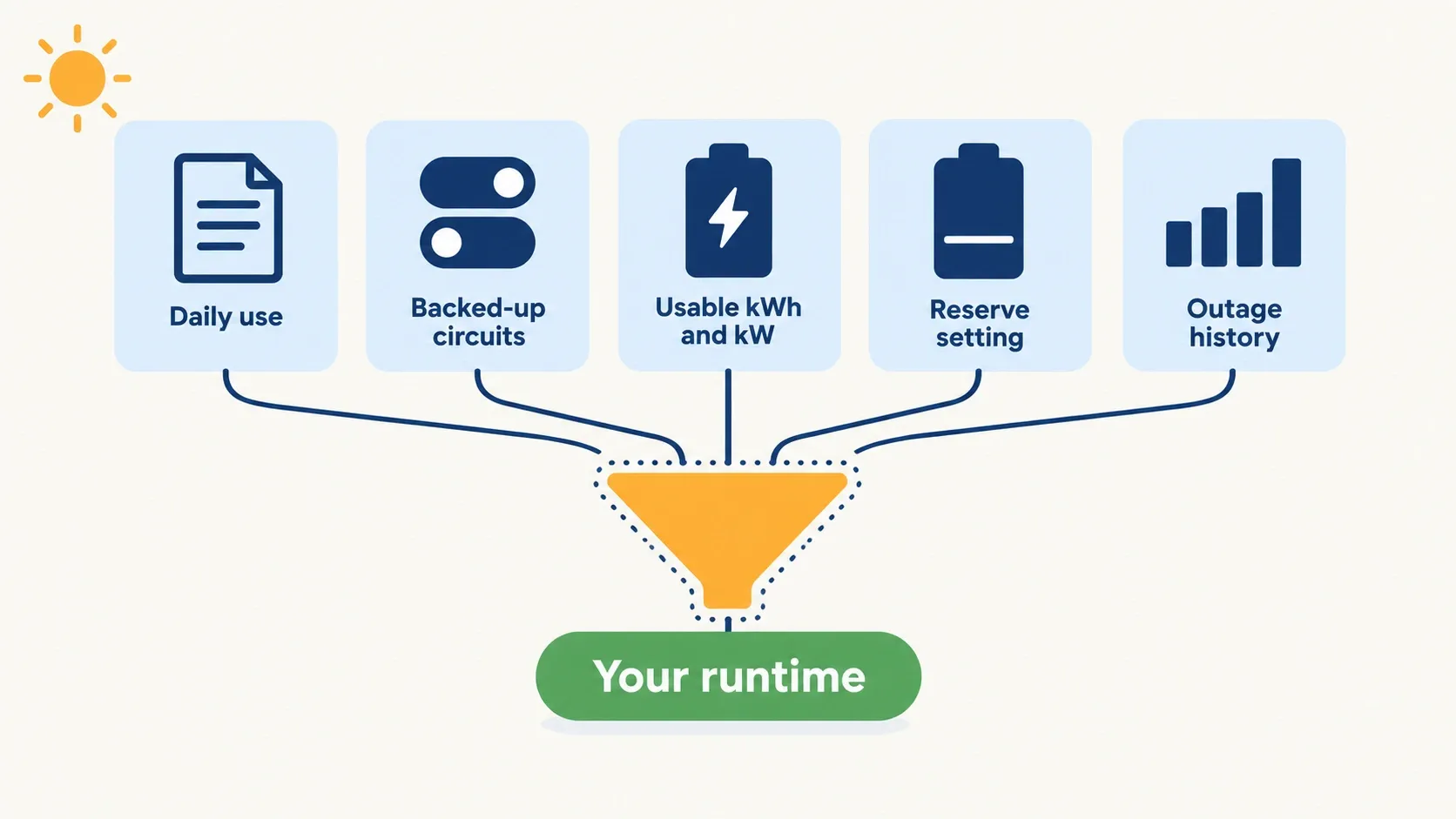
Divide the energy you will actually have by the load you will actually run, and compare the answer to the outages you actually get. Then ask the installer to put the expected runtime for your chosen circuits in writing, alongside the rest of the questions to ask before you sign.
A runtime quoted without its load is a marketing number. A battery can be advertised as lasting a day or more because at a small enough load it will, and nothing about that claim is false. It simply describes a house with the air conditioning, the range and most of the lights turned off. The honest version of the claim names the circuits, the load and the starting charge, and a seller who will not put those three in writing is asking you to assume the best case.
At the U.S. average household use the EIA reports, about 29.6 kWh a day, a full 13.5 kWh battery would run a whole home for about 11 hours at best. Limited to essential circuits, it lasts longer; with heavy loads such as central air conditioning running, much less.
Only if the battery system's power rating and capacity are sized for it. In homes that have it, central air is one of the heaviest loads, and its compressor draws a surge when it starts, so it is usually left off essential-loads designs and planned for only in whole-home backup.
It can help, if the panels, battery and equipment are configured to recharge during an outage. How much depends on the array, the season and the weather, and the weather behind a long outage does not always leave sunny days to recharge on.
Usually because it started the outage below full, because the loads running were larger than the estimate assumed, or because energy is lost converting stored power into household power. Ask what backup reserve your battery holds and which circuits it carries.
You set the priorities; a licensed electrician decides which circuits fit, sizes the panel and backup system to them, and wires them to the code that applies where you live.
One email a week with new guides, tips, and solar news. Zero fluff, no sales pitch.