Oversize Solar System NEM 3.0? What to Weigh

United States only. This page gives no panel count, no system size and no average, on purpose. Every page that answers this question with a number has substituted somebody else's house for yours.
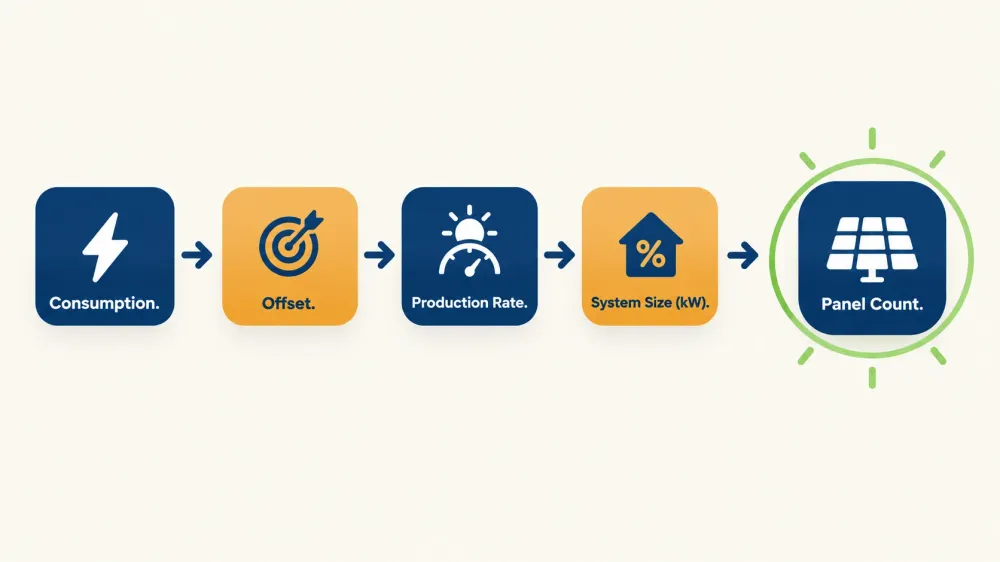
Panel count is the last thing that gets decided and the first thing everybody asks. It falls out of a chain of four other decisions, and each one is specific to your address, your bills and your roof.
Here is the chain, in the order it actually resolves. You can run the first three yourself in an evening, for free.
Twelve consecutive months of kilowatt-hours from your utility, added up.
Not one bill. Household usage swings hard with season, and picking a mild month undersizes while picking your heaviest oversizes. Your utility's online account will usually show twelve months as a chart and let you download it, which takes about ten minutes and settles the question.
Keep the twelve monthly figures, not just the total. The shape decides how much of your own production you will consume rather than export, and on modern tariffs that is where the money is.
What proportion of that consumption do you want the system to produce over a year?
This is a choice, not a calculation, and the default in most proposal software is full offset, which is a default rather than a goal.
What it should depend on is what your utility pays you for exported electricity. Where exports are credited near the retail rate, annual energy balance is a reasonable target. Where they are credited well below it, production beyond what you use yourself is worth much less and the last increment of system earns least.
What net metering is and why the version matters is the mechanism, and the arrangement differs substantially by state. Your utility's current tariff is the document.
This is the step people skip, and it is the one that makes a national average useless.
The same system produces materially different amounts in different places, on different roof orientations, at different pitches, with different shading. Location, direction, tilt and shade are all inputs, and they are all specific to your house.
Do not use a rule of thumb here. Use a public production modeling tool, run for your own address, with your own roof orientation and tilt. These exist, they are free, they are run by public institutions, and they will give you an annual production estimate per unit of installed capacity for your specific location and roof.
That figure, for your address, is what turns your consumption target into a system size.
Consumption target divided by production per kilowatt at your address gives you a system size in kilowatts.
Stop here and use this number, not a panel count, for everything that follows: comparing proposals, understanding pricing, and talking to companies. Cost per watt, incentives and tariff rules are all expressed against system size, not against panel count.
System size divided by the wattage of the panels being offered gives you a panel count.
Which is why the count is unhelpful as a starting point: it changes when the panel changes, with no change to your house. A more efficient panel means fewer of them for the same capacity, and quoting a count without the wattage says almost nothing.
And then the roof intervenes. Panels come in fixed sizes, they must sit in rows on usable planes, and setbacks, obstructions, vents and edges all take space. The layout frequently forces the number up or down, which is why a good proposal shows you a plan.
Not a rhetorical point. The standard published answer combines a national average consumption figure with an average production figure and an average panel wattage.
Each of those three is wrong for you in an unknown direction, and the errors compound. A household consuming well under the average, in a sunny location, on a south-facing roof, and a household consuming well over it, in a cloudier one, on an east-west roof, are told the same thing.
The number you get is not an estimate. It is a description of a house that does not exist.
You now have a number you derived and three numbers other people derived, and the disagreements are the conversation.
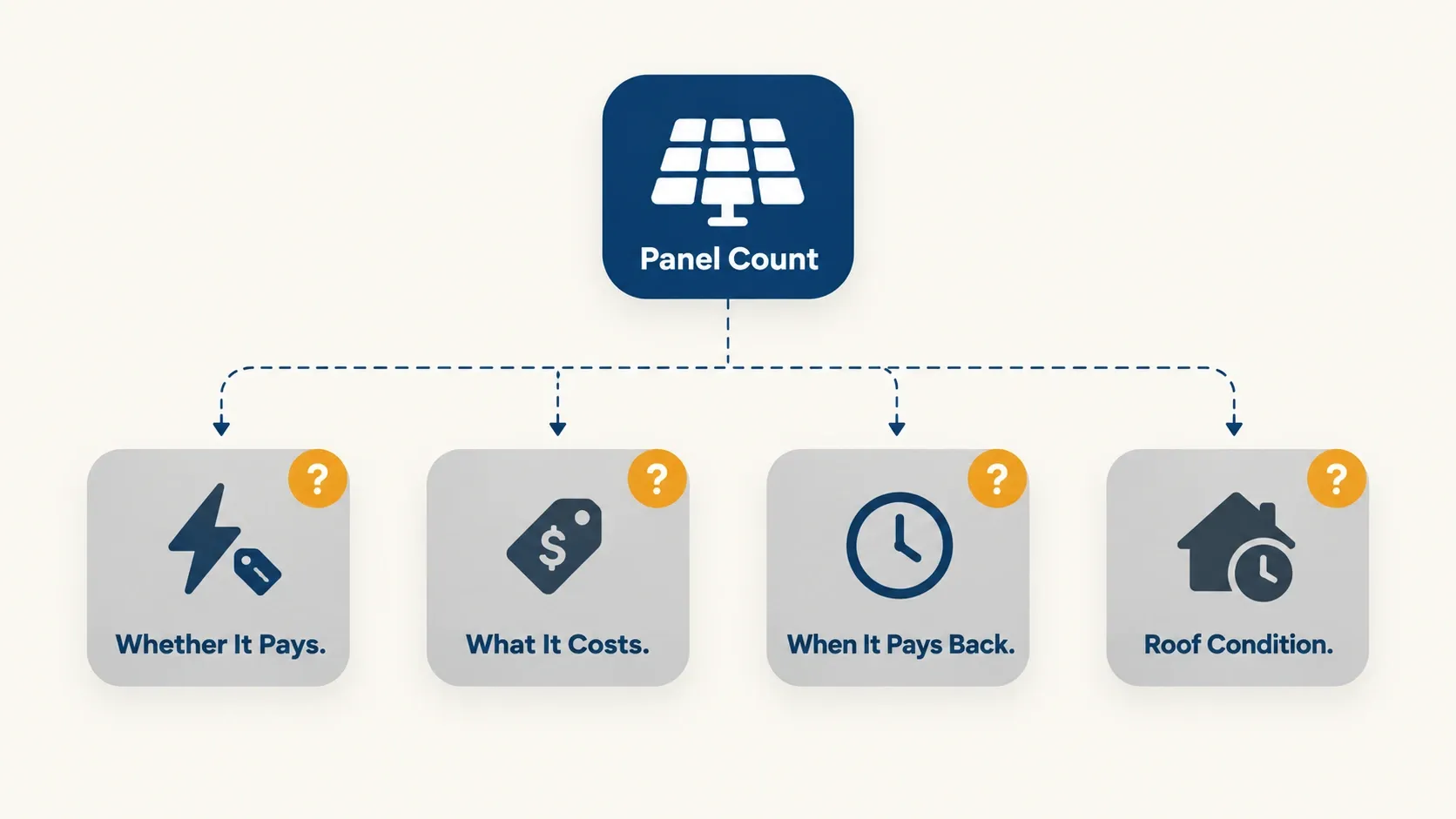
Whether solar is worth it for you. That is decided far more by what you pay per kilowatt-hour and by your export arrangement than by how many panels fit. What your electricity rate does to the whole calculation is the first question, not the last.
What it will cost. Pricing does not scale linearly with size, because permitting, design, interconnection, labor mobilization and the inverter are largely fixed. That is why cost per watt usually falls as systems get larger, and it is the strongest argument for not shaving a system down too far.
When it pays back. The payback calculation needs the price, the production, the tariff and the incentives together.
Whether the roof can take it. Age and condition of the roof are a separate question and a consequential one, because a system on a roof with a few years left in it has to come off and go back on.
Between one and however many fit, and the only way to know is to run your own four numbers.
Anyone who answers it with a specific count before asking for your consumption, your location, your roof and your tariff has answered a different question.
Why will this page not just tell me how many panels an average house needs? Because the standard published answer combines a national average consumption figure with an average production figure and an average panel wattage, and each of those three is wrong for you in an unknown direction, so the errors compound. A household consuming well under the average, in a sunny location on a south-facing roof, and a household consuming well over it in a cloudier place on an east-west roof, get told the same thing. The number that comes out is not an estimate of your house, it is a description of a house that does not exist.
What can I work out myself before talking to anyone? The first three steps, in an evening, for free. Download twelve consecutive months of kilowatt-hours from your utility account and add them up, keeping the twelve monthly figures and not just the total. Look up your utility's current export tariff, which is the document that should set your offset target. Then run a public production model for your own address at your own roof orientation and tilt, which gives you annual production per unit of installed capacity for your specific location. Divide your consumption target by that figure and you have a system size in kilowatts.
Why talk in kilowatts rather than panels? Because panel count changes when the panel changes, with no change at all to your house: a more efficient panel means fewer of them for the same capacity, so a count quoted without the wattage says almost nothing. Cost per watt, incentives and tariff rules are all expressed against system size rather than panel count, so kilowatts is the unit that lets you compare proposals, understand pricing and talk to companies without confusion.
Why does the count in a proposal not match my arithmetic? Because the roof intervenes after the arithmetic. Panels come in fixed sizes, they have to sit in rows on usable planes, and setbacks, obstructions, vents and edges all take space, so the layout frequently forces the number up or down. That is why a good proposal shows you a plan. It is also worth comparing each proposal's assumed consumption and assumed export rate against the data you gathered yourself, because any assumption that disagrees with your own figures is the thing to ask about.
Does the panel count tell me whether solar is worth it? No. That is decided far more by what you pay per kilowatt-hour and by your export arrangement than by how many panels fit on the roof. The count does not tell you the cost either, because pricing does not scale linearly with size when permitting, design, interconnection, labor mobilization and the inverter are largely fixed. It does not give you a payback, which needs the price, the production, the tariff and the incentives together. And it says nothing about whether the roof can take the system, since a roof with only a few years left in it means the array has to come off and go back on.
Panel count is the last output, not the first input. Get twelve months of your own consumption, decide an offset target based on what your utility actually pays for exports, model production for your own address and roof with a public tool, and divide to get a system size in kilowatts. Use kilowatts, not panels, for every comparison, because the count changes when the panel changes. Then get three proposals and treat any assumption that disagrees with your own data as the thing to ask about.
One email a week with new guides, tips, and solar news. Zero fluff, no sales pitch.