Solar Options for Renters: Four Routes Compared

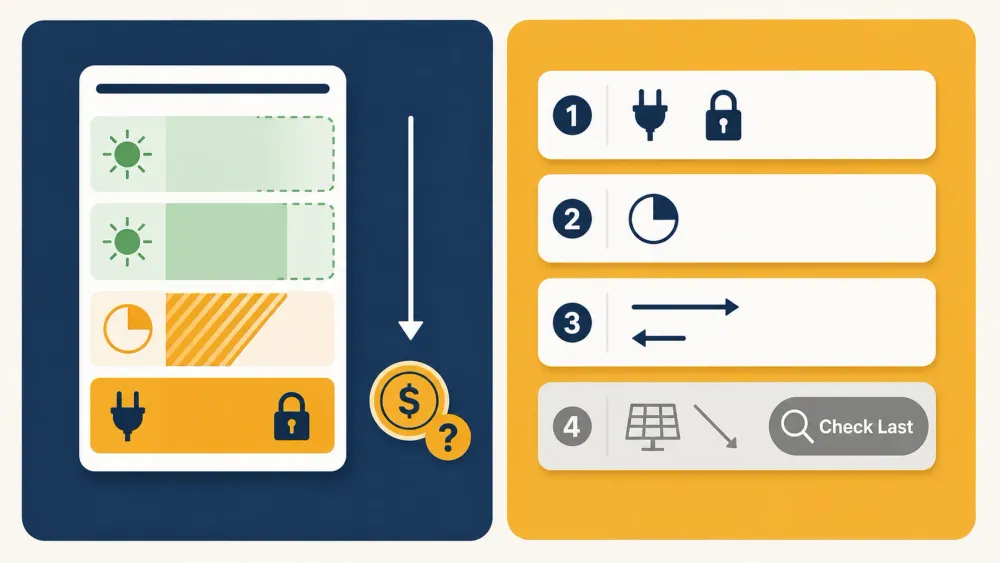
A solar bill still high after installation usually points at the tariff, not at a broken system. A grid-tied home stays a utility customer, so fixed service and delivery charges continue no matter how much you generate. On top of that, most systems are sized to offset part of a year's usage rather than all of it, exported energy is often credited at less than you pay to import, and household usage tends to rise once the panels are on. A genuine production shortfall is possible, but it is the last thing to check, not the first.
This is general information for US homeowners with a grid-tied system, not financial or tax advice. Rate structures, credits and charges are set by your utility and your state regulator, and they differ enough that only your own bill and your own tariff can answer the question for your house.
Open your bill and separate it into two kinds of line item: charges that scale with kilowatt-hours, and charges that do not. Customer or basic service charges, meter charges, and most delivery and distribution components sit in the second group. They pay for the poles, wires, metering and billing that connect your house, and they are owed by every connected customer. Solar reduces the first group. It generally does not touch the second. Many states also apply non-bypassable charges to the energy you consume, which are collected even when a credit covers the rest.
This is why a bill can fall by most of its value and still arrive with a real number on it. Comparing the new total against zero is comparing it against something the tariff never offered.
An offset percentage in a proposal is an annual energy ratio, not a promise about the bill. A system quoted at 90 percent offset was designed to generate about 90 percent of a year's consumption, with the shortfall imported. Roof space, shading, utility size limits and budget all push that number below 100 regularly, and the proposal usually says so somewhere. Our explainer on what a solar offset percentage actually means sets out why that figure and your bill reduction are two different measurements.
Net metering, in the Department of Energy's guide for homeowners going solar, is "an arrangement between solar energy system owners and utilities in which the system owners are compensated for any solar power generation that is exported to the electricity grid." What that compensation is worth is the whole question, and it has been moving.
In California, for example, the Public Utilities Commission states that under the older net energy metering tariffs, "participating customers receive bill credits for excess generation that is exported to the electric grid," credited "at the retail rates (including generation, distribution, and transmission components)." Those tariffs are closed to new enrollments. Applicants since April 15, 2023 are served under the Net Billing Tariff, where "compensation for excess generation exported to the electric grid is applied to a customer's bill at a rate reflecting the value of this generation to the grid." When an exported kilowatt-hour earns less than an imported one costs, a home can export a lot and still owe money. If you are on a California tariff, how NEM 3.0 pays for exports covers the mechanics, and net metering state by state is the starting point everywhere else.
This one is uncomfortable and extremely common. A new electric vehicle, a heat pump, a hot tub, an added room, or a household that started working from home all add load the system was never sized for. The Energy Information Administration reports that US residential utility customers used an average of about 899 kWh per month in 2022, and a single vehicle charged at home can move a household well above its own previous baseline. If your consumption in kilowatt-hours is higher than it was the year before you installed, the system is working against a bigger target. The number to compare is annual kWh, and finding your annual kWh on the bill is how to get it cleanly.
Many solar customers are placed on a time-of-use rate, where a kilowatt-hour costs different amounts at different hours. Solar generates at midday. Many homes consume most in the early evening. On a time-of-use rate, that mismatch is not only an energy question, it is a price question, because the energy imported in the evening may be the most expensive of the day while the energy exported at noon was among the cheapest. A home can be a net annual exporter in kilowatt-hours and still owe money in dollars. This is the point where some homeowners start looking at storage, and whether a battery makes sense with solar sets out the trade-off rather than a sales answer.
It happens, and it is worth ruling out properly. But it sits sixth because the five reasons above explain most high bills on correctly working systems, and because a production problem shows up in production data, not in a bill total. A bill is the product of production, consumption, rate structure and billing period, so it cannot by itself tell you which of the four moved.
| Line item type | Does solar reduce it? | What it pays for |
|---|---|---|
| Energy or generation charge | Yes, this is the target | The kilowatt-hours you import |
| Customer or basic service charge | No | Being connected at all |
| Delivery, distribution, transmission | Usually not, or only partly | The network bringing power to you |
| Non-bypassable charges, where they apply | No | State programs collected per kWh consumed |
| Minimum bill or minimum delivery charge | No | A floor some tariffs set regardless of net usage |
| Taxes and local surcharges | They follow the charges they sit on | Varies by jurisdiction |
The exact names differ by utility. The grouping does not.
Twenty minutes with two documents will usually settle it, and it costs nothing.
If steps one to five account for the bill, the system is behaving as designed and the gap was in the expectation, usually set during the sale. If step two shows a real shortfall against the written estimate, that is a different conversation, and it belongs with your installer in writing, with your production guarantee clause in front of you.
Some of these are fixable and some are not. Fixed charges and tariff design are not things a homeowner changes. Usage, timing and sizing are, at least partly. Whether any particular change is worth its cost depends on numbers specific to your house, your rate and your contract, and nobody can hand you that answer from the outside, including us. What a homeowner can reasonably do is work out which of the six reasons applies before paying for a remedy aimed at a different one.
If you believe the bill itself is wrong rather than disappointing, that is a utility matter. Raise it with the utility in writing first, and if it is not resolved, your state's public utilities commission is the body that handles billing and metering disputes.
Most often because fixed service and delivery charges continue, the system was sized to offset only part of your usage, and exports are credited at less than imports cost. Rising household consumption after installation is the next most common cause.
Generally no. A grid-connected home keeps paying the charges tied to being connected, and only a system sized and credited to cover all of your annual consumption would remove the energy portion as well.
A battery can shift stored daytime energy into evening hours, which changes how much you import and when. It does not remove fixed charges, and whether it pays for itself depends on your rate structure and your own usage pattern.
Compare twelve months of recorded production against the annual estimate in your signed proposal. A bill total cannot answer this, because consumption and rates move it too.
Some tariffs set a monthly minimum or apply charges per kilowatt-hour consumed that credits cannot offset. Check your utility's rate schedule for your specific tariff, since this varies by state and by utility.
One email a week with new guides, tips, and solar news. Zero fluff, no sales pitch.