Solar Panel Recycling and Disposal: US Rules in 2026

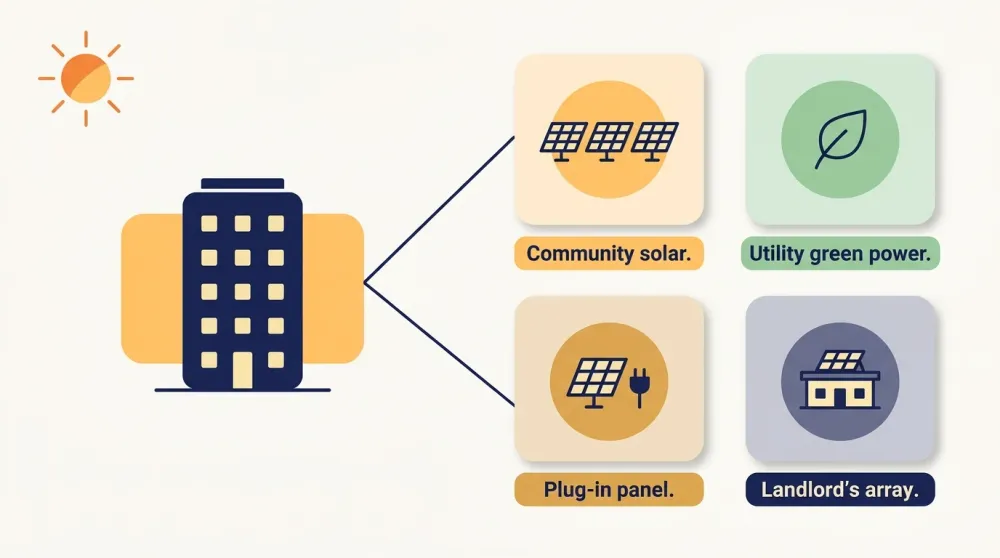
Can renters go solar? Yes. Solar options for renters exist, but they are not the same product. There are four routes: subscribing to community solar, buying a green power product from your utility, using a small plug-in panel where your state allows it, or living in a building whose owner installs solar. They differ on the thing renters care about most. The Department of Energy describes community solar as a bill credit that helps reduce electricity costs. The Environmental Protection Agency says utility green power customers usually pay a premium. Plug-in panels need your state's law and your landlord's terms on your side. A landlord's array depends entirely on the landlord.
United States only. Federal agency pages and two state laws were read on November 12, 2026. Programs vary by state and utility, and this is general information rather than financial or legal advice.
| Route | What you get | What it costs you | Contract | Who has to agree |
|---|---|---|---|---|
| Community solar subscription | A credit on your electric bill for your share of an off-site array | Usually a subscription fee, set against the credit | A subscription agreement with the provider | You, and the program must exist in your area |
| Utility green power product | Renewable electricity attributes bought on your behalf | Usually a premium per kilowatt-hour | Often month to month | You, if your utility offers one |
| Plug-in panel | A small amount of your own generation, behind your meter | The device, plus any electrical work | Depends on your state and lease | State law, your utility's rules, your landlord |
| A landlord's rooftop array | Whatever benefit the building owner passes on | Set by the owner | Your lease | Your landlord |
The rest of this page explains where each column comes from.
The Department of Energy's Community Solar Basics describes the model: "Community solar subscribers (i.e., households, businesses, or any other electricity customer) pay for a share of the electricity generated by the community solar project. This is typically in the form of a monthly subscription fee." The utility pays the provider for the energy, and "each subscriber receives a portion of the dollar value generated by their community solar subscription as a credit."
DOE names renters among the people it can suit: it "can be a great option for people who are unable to install solar panels on their roofs because they are renters, can't afford solar, or because their roofs or electrical systems aren't suited to solar."
Two limits come from the same page. First, it is not everywhere: DOE says there is at least one community solar project in 44 states and localities including the District of Columbia, and 24 of those have passed enabling legislation. Second, savings depend on the program. DOE lists, as a consumer protection best practice, "Ensuring subscribers will receive a bill credit, including at least 20% household savings." That is DOE's recommendation for good programs, not a guarantee that every subscription delivers it.
Our reading: of the four routes, this is the only one whose purpose is a lower bill for someone without a roof. Whether your subscription actually saves money depends on how your state values the credit and what the provider charges, and the credit itself is a cousin of the export credit explained in our guide to how net metering works.
The Environmental Protection Agency describes a utility green power product (page last updated July 10, 2026) as an optional product from your default utility, where "Participating customers usually pay a per-kilowatt-hour (kWh) premium through an additional line item on their monthly electric utility bill." EPA lists among the challenges that it "Often has a larger price premium than other green power procurement options" and that a "Customer's default utility may not offer a green power program."
The upside for a renter is flexibility. EPA notes that "Customers can typically subscribe or unsubscribe to a utility green power program at any time, on a month-to-month basis."
Our reading: a green power product suits a renter who wants their electricity matched with renewable generation and will pay for it. It is not a way to cut the bill, and it should not be compared with community solar as if both were savings products.
A plug-in panel connects to an ordinary outlet. Whether a renter can use one legally depends on the state. The two state laws below are worked examples only: each applies in its own state, and other states' rules may differ.
Both laws set a 1,200 watt limit (Vermont's applies to the combined inverter capacity of the devices on one meter, Maryland's to the output a device supplies to the building), and both define the device by reference to certification from a nationally recognized testing laboratory. Vermont's definition names UL 3700. Our reading: in a state without such a law, a device that feeds power into a building's wiring is likely to fall under your utility's ordinary rules for connecting generation, the same rules behind a rooftop system's permission to operate. Plug-in solar is a safety-critical topic: the device must meet the certification your state names, and any wiring change is work for a licensed electrician, never a renter. This page gives no installation steps.
DOE notes that owners or occupants of apartment and condominium buildings can develop arrays on their own property or roof and supply residents from them. For a renter, that is a conversation with the building owner, not a purchase. If your building has an array, ask how the benefit reaches tenants: through a bill credit, a lower rent, or not at all.
With both community solar and green power, someone holds the renewable energy certificates that represent the solar generation. The community solar program tracker kept for DOE by the National Laboratory of the Rockies shows that in some programs the developer or the utility owns or retires them, not the subscriber. For utility green power, EPA says the utility retires certificates on the customer's behalf. That affects whether you can say you use solar power, not whether your bill goes down. Our explainer on who owns solar renewable energy certificates covers why selling the certificate sells the claim.
Usually not on the roof, because that is the owner's decision. Renters can subscribe to community solar where a program is open, buy a utility green power product, ask a landlord about a building array, or use a plug-in device where state law and the lease allow.
It is designed to. DOE describes subscribers receiving a bill credit for their share of a project's output and lists guaranteed household savings among its consumer protection best practices. Actual savings depend on your state's credit value and the provider's fee.
No. EPA describes green power products as usually carrying a per-kWh premium, while community solar gives subscribers a bill credit. One is a purchase of renewable attributes, the other a share of a project's value.
In Vermont, the law we read requires 10 days' notice to the landlord and lets the landlord set reasonable restrictions. Elsewhere, your lease and your state's rules decide. Ask before buying.
According to DOE, non-regulated utilities or municipal utilities may develop their own programs in states without community solar legislation. Ask your utility directly.
One email a week with new guides, tips, and solar news. Zero fluff, no sales pitch.