Do I Need a Battery With Solar? The Real Trade-Off

Reviewed August 9, 2026. US residential solar market.
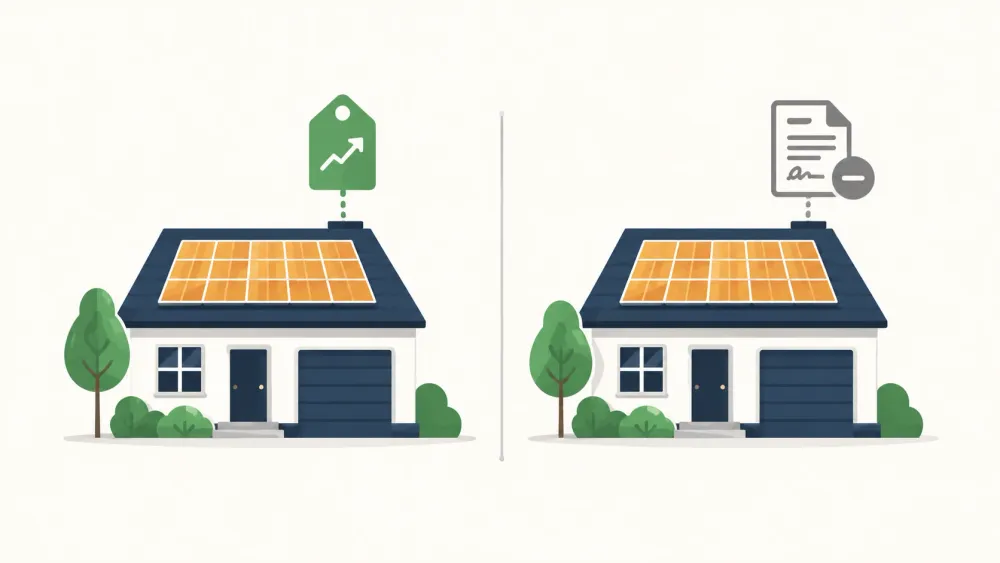
For an owned solar system in the US, published research does show a resale premium. Lawrence Berkeley National Laboratory's 2015 "Selling Into the Sun" study, done with the Department of Energy, found home buyers across eight states consistently paid more for houses with an owned solar array. That finding does not carry over to a leased or PPA system, which is a contract a buyer must take on or a seller must pay to end, not an asset the buyer simply owns. This article names the study, states its own vintage, and keeps the two ownership types separate throughout, since collapsing them is the most common error in content answering this question. For the wider question of whether solar pays at all in 2026, see Are Solar Panels Still Worth It in the US in 2026?
The standard reference for this question is a single study: "Selling Into the Sun: Price Premium Analysis of a Multi-State Dataset of Solar Homes," published in January 2015 by Lawrence Berkeley National Laboratory (LBNL), a US Department of Energy national laboratory, with support from the Department of Energy's SunShot Initiative. It analyzed roughly 22,000 home sales across eight states (California, Connecticut, Florida, Maryland, Massachusetts, New York, North Carolina, and Pennsylvania), of which about 4,000 involved a home with an installed photovoltaic (PV) system, covering sales that took place between 2002 and 2013.
LBNL found that buyers consistently paid more for homes with an owned solar array, across the different states, housing markets, and home types in the dataset. The Department of Energy's own summary of the research states the premium worked out to about $15,000 for a home with an average-sized solar array, which LBNL's report expresses as roughly $4 per installed watt, the same per-watt unit used to compare two solar quotes. The Department of Energy is explicit that this finding covers homeowner-owned solar arrays. It says nothing about leased or PPA systems, a distinction the next two sections cover in full.
Stating the vintage plainly matters to a reader deciding now: this study is over a decade old, and its most recent home sales predate 2014. It was conducted years before the federal Section 25D credit expired at the end of 2025, before the swings in equipment prices that followed, and before the interest-rate environment that shapes financed purchases today. As of this writing, no more current LBNL analysis of this specific question, an owned rooftop system's resale premium, has been published. (LBNL has published newer research on a different question, property values near large utility-scale solar farms, which concerns proximity to a solar installation someone else owns, not a homeowner's own rooftop system, so it does not apply here.)
Because of that gap, this article will not restate the 2015 dollar figure as an estimate of what a system adds to a home's resale value today. A number computed from home sales through 2013 is not evidence of a 2026 outcome, even if the underlying relationship, that buyers value an owned, paid-for system, plausibly still holds in some form. Other figures circulate for this question, expressed as a percentage of a home's price or as a specific total dollar amount, but none of the versions found circulating trace back to a named, dated LBNL, DOE, NREL, or EIA source in the form they are presented, so none appear in this article.
LBNL's researchers checked whether the premium they found held up differently depending on the state, the local housing market, or the type of home, and reported that it did not vary in a statistically significant way across those splits in their dataset. That is a narrower finding than "solar adds the same value everywhere." It means the study's dataset did not turn up a clear regional pattern, not that every local market treats an owned system identically today.
Several variables plausibly still shape any premium a specific home commands, even without a current dataset to quantify each one: the local price of electricity (a system that offsets a higher local rate is worth more to whoever benefits from it), how common solar already is in the neighborhood (a buyer in a market full of solar homes may treat it as unremarkable rather than a differentiator), the system's age, remaining equipment life, and any transferable warranty, and whether comparable solar sales exist nearby for an appraiser to reference at all.
One detail from the study is more useful than any single dollar figure: LBNL compared the premiums buyers actually paid against two separate valuation methods, the income approach (the present value of the energy a system is expected to save over its remaining life) and the cost approach (what it would cost to replace the system at the time of sale), and found the market premiums were statistically similar to what those methods produced. That is the same logic professional appraisers already apply to other home improvements, and it is worth understanding before the appraiser section below.
Everything above describes an owned system, one paid for in cash or with a loan, with no outstanding lease, PPA, or third-party claim attached to the equipment itself. LBNL's research, and the Department of Energy's own framing of it, is specifically about that category. An owned system sits on the home like any other fixture. A buyer evaluates it, and an appraiser can attempt to value it, the same way they would a renovated kitchen or a new roof.
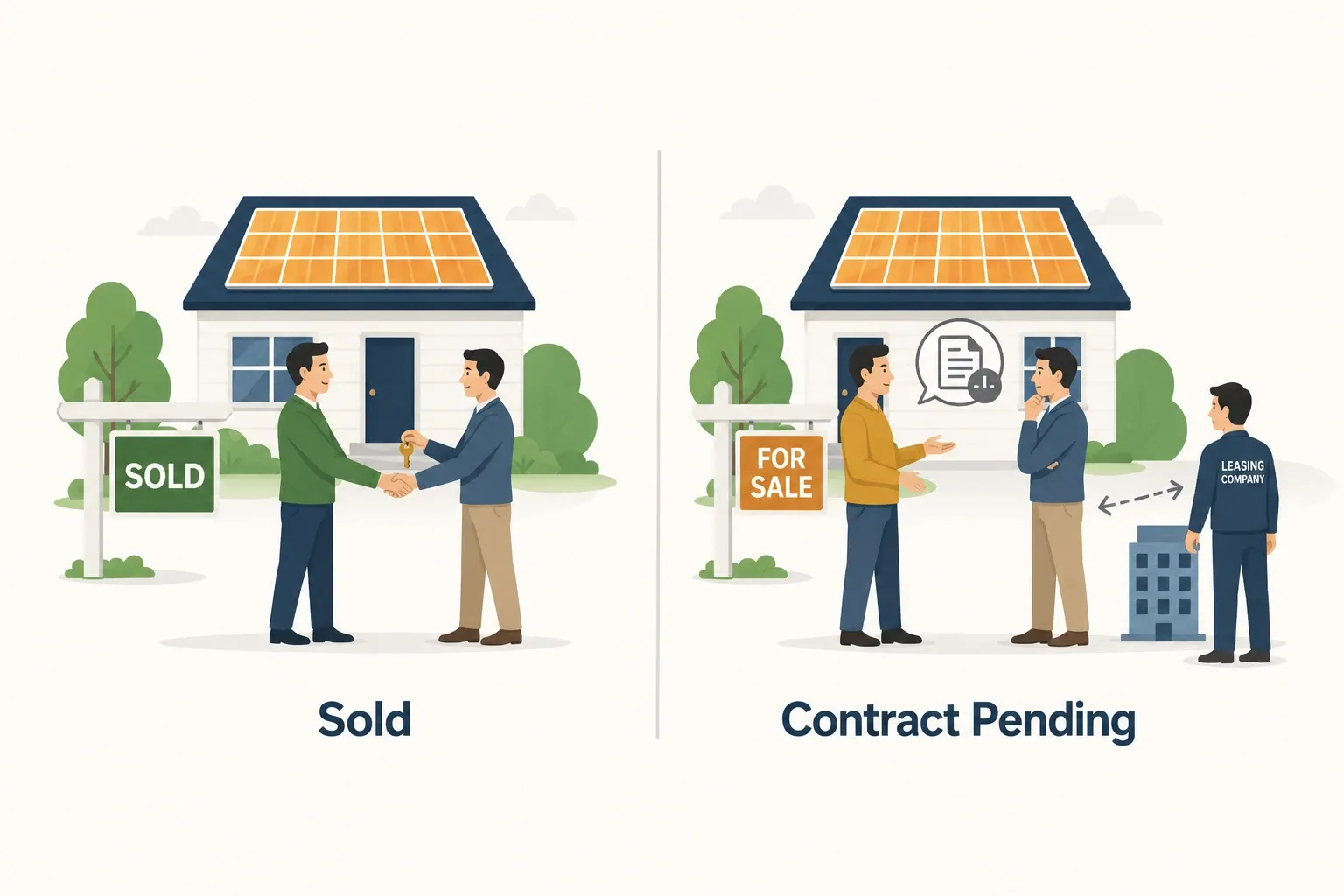
A leased system or a power purchase agreement (PPA) is a different legal object entirely. The homeowner selling the house does not own the panels; a leasing or PPA company does. What transfers at a sale is not equipment, it is a multi-year payment contract. Lease vs Buy After the Credit Expired covers how that ownership split changed after the federal credit's 2025 expiration; the resale consequence of that same split is the subject of this section.
| Owned system (cash or loan, paid off) | Leased or PPA system | |
|---|---|---|
| Who owns the equipment | The homeowner | A third-party leasing or PPA company |
| What the LBNL premium research covers | This category, directly | Not covered; the study is specific to owned systems |
| What transfers at sale | The system itself, as a fixture of the home | The remaining contract, not the equipment |
| What the buyer must do | Nothing solar-specific beyond a normal home purchase | Qualify to take over the contract, or wait for the seller to resolve it first |
| Typical treatment at appraisal | Can be assessed as a value-adding fixture | Generally not counted as home equity, since the seller does not own it |
The financing path a system started on does not change on its own once you sell. If you bought the system, it stays owned. If you leased it or signed a PPA, it stays a contract, and the next section covers what that actually requires at closing.
Selling a home with an active solar lease or PPA adds a step that a home without one does not have, and it needs to start well before closing, not at the closing table.
The contract has to be disclosed to the buyer as part of the sale, including the remaining term, the payment amount, and any annual escalator clause written into it. From there, one of two things generally has to happen. The buyer can apply to take over the remaining contract, which typically means a credit review by the leasing or PPA company similar to what a lender would run, since the buyer is agreeing to take on a recurring payment obligation the seller currently carries. Approval is not automatic; a buyer who does not qualify, or who simply does not want the contract, is a real possibility. Alternatively, the seller can pay to end the contract before closing, sometimes called a buyout, which removes the obligation and, depending on the contract's terms, may leave the system with the home as an owned fixture going forward or require its removal.
This article will not state a typical buyout cost. It depends on the specific contract, how many years remain on it, and the terms set when the lease or PPA began, none of which is published anywhere as a general figure. What is worth doing well ahead of listing the home is getting the exact payoff or transfer terms in writing from the leasing or PPA company directly, since that number determines whether a buyer's qualification process or a seller-side buyout is the more realistic path. Cash, Loan, Lease or PPA covers how these payment structures differ from the point of purchase, which is the same distinction that resurfaces here at resale.
A licensed appraiser working on a home with solar does not simply add a flat amount to the price. The tool built most directly for this problem is PV Value, developed by Sandia National Laboratories with Department of Energy funding and endorsed by the Appraisal Institute, the largest professional organization for US appraisers. It lets an appraiser calculate a system's contribution using the same two methods LBNL's research checked against actual sale premiums: the income approach and the cost approach described above. Its existence signals that valuing solar is a recognized, standardized appraisal problem, not a niche judgment call, but it also confirms there is no single number that applies to every home.
A buyer's agent, working the other side of the transaction, is typically checking a narrower set of things: whether the system is owned outright or under an active lease or PPA, whether any lien or financing filing is attached to the home's title because of it, the system's age and any remaining manufacturer or workmanship warranty, and whether production data or utility bills are available to back up what the system is claimed to produce. None of that guarantees added sale price. It is the information that determines whether the system reads as an asset, a neutral feature, or a complication to the sale.
Local market conditions and individual appraiser practice vary by state, by lender, and by how familiar a given appraiser is with solar specifically. A reader planning to sell within the next few years is better served by asking a local, licensed appraiser or real estate professional how solar is treated in that specific market than by any national figure, including the one in the LBNL study above.
Does LBNL's research prove solar increases my home's value? It documents that, in its dataset of home sales from 2002 through 2013 across eight states, owned solar systems were associated with a resale premium. That is evidence about the market described in the study, not a promise about any individual home's future sale.
Does a solar lease or PPA add resale value the same way an owned system does? No. LBNL's research and the Department of Energy's own summary of it are specific to owned systems. A lease or PPA is a contract, not an asset the seller owns, and it must be transferred to the buyer or bought out before closing rather than counted as added home equity.
How old is the research behind the "solar adds home value" claim? LBNL published "Selling Into the Sun" in January 2015, using home sales data through 2013. That makes it over a decade old as of this writing, and no more current LBNL analysis of the same question, an owned rooftop system's resale premium, has been published.
Can you tell me a specific dollar amount solar will add to my home's sale price? No, and any page that gives you one without naming a current, dated source is guessing. LBNL's own figure is over a decade old and specific to its dataset. What a system adds depends on your local market, the system's condition and age, and how an appraiser in your area treats it; a licensed local appraiser is a better source for a current number than any national study.
What happens to my solar lease if I sell my house before the contract ends? The contract generally must either transfer to the buyer, who typically needs to qualify with the leasing or PPA company first, or be bought out by the seller before closing. Start this process early, since it can affect your closing timeline.
Do all appraisers know how to value solar panels? Not automatically. Tools like PV Value, developed with Department of Energy funding and endorsed by the Appraisal Institute, exist specifically because valuing solar is not yet routine everywhere. Appraiser familiarity with solar varies by market, which is part of why local practice matters as much as the underlying research.
One email a week with new guides, tips, and solar news. Zero fluff, no sales pitch.