Do Solar Panels Need Cleaning? What 3 Makers Say

In your first year with solar panels, normal looks like this. A utility bill that is smaller but still arrives. Production that is high in summer and low in winter. A monitoring app whose numbers never quite match the bill. And an annual total that lands somewhere near the estimate your installer put in writing. What is not normal is a flat zero on a clear day, an annual total well below the written estimate, or an installer who stops returning calls. Judge the system on twelve months of data, not on one alarming week.
This guide is for US homeowners with a grid-tied system. Rates, billing cycles and consumer-protection routes are set by your state and your utility, so confirm the specifics against your own utility and your own contract.
The first year is not really a performance test. It is a calibration period, and it has two distinct halves.
The first few months are administrative. The system is installed and inspected, and then the utility grants permission to operate, which is the point at which it may legally export to the grid. Your meter is usually swapped or reprogrammed around the same time. Until all of that is finished, a system can sit on the roof doing nothing, and that is not a fault.
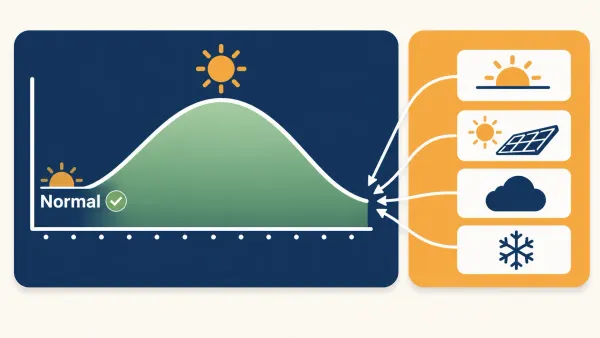
After that, the seasons do the talking. Output climbs into late spring and summer, falls through autumn, and bottoms out in December or January. A system that produces half as much in December as it did in June has not broken. The annual estimate in your proposal already assumed that curve, which is why the estimate is annual and not monthly. The Department of Energy's homeowner's guide to going solar points homeowners at the PVWatts tool precisely because production is modeled over a year for a specific location and roof, not assumed from a panel's nameplate rating. If your proposal never showed you those inputs, our guide to whether your production estimate is realistic covers which ones decide the number.
This is the most common year-one confusion, and it is not an error in either place.
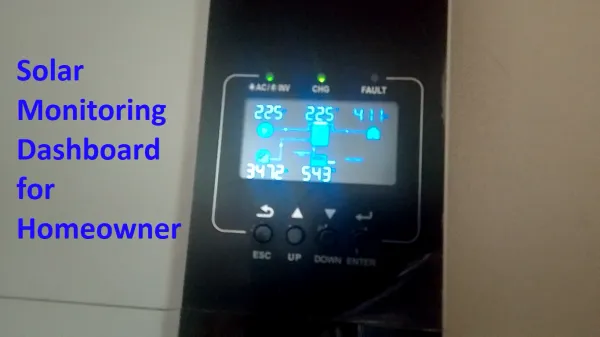
Your monitoring app counts what the system generates. Your utility meter counts only what crosses the meter in each direction: energy you import, and surplus you export. Everything your home consumes the instant it is produced never touches the meter at all. So a household that runs its laundry, dishwasher and air conditioning in the afternoon will see a large number in the app and a small export figure on the bill, and both are correct.
The second mismatch is timing. Utility billing periods rarely start on the first of the month, and app summaries usually do. Comparing an app month against a bill period compares two different sets of days.
The third is the credit itself. Under net metering, as the Department of Energy describes it, "system owners are compensated for any solar power generation that is exported to the electricity grid." What that compensation is worth varies enormously by state and by tariff, which is why what net metering actually is is worth reading before you try to reconcile anything.
| What you see | Usually normal because | Worth a call when |
|---|---|---|
| A bill still arrives every month | Fixed service and delivery charges are not offset by generation, and you still import at night | The energy charges themselves are no lower than before solar |
| December output is half of June | Shorter days and a lower sun angle were built into the annual estimate | Output is also weak in clear spring weather |
| A flat top on the midday curve | The system is operating at its rated output limit, which many are designed to do | The flat section grows longer month after month at the same time of year |
| Short gaps in the data | Monitoring depends on your home internet, which drops | Generation, not just reporting, is missing on the utility side too |
| The app total beats the bill savings | Self-consumed energy never crosses the meter | The twelve-month total is well under the written estimate |
A sixth, less discussed: your own usage changes after installation. A new electric vehicle, a heat pump, or a household working from home adds load the system was never sized to carry. That is a sizing question rather than a fault, and what a solar offset percentage really means explains why an 80 percent offset quote was never a promise of an 80 percent smaller bill.
A short list, because the list of normal things is long enough to hide real problems.
Two safety lines apply to every item above, without exception. Do not get on the roof to check any of it. Observation from the ground, with binoculars if you need them, is the whole of the homeowner's role. And do not open, probe or disconnect anything on the DC side of the system, including combiner boxes, rooftop disconnects and conduit. That is work for a licensed electrician or your solar contractor, and the voltages involved are present whenever the sun is up, whether or not the system is switched on.
This is the part the service-call articles skip, and it is the part that matters, because a production shortfall is a contract question before it is a technical one.
Most of what you can enforce in year one comes from paper you already have: the signed proposal with its annual production estimate, the workmanship warranty, the equipment warranties, and, if you have one, a production guarantee. The Federal Trade Commission's guidance on solar power for your home makes the point for the signing stage, and it holds just as well afterwards: check that the terms "match what the company's ads, proposals, and salespeople told you," including guarantees and who is responsible for maintenance.
So build one file in month one, and keep adding to it.
If you do have a production guarantee, read the trigger now rather than at month eleven. The measurement window, the weather adjustment and the notice deadline are usually in there, and our breakdown of the clauses that decide a production guarantee walks through what each one does.
Start with the installer, in writing, stating the estimated annual figure from the proposal, your measured figure, and the period both cover. Ask for a site visit and a written finding. Keep it factual.
If the equipment is the issue and the installer is gone or unresponsive, the manufacturer's warranty is a separate route with its own claim process, independent of the company that installed the system.
If the dispute is about the sale itself, the contract, or a savings claim you were given, the consumer route is separate again. The FTC directs complaints to "the Federal Trade Commission at ReportFraud.ftc.gov" or "your state attorney general." Most states also license solar contractors through a board that accepts complaints about workmanship.
If the dispute is with the utility about billing or metering rather than with the installer, your state's public utilities commission is the body that handles it, after you have raised it with the utility first.
Two identical systems in the same town can produce different amounts because of pitch, azimuth, shading and snow. A neighbor's figure is not a benchmark. Your own written estimate is the benchmark, and regional sunlight differences are large enough that peak sun hours by state are worth understanding before you compare anything to anything.
You will usually see a change on the first full bill after permission to operate, but the meaningful comparison is twelve full months against your previous twelve months, because both production and household usage swing seasonally.
Yes. A grid-tied home stays a utility customer, and fixed service and delivery charges generally continue regardless of how much you generate. What should change is the energy portion of the bill.
Because the app counts everything the system generates, while the meter only sees energy crossing it. Power your home uses the moment it is produced never appears as an export credit.
Put the two numbers side by side in writing, with the dates each covers, send them to your installer, and ask for a written finding. Check your production guarantee for a notice deadline before you wait any longer.
Routine homeowner maintenance is minimal on most residential systems. Monitoring the output and keeping the paperwork is the real year-one task, and anything requiring roof access or DC-side work belongs to your contractor.
One email a week with new guides, tips, and solar news. Zero fluff, no sales pitch.